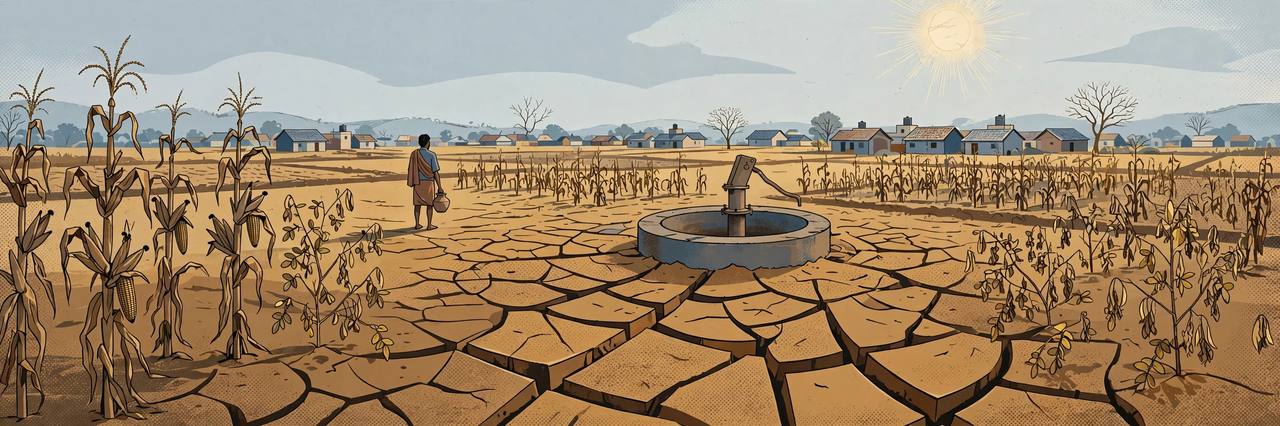
Karnataka Deputy Chief Minister G Parameshwara has written to Prime Minister Narendra Modi seeking immediate central assistance of ₹20,585.73 crore under the National Disaster Response Fund (NDRF), citing estimated drought losses of ₹62,481.88 crore — yaani roughly ₹0.62 lakh crore — from a severe Kharif drought affecting 57.93 lakh hectares, ANI reported on Friday, October 23.
Source: ANI via LatestLY
Parameshwara, who is also the state's Revenue Minister, sent separate letters to the Prime Minister, Union Home Minister Amit Shah and Union Agriculture Minister Shivraj Singh Chouhan urging the Centre to urgently sanction and release the amount, NewKerala reported.
Second-lowest monsoon since 1956
In his six-page letter dated October 22, Parameshwara said Karnataka recorded one of its worst Kharif droughts: the 2026 southwest monsoon delivered 551 mm of rain against a normal of 852 mm, a deficit of 35 per cent — the second-lowest since 1956 and the seventh-lowest since 1901. Of the 122 monsoon days, 79 saw deficit or large-deficit rainfall.
Following assessment under the Manual for Drought Management, 2020, the state has declared 226 taluks drought-affected — 177 declared earlier and 49 additional ones. Crop losses span 53.92 lakh hectares of agricultural crops and 4.01 lakh hectares of horticulture, with damage ranging from 33 to 100 per cent and most crops hit by more than 50 per cent.
Where the money would go
The state's memorandum seeks ₹6,128.70 crore as crop-loss input subsidy and ₹12,146.99 crore as gratuitous relief for 61.91 lakh small and marginal farmers, calculated at ₹327 per day for 60 days. It also seeks ₹1,727 crore for drinking water supply and ₹583.04 crore for animal husbandry and livestock protection, along with 476 cattle camps and 583 fodder banks.
The worst-hit crops include maize (11.82 lakh hectares), red gram or tur (10.12 lakh hectares), cotton (6.68 lakh hectares), ragi (5.56 lakh hectares) and sugarcane (4.88 lakh hectares). Parameshwara also urged the Centre to use Karnataka's FRUITS farmer database instead of the Agriculture Census 2015-16 for calculating input subsidies. The Centre has not yet announced its response to the memorandum.