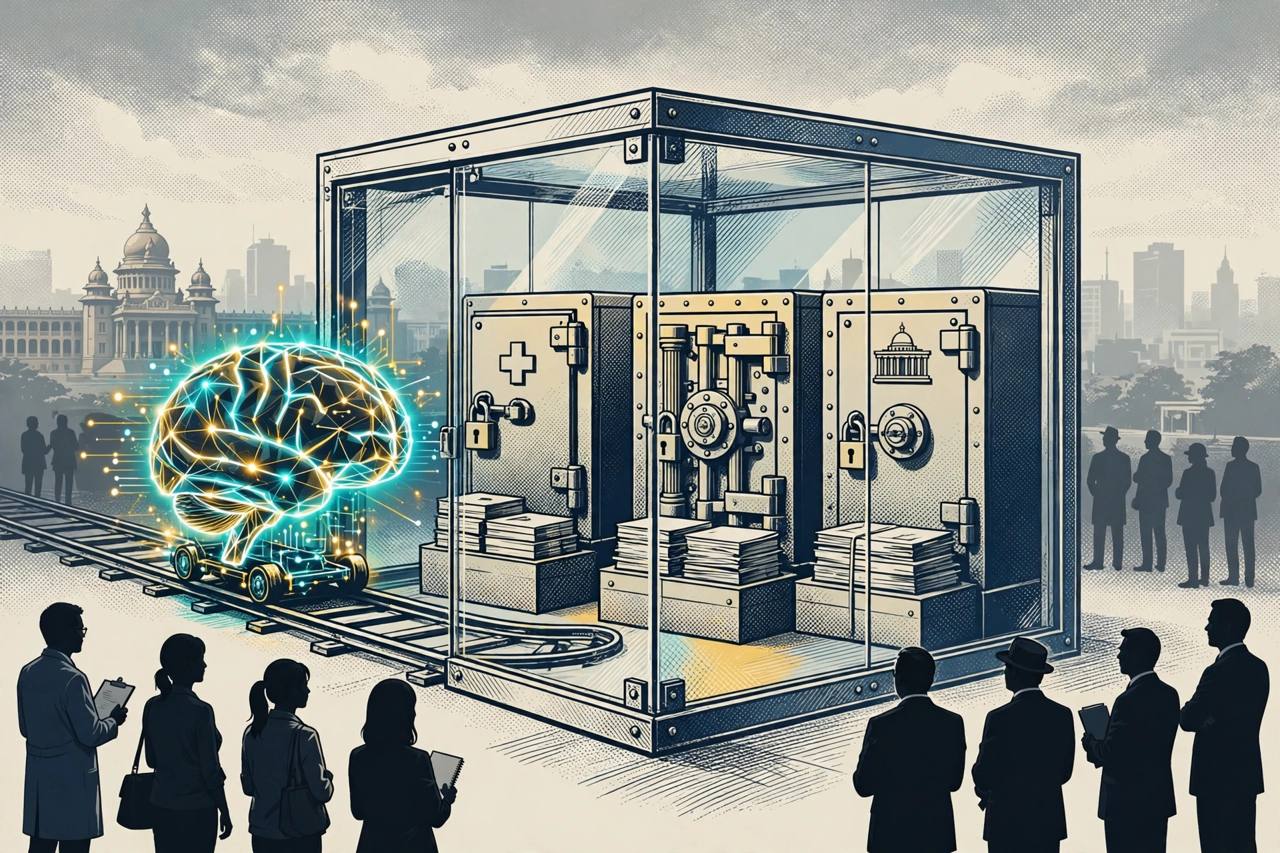
Bengaluru, Oct 31 — The Union Ministry of Electronics and Information Technology (MeitY) on Saturday launched the Handbook on Data Empowerment and Protection Architecture (DEPA) for AI Training at a high-level roundtable in Bengaluru, an official release said. MeitY Secretary S. Krishnan unveiled the handbook, which was developed with support from the iSPIRT Foundation.
Source: YourStory / MeitY release
"India's AI ambitions must be matched by the ability to use data responsibly and securely. The DEPA Training Framework enables trusted data collaboration at scale, unlocking access to large-scale datasets for AI training while safeguarding privacy, commercial confidentiality and institutional control," Krishnan said, according to The Hindu BusinessLine.
Source: The Hindu BusinessLine
The framework combines contractual permissions, controlled computing environments and privacy-enhancing safeguards, and incorporates data provenance so the origin, permissions and use of data can be traced throughout the training process, the release said. Its four technical pillars are a Data Exchange Platform, machine-readable electronic contracts, a Secure Data Environment and differential privacy, Elets CIO reported from the handbook.
Source: Elets CIO
Principal Scientific Adviser Ajay Kumar Sood explained the core idea: "Under DEPA, the model travels to the data, rather than the data travelling to the model." Training runs inside a secure computing environment — described as a sealed room — that executes only what the authorised electronic contract permits; the developer sends in a model and gets back only the trained model, or in some cases just a decision. Sood said the approach could enable trusted multi-party and cross-border collaboration and described it as India's contribution to global science diplomacy.
Source: The Hindu BusinessLine
The handbook calls the problem it targets a "data deadlock": the data needed for the next generation of AI is split across hospitals, banks and public agencies and locked behind separate institutional and regulatory walls, and simply stripping out names is not enough because anonymised data can often be re-identified. Pilots demonstrated at the launch included a bank identifying which customers of a fintech partner qualified for its credit cards before seeking consent, and hospitals training a tumour-detection model on MRI scans that the health-tech startup never sees, Elets CIO reported, citing the handbook and Mint.
Source: Elets CIO
iSPIRT co-founder Sharad Sharma compared the launch's importance for India's data economy with the announcement of UPI in February 2016, while Infosys co-founder Kris Gopalakrishnan said the framework could help researchers access diverse datasets to build more robust AI models while protecting the rights of data custodians, The Hindu BusinessLine reported. The framework is a draft and is not legally binding; consultations are expected in the coming weeks, with pilots in finance and healthcare and regulatory sandboxes first, Elets CIO reported.
Source: The Hindu BusinessLine