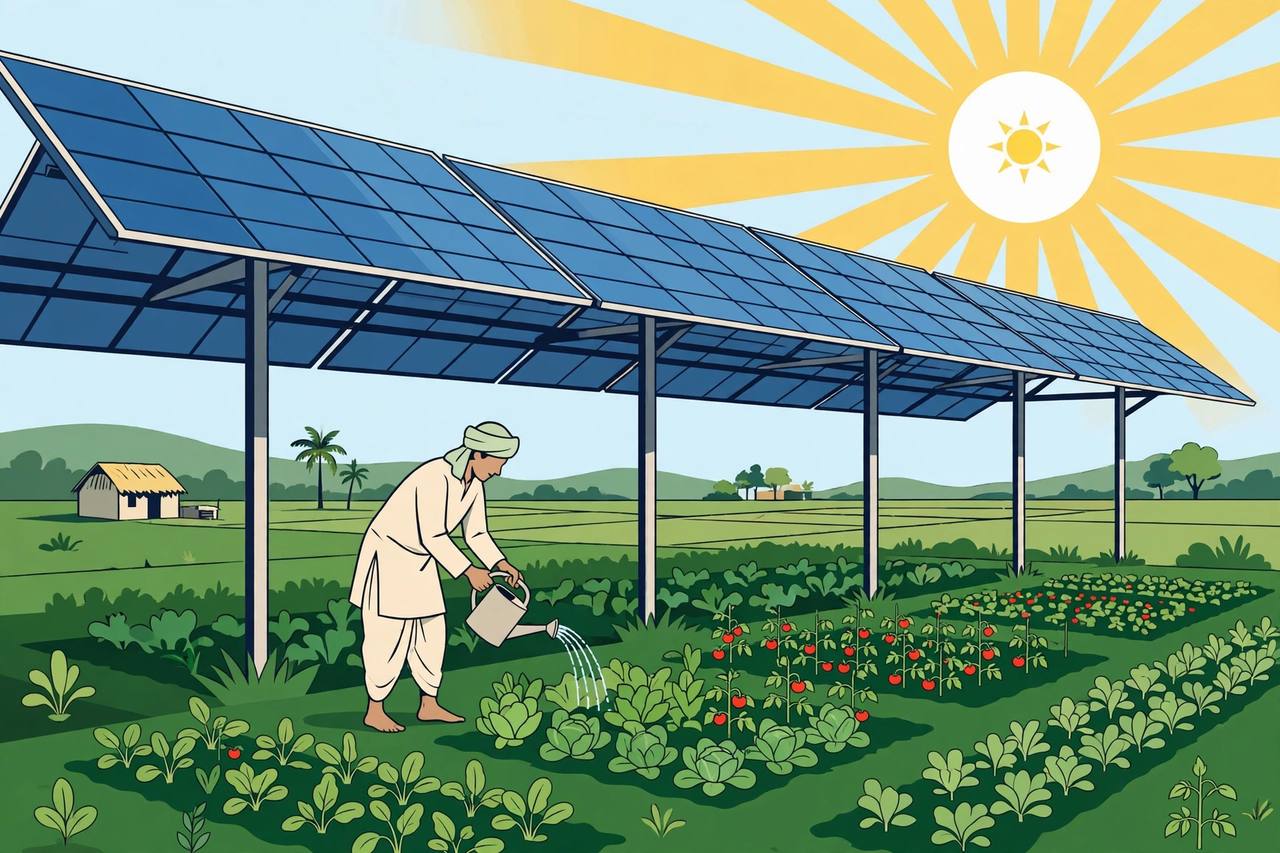
The Ministry of New and Renewable Energy (MNRE) is working on a mechanism to bring agrivoltaics under a Centre-supported scheme so farmers can generate solar power while continuing to farm the same land, MNRE Secretary Santosh Kumar Sarangi said on Monday, October 19.
Speaking ahead of the Agrivoltaics World Conference 2026, Sarangi said the ministry is working with the Ministry of Finance to provide financial support either through an existing scheme such as PM-KUSUM or a standalone scheme, to nudge states with an initial incentive. He said India could add upwards of 5 gigawatts of agrivoltaic capacity over the next three to four years, depending on how quickly states notify feed-in tariffs and facilitate investment.
Agrivoltaic projects cost about 25-30% more than conventional ground-mounted solar because panels are installed on elevated structures to allow farming underneath, and the proposed support aims to neutralise that gap. Odisha, Madhya Pradesh and Maharashtra have shown interest.
Initial assessments by the Indian Agricultural Research Institute (IARI) suggest vegetables, horticultural crops and floriculture are more suitable under panels than rice, wheat and sugarcane, though more research is needed for India's diverse agro-climatic conditions. Sarangi noted 85% of India's solar deployment is currently confined to five states, and agrivoltaics could spread generation to states with farmland but limited non-arable land, reducing pressure on long-distance transmission.
MNRE working on a Centre-supported agrivoltaics scheme • Support via PM-KUSUM or a standalone scheme, with the Finance Ministry • Target: upwards of 5 GW in 3-4 years • Agrivoltaic projects cost 25-30% more than conventional solar • Odisha, Madhya Pradesh and Maharashtra have shown interest • IARI: vegetables, horticulture and floriculture suit panels better than rice, wheat and sugarcane
Sources: ANI (via Latestly and GhanaMMA, Oct 19, 2026) and Indian Economic Observer (Oct 19, 2026) reporting Sarangi's remarks.