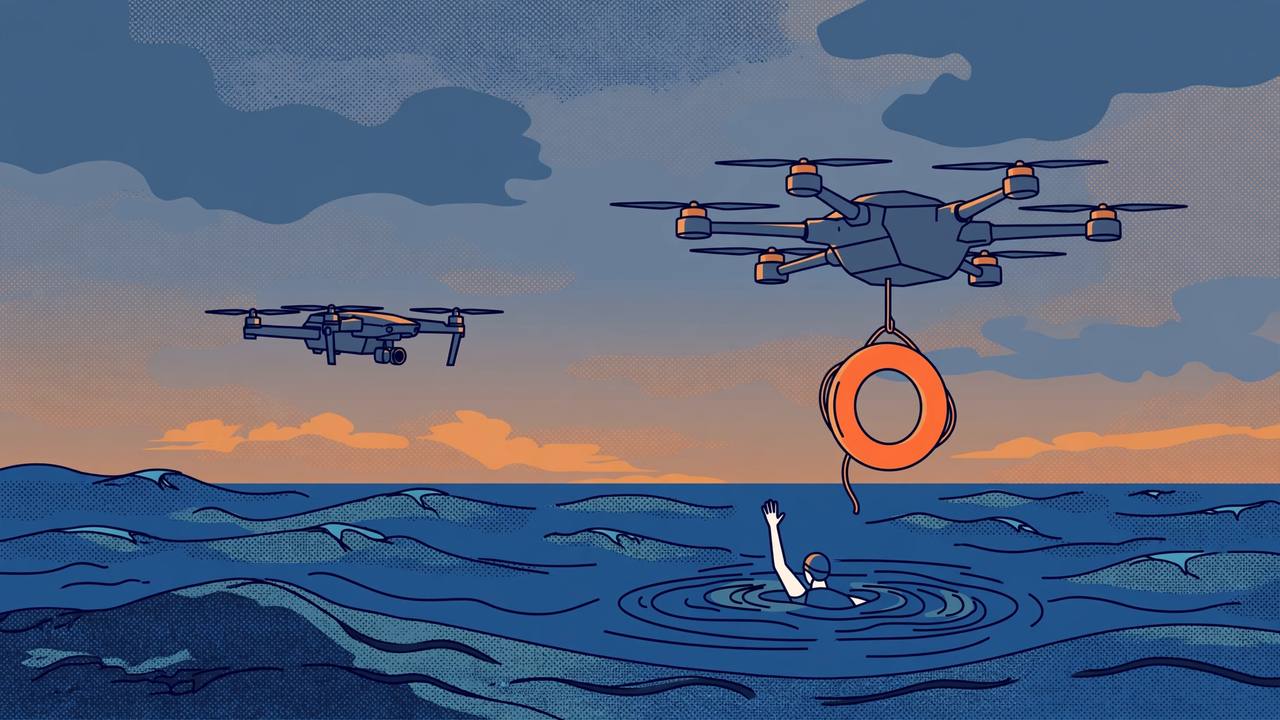
A team from the Indian Naval Academy has developed a pair of autonomous unmanned aerial vehicles (UAVs) designed for long-range maritime Search and Rescue (SAR) operations, ANI reported. The system has two drones that work together: a quadcopter searches for a person in the water, and a hexacopter then delivers a lifebuoy to the spot, with the two linked through long-range RF communication, the report said.
Source: ANI via NewKerala
Speaking to ANI, Midshipman Sudhanshu Tanwar, one of the developers, said the quadcopter does the searching with 2K optical and thermal cameras, and that an AI model called YOLO scans the live feed and flags a possible person in the water. Once a person is flagged, the hexacopter flies out on GPS carrying the lifebuoy, which is dropped only on the command of an operator, keeping a human in control of the final decision, after which the hexacopter returns home on its own, ANI reported.
Source: ANI via Devdiscourse
Both drones were built by the team, ANI reported. The quadcopter has a flight time of 45 minutes, a payload capacity of 0.5 kg and a maximum speed of 50 km/h, while the hexacopter can fly for 25 minutes, carry a payload of 2.5 kg and reach a maximum speed of 40 km/h. Both drones have an operating radius of 10 km.
Source: ANI via APNA MA TV
Tanwar said the aim is to give rescuers a faster way to find and reach people in distress at sea, ANI reported. The system pairs automated detection with a human-approved drop, so the search can begin quickly while the final rescue decision stays with an operator.
Source: ANI via NewKerala