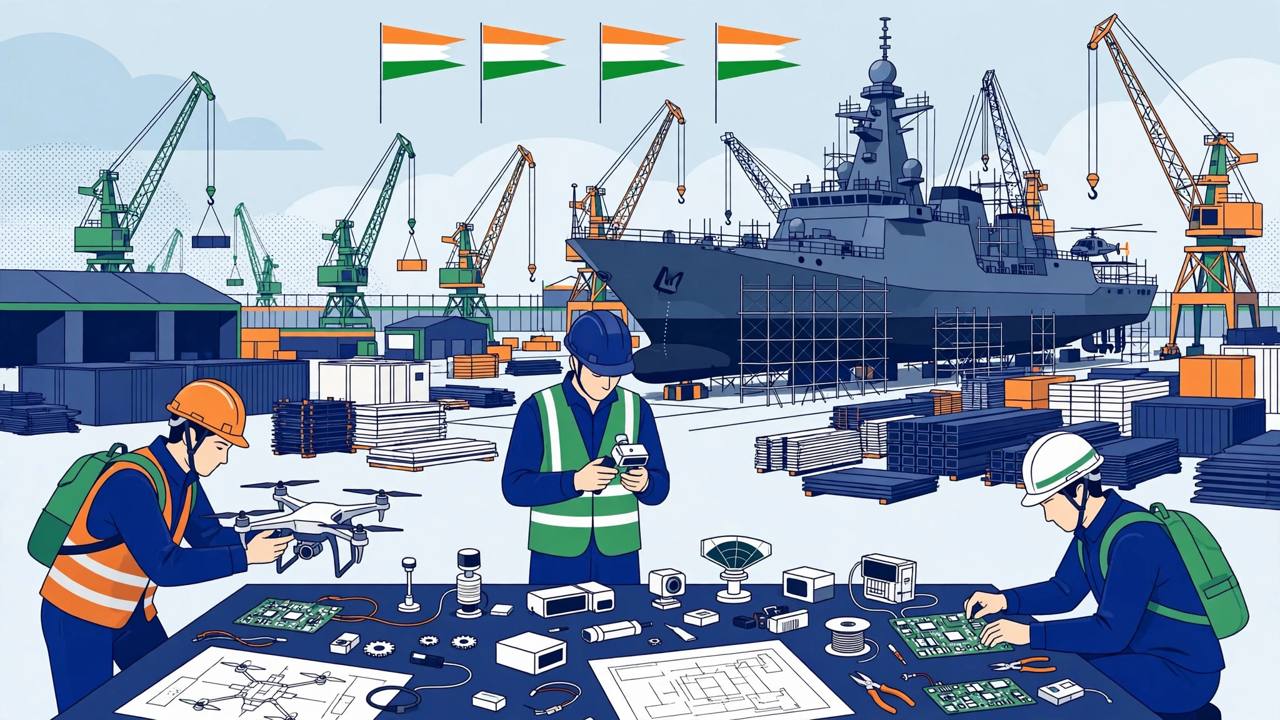
Defence Minister Rajnath Singh on Monday, October 26, called for 'Aatmanirbharta 2.0' in the defence sector, with emphasis on developing state-of-the-art technologies and building resilient supply chains, contributing to the vision of Viksit Bharat@2047, IANS reported. Addressing the fifth edition of SWAVLAMBAN, the Indian Navy's Naval Innovation and Indigenisation Seminar in New Delhi, he stressed strengthening research and development (R&D), reducing import dependence and achieving technological superiority.
Source: IANS via Hi India
Singh said India must enter phase two of self-reliance in defence with the aims of cost-effectiveness and global competitiveness, PTI reported. He said the next phase must focus not only on the quantity of indigenous products but also on their quality, efficiency and affordability, so that self-reliance strengthens national security as well as economic resilience, and that products made in India should be cost-effective, operationally superior and globally competitive.
Source: PTI via DailyWorld
He highlighted that demand for naval ships is steadily increasing in view of the evolving situation in the Indian Ocean Region, and since their construction is capital-intensive, there is a need to explore ways to reduce costs while expanding domestic production. He said defence innovators with futuristic vision and scientific discipline could play the role of 'impact players' in pursuing more challenging technological goals, building on the gains of the first phase of self-reliance achieved under Prime Minister Narendra Modi's leadership.
Describing supply chain management as not just a technical issue but a strategic imperative directly linked to national security, Singh called for a dynamic roadmap that sets clear timelines for achieving self-reliance in each item, identifies the technologies to be developed and the industries that will drive their innovation, and outlines the resources required. He said assessment of buffer stocks and domestic production capabilities must be carried out in advance rather than waiting for a crisis.
He identified R&D as central to addressing these challenges and stressed a deep-rooted culture of research and innovation through stronger industry-academia collaboration, greater encouragement in educational institutions and more opportunities for the youth to pursue careers in R&D.