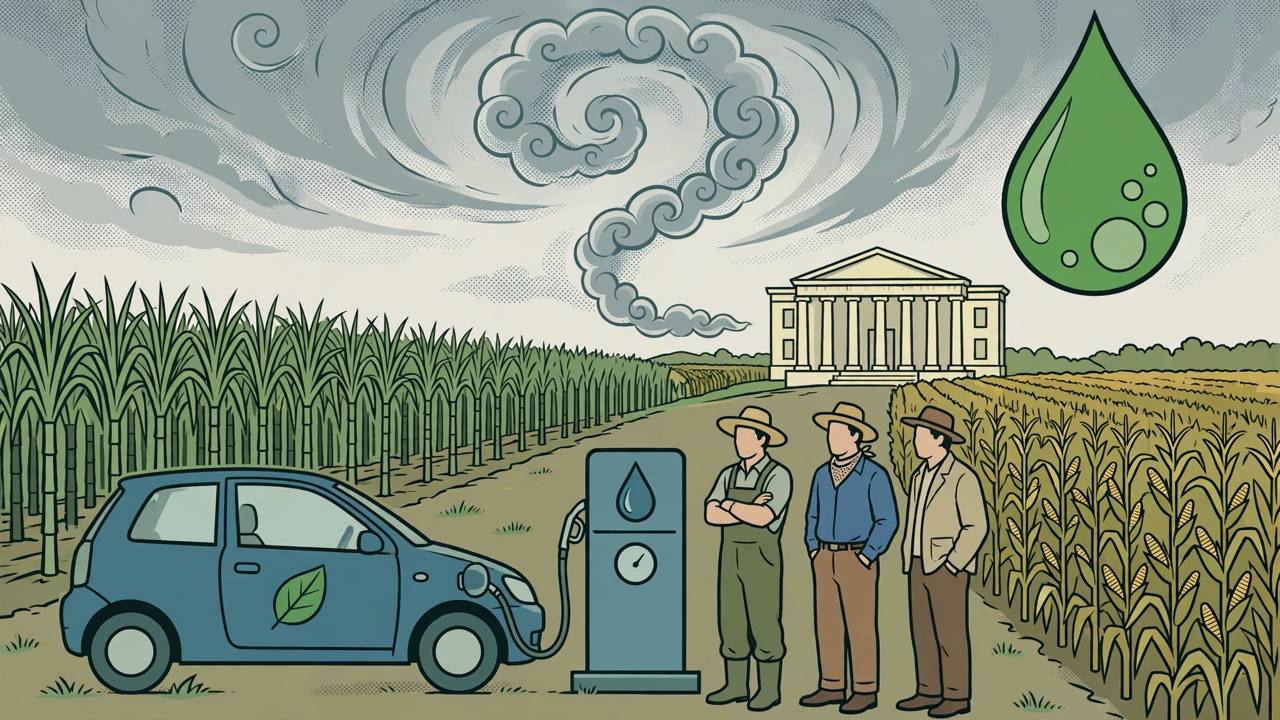
The Supreme Court on Thursday, October 29, asked the Centre a basic supply question about its new flex-fuel rules: if vehicles running on 100 per cent ethanol are now permitted, how will the fuel actually be supplied? A Bench of Justices M M Sundresh and Prasanna B Varale put the question while hearing pleas concerning ethanol allocation for Ethanol Supply Year (ESY) 2025-26, PTI reported.
Source: PTI via Verdictum
The Bench referred to recent newspaper reports on the change. "Day before yesterday, we saw some newspaper reports wherein it is stated that 100 per cent ethanol-driven vehicles are permitted," the Bench said. "Academically, we want to know if the permission is given to have 100 per cent ethanol-run vehicles, how will you make the supply," it asked, PTI reported.
Source: PTI via Verdictum
Attorney General R Venkataramani responded that supplying E100 at scale "will require large-scale manufacturing re-arrangements," PTI reported. He told the Bench he would address the farmers' aspect during his arguments in the matter, LawTrend reported.
Source: LawTrend
The rule change behind the question
On October 26, the Road Transport Ministry notified changes to the Central Motor Vehicles Rules, 1989, including E100 alongside E85 in the emission-certification provisions for flex-fuel vehicles designed and certified for those fuels. E100 is nearly pure ethanol, while E85 is 85 per cent ethanol. A day later, on October 27, Petroleum and Natural Gas Minister Hardeep Singh Puri said the Centre has no immediate plan to increase ethanol blending in petrol beyond the current 20 per cent, PTI reported.
Source: PTI via Verdictum
Farmers, public interest and the allocation dispute
The Bench stressed that the case must also be looked at from the angle of larger public interest and the environment, and underlined the need to empower farmers. "We need to empower the common man which is still in the villages," Justice Sundresh observed, PTI reported.
Source: PTI via Verdictum
The proceedings arise from a dispute over ethanol allocation for ESY 2025-26, in which an oil marketing company challenged a Karnataka High Court direction asking Bharat Petroleum, Hindustan Petroleum and Indian Oil to consider a dedicated ethanol manufacturer's representation seeking increased allocation. On June 30, the Supreme Court directed that status quo be maintained on that direction. The matter will be heard further next month, LawTrend reported.
Source: LawTrend
The exchange leaves a practical gap on the record: vehicle rules now recognise E100, but the court has asked how production and supply would be rearranged if such vehicles actually reach the road in numbers — and the Centre's answer, for now, is that it would take large-scale manufacturing changes.