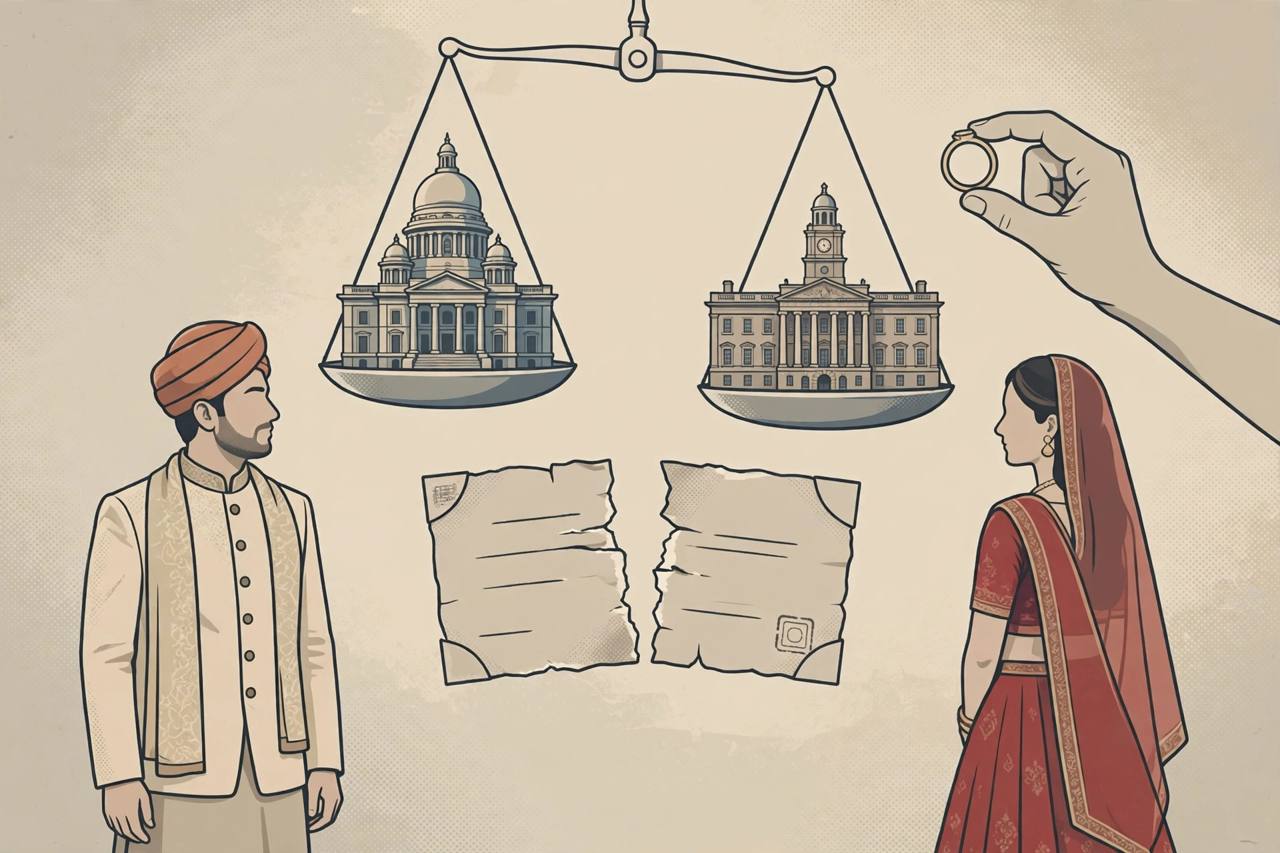
The Supreme Court on Tuesday (November 3) held that a divorce granted by a foreign court on the ground of irretrievable breakdown of marriage cannot automatically be recognised in India, and upheld bigamy proceedings against a man who remarried abroad on the strength of a UK divorce decree after taking British citizenship.
Source: Live Law
A bench of Justice Prashant Kumar Mishra and Justice Sree Chandrashekhar, in a judgment authored by Justice Mishra, said irretrievable breakdown is not a statutory ground for divorce under the Hindu Marriage Act, 1955, and that the foreign decree did not satisfy Section 13 of the Code of Civil Procedure (CPC), which sets the conditions for a foreign judgment to be enforceable in India.
According to the case record reported by The CSR Journal, the man married his first wife on April 18, 2003, at Sattenapalli in Andhra Pradesh according to Hindu rites, moved to the United Kingdom on February 4, 2005 for his medical career, and was granted UK citizenship on February 1, 2013. A Cambridge County Court decree was made absolute on January 29, 2014 on the ground of irretrievable breakdown, after which he remarried in Norfolk in the UK.
Source: The CSR Journal
In 2016, the first wife lodged a complaint under Sections 494 (bigamy) and 120B read with Section 34 of the Indian Penal Code, LawTrend reported. The husband challenged the Andhra Pradesh High Court's order dismissing his plea to quash the proceedings.
Rejecting his arguments, the Court observed that the foreign decree was passed in contravention of the existing matrimonial law in India and on a ground not recognised statutorily, and that the wife had never submitted herself to the foreign court's jurisdiction — her participation after raising a jurisdictional objection could not be treated as unconditional submission. The Court cited its recent ruling in Kishorekumar Mohan Kale v. Kashmira Kale and the earlier Y. Narasimha Rao precedent.
Source: LawTrend
The Court also rejected the plea based on Section 4 of the IPC — that he was a British citizen and the second marriage took place outside India — holding that an enquiry into bigamy cannot be confined to the place of the second marriage and must take into account the subsisting matrimonial relationship, and that a later change of nationality cannot defeat its legal consequences.
While the bigamy proceedings against the husband will continue, the Court quashed the criminal proceedings against his parents and his second wife, finding no material of an agreement by them to commit bigamy. The appeal was dismissed.
A marriage solemnised in India under Hindu law is not treated as dissolved in India merely because a foreign court has granted a divorce on a ground Indian law does not recognise. Such a decree must first pass the Section 13 CPC test.