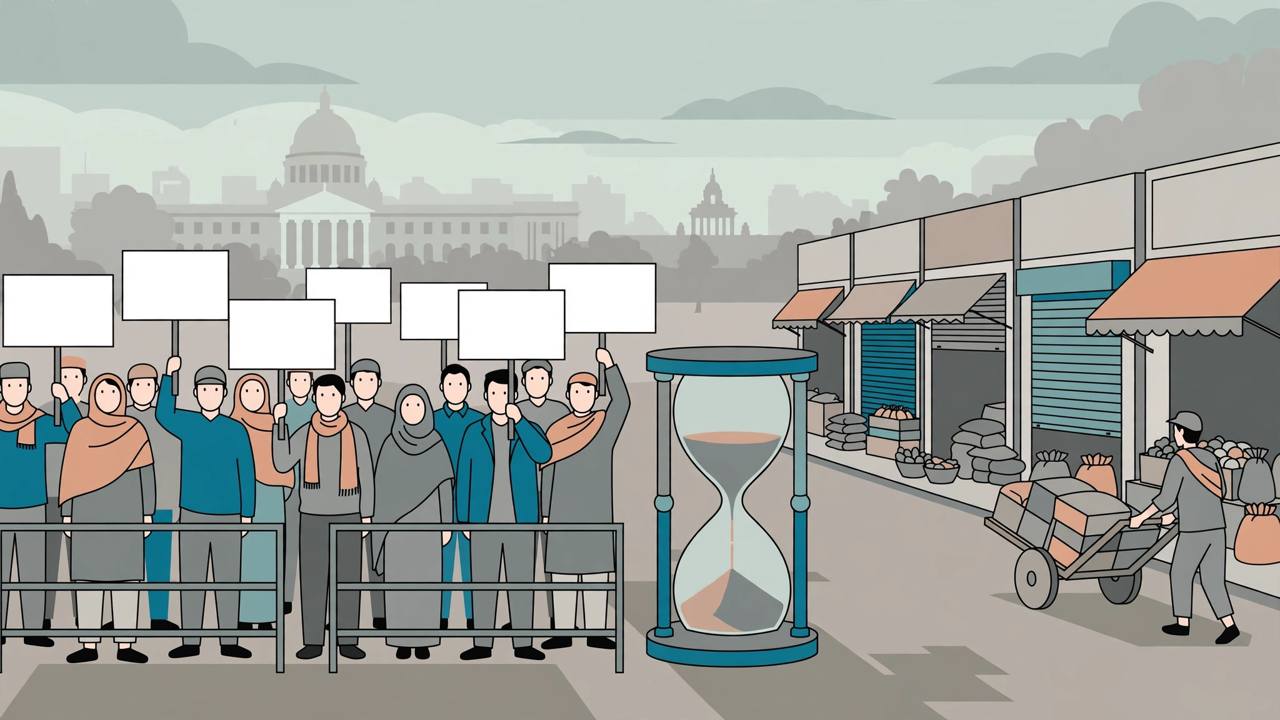
The Supreme Court on Tuesday directed the Kirana Committee Delhi to add the organisers of the Delhi protests against Chief Election Commissioner Gyanesh Kumar as parties to the traders' plea over business losses, while hearing a batch of petitions arising from the October protests in the capital. A Bench of Chief Justice of India Surya Kant, Justice Joymalya Bagchi and Justice V Mohana passed the direction.
Source: LiveLaw
“You cannot occupy a site for all times to come. There are other protesters. Where will the farmers go? Where will the workers go? Where will the trade unions go? Where will the homeless go? Everybody has a right to protest,” Chief Justice Kant said, adding that a designated protest site can be occupied only for a specified period so that other groups can also use it.
Source: Bar and Bench
The Chief Justice said the right to protest and the right to trade and carry on business are both constitutionally recognised, and turned to the daily wager: “We are not talking about trade merely in terms of commercial establishments. We are talking about the source of livelihood of a daily-wage worker. Where does that person go for their daily bread?”
Source: Bar and Bench
What the traders told the court
Senior Advocate Mukul Rohatgi, appearing for the trading associations, claimed that the protests had caused a revenue loss of Rs 2,000 crore, and said sales had fallen sharply in the festive season. He said Ramlila Maidan, the designated protest site, sits about a mile from Connaught Place, surrounded by wholesale markets and neighbourhoods, and urged the court to look for an “out-of-the-box solution”. He also urged that no protests or dharnas take place for the next two months.
Source: Bar and Bench / LiveLaw
Solicitor General Tushar Mehta, appearing for the Delhi Police, submitted that the protest at Jantar Mantar had been permitted for one day but the site was occupied for 17 days, and that protesters had then marched towards Parliament without permission. “Parliament is not just a political building. It is a symbol of the sovereignty of India. You cannot be permitted to go to Parliament,” he said.
Source: Bar and Bench
The other side: police action and barricades
The court also heard the protesters' side. Senior Advocate Menaka Guruswamy submitted that Jantar Mantar was a designated protest site and alleged that the violence during the protests was perpetrated by the Delhi Police, referring to the detention of around 7,000 people. The Solicitor General replied that the individuals were not detained but merely removed from the site.
Source: LiveLaw
Justice Bagchi questioned whether business losses could be attributed only to the protesters when the State itself puts barricades on roads and, it was argued, forces shops to close. Senior Advocate N Hariharan argued that businesses were affected by police barricading, and asked where people should protest now that Jantar Mantar has been relocated and Ramlila Maidan is also disputed.
Source: Bar and Bench
Advocate Prashant Bhushan raised the surveillance of protesters and the right to privacy in a public place. The Solicitor General responded that there was only CCTV surveillance, noting that hundreds of influencers were recording live. The Bench also allowed the intervention of auto-rickshaw and truck operators who said their livelihood was affected by the protests.
Source: Bar and Bench / LiveLaw
Why this hearing matters: the earlier protests
This hearing is the latest step in the cases that grew out of October's Delhi protests against Chief Election Commissioner Gyanesh Kumar over the electoral-roll revision exercise. The petitions before the court raise alleged police brutality, unlawful detentions, restrictions on public movement, the closure of metro stations and internet shutdowns; on an earlier date the court had directed the Union to produce the Section 163 BNSS orders imposed in Delhi during the protests. Traders have pressed their loss claims in recent days, including before the police, and the Supreme Court hearing now takes those claims into the courtroom, with the organisers to be added as parties before the matter proceeds further.
Source: LiveLaw
No final order on the merits of the protest petitions was reported from Tuesday's hearing. The court signalled that permission orders for protests must clearly define their terms and conditions, and that a designated period must be fixed for a designated site.
Source: LiveLaw