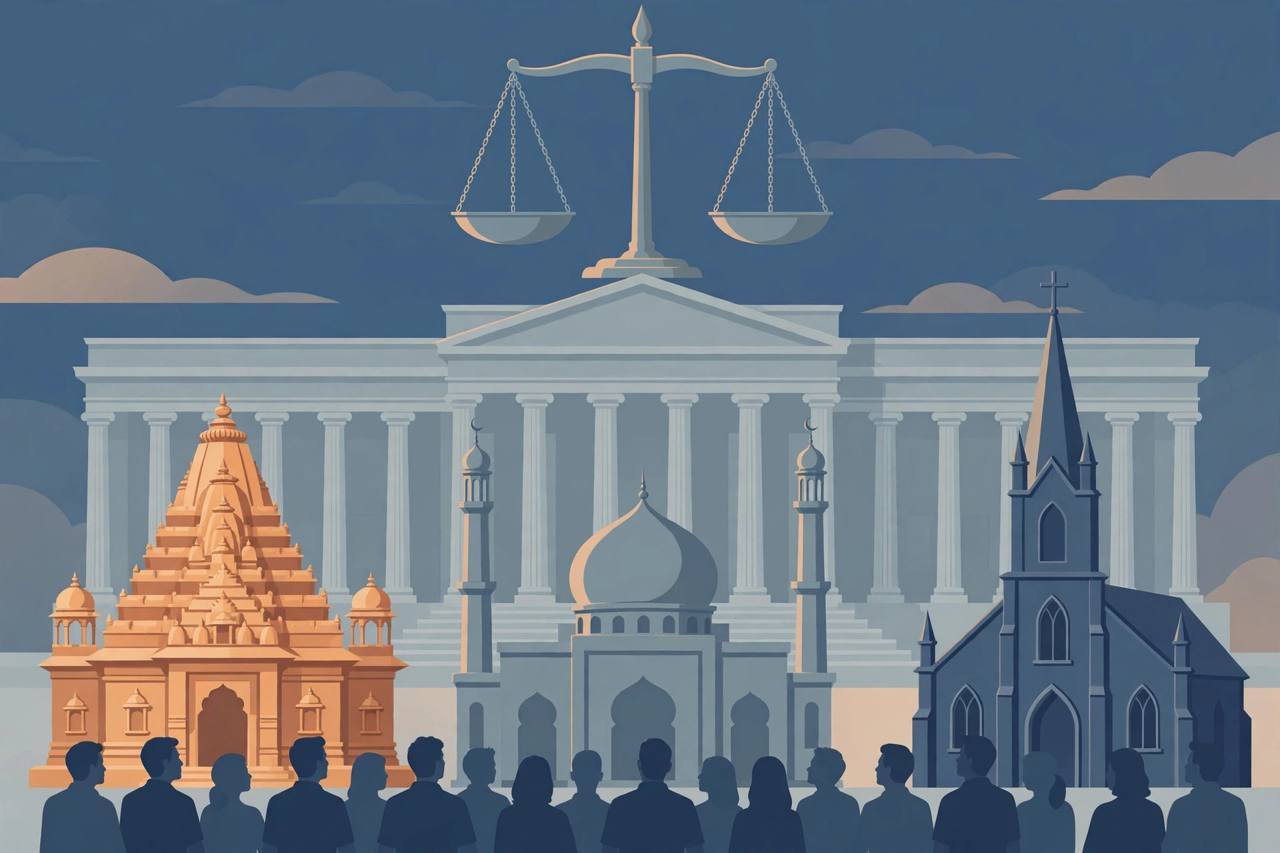
The Supreme Court on Wednesday declined to consider a public interest litigation (PIL) seeking for Hindus, Jains, Buddhists and Sikhs the right to establish, manage and maintain their religious places like Muslims, Parsis and Christians, LawStreet reported. A bench led by the Chief Justice of India said this is a matter of policy and the court will not enter the legislative domain.
Source: LawStreet
The bench, also comprising Justices J B Pardiwala and Manoj Misra, told advocate Ashwini Kumar Upadhyay, who filed the petition in his own name, that it cannot entertain a matter containing general prayers. "What are these prayers? Can these reliefs be granted? Withdraw this petition and file a petition with prayers which can be granted," the bench told the petitioner, according to LawStreet. The court found the plea publicity-oriented and not maintainable, and said the petitioner can move Parliament or the government.
Source: LawStreet
The bench observed that the Constitution already provides this right to everyone: under Article 26, every religious denomination has the right to establish and maintain institutions for religious and charitable purposes, and Article 25 guarantees freedom of conscience and religion. The Law Advice, reporting the same hearing, said the PIL had sought a uniform endowment code and claimed that laws administering the properties of temples and gurdwaras are arbitrary and violate Articles 14, 15 and 26 of the Constitution.
Source: The Law Advice
Upadhyay submitted, as his claim before the court, that a total of four lakh temples are under government control but not a single mosque or church, and pointed to Delhi's Kalka temple being under government control while Jama Masjid is not. The bench responded that this is all a matter of policy: "We are not going to direct the government to do x, y, or z in terms of religious places. That is a matter of policy. We will not enter the legislative domain."
Source: LawStreet
Solicitor General Tushar Mehta, representing the Centre, said the petitioner may have a case but the way the petition is drafted is not correct, LawStreet reported. The hearing leaves the petitioner free to file a fresh petition with specific prayers that the court can grant, or to pursue the demand before Parliament and the government, which the bench identified as the proper forum for a policy change of this kind.
Bench: led by the Chief Justice, with Justices J B Pardiwala and Manoj Misra. Plea by: advocate Ashwini Kumar Upadhyay. Court's stand: general prayers cannot be granted; Articles 25 and 26 already give every denomination the right; religious-place management is policy, for Parliament and the government — not the court.