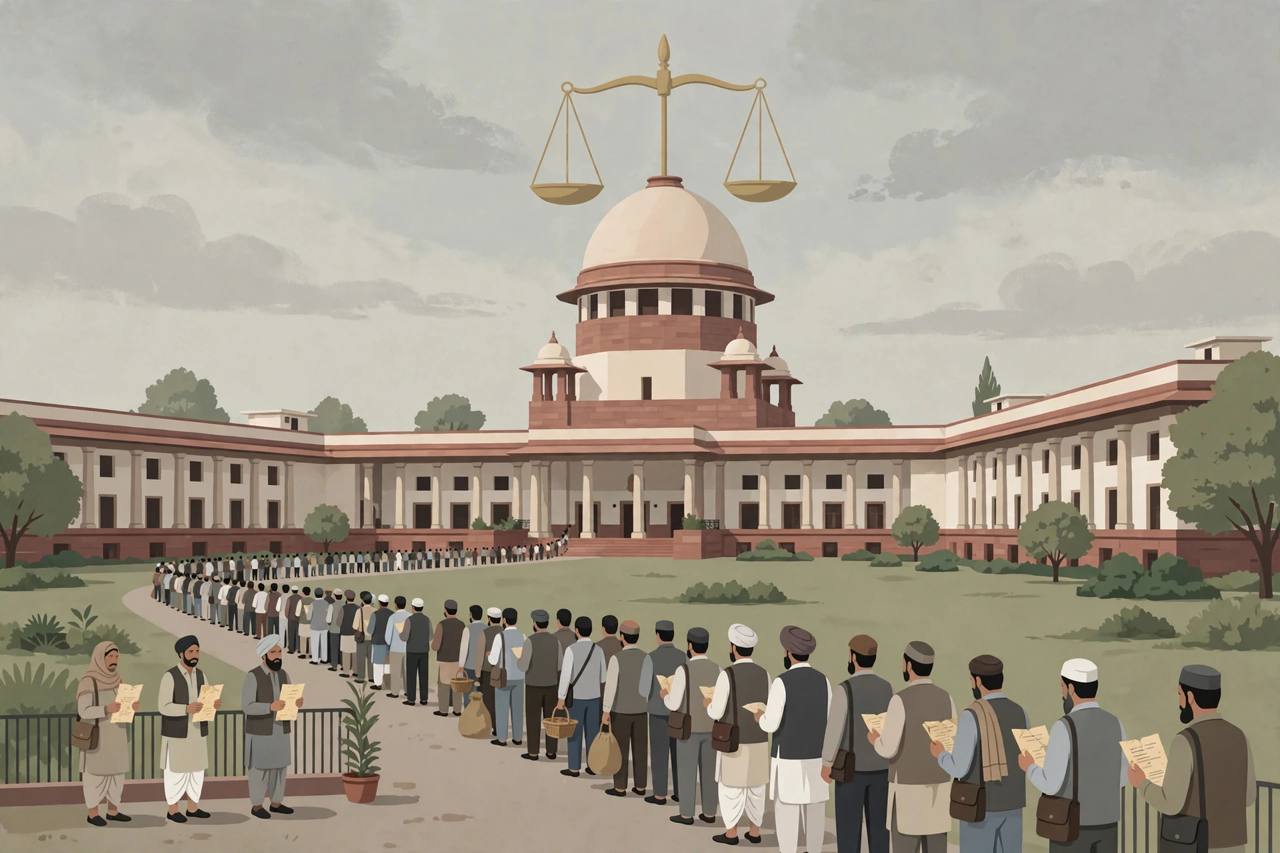
The Supreme Court on Monday pulled up the Tamil Nadu government for repeatedly seeking adjournments in a decades-old case over compensation for property and business losses suffered in the 1996 communal riots in Thoothukudi, LiveLaw and LawChakra reported.
Source: LiveLaw
A Bench of Justice S.V.N. Bhatti and Justice N.V. Anjaria said the State ought not to be dragging its feet in what it called a simple matter. Justice Bhatti remarked: "It is a simple matter; the State ought not to be dragging its feet." The Court was told a letter seeking an adjournment had been circulated on the preceding Saturday, and it declined to give the State two more weeks to file a rejoinder.
Source: LawChakra
The Bench adjourned the matter to Tuesday, October 27, and asked the State to specify what exemplary consequences should follow from the prolonged delay in disbursing compensation. The Court was also informed that the State has already deposited 50 per cent of the compensation amount.
A uniform Rs 2 lakh order is at the heart of the dispute
After the 1996 riots damaged businesses and properties in Thoothukudi, the State appointed a former District Judge as a one-man commission to assess losses and recommend compensation based on the actual losses suffered. The government then issued G.O.Ms. No. 1834, granting a uniform compensation of Rs 2 lakh — yaani two lakh rupees — to all affected persons, instead of loss-based amounts.
Affected persons challenged that order before the Madras High Court. Both the Single Judge and the Division Bench favoured compensation in accordance with the one-man commission's recommendations. The State then appealed to the Supreme Court in the case titled The Government of Tamil Nadu v. D.G. Rajan @ Gnanaraj, where the matter has been listed repeatedly.
The Bench also observed that governments appoint commissions after communal violence and arson, leading people to expect their grievances will be addressed, and that the State must ensure the promised relief actually reaches them. The appeal has not been decided on its merits, and the State's position on the uniform Rs 2 lakh grant remains to be argued.