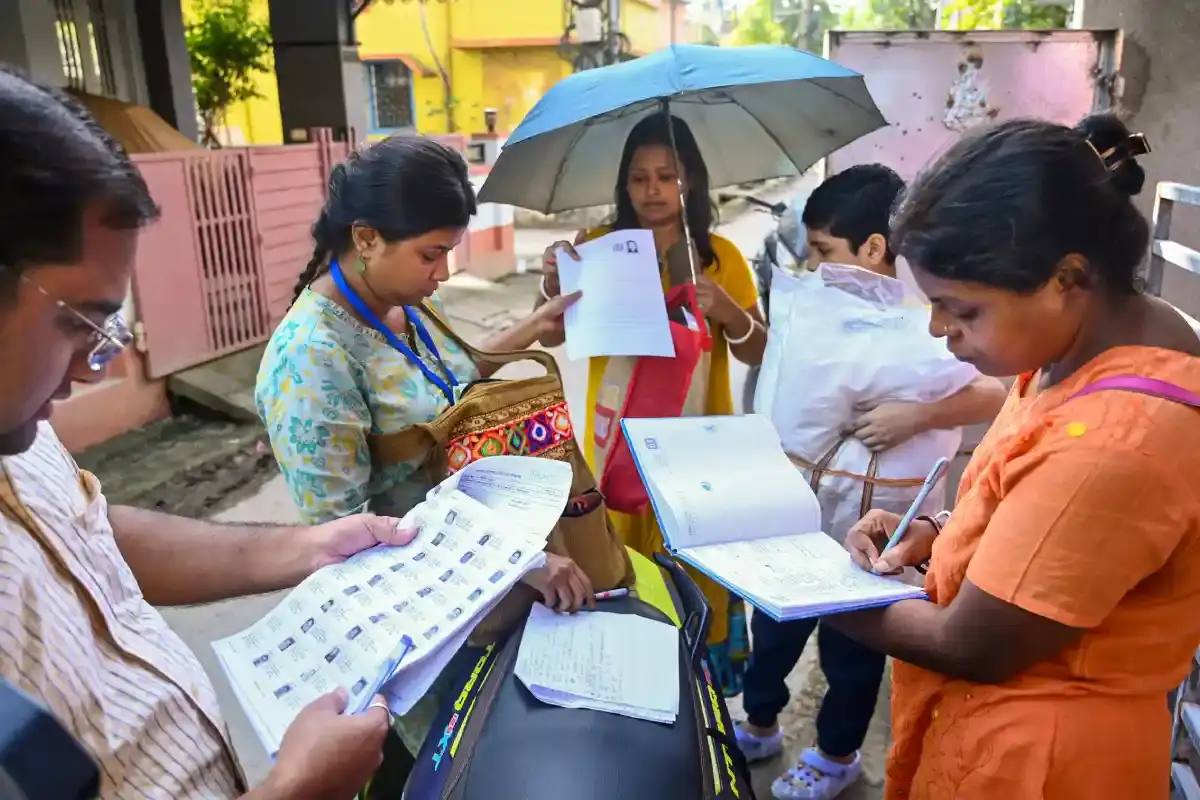
The number of voters across Uttar Pradesh, Uttarakhand, Goa, Punjab and Manipur has come down by up to 13.24 per cent after the completion of the Special Intensive Revision (SIR) of the voter lists, according to data made public by the Election Commission and state chief electoral officers, The Hindu BusinessLine reported on November 2.
Source: The Hindu BusinessLine
Across the five states, the electorate shrank from about 18.71 crore to 16.43 crore after the SIR — a net reduction of around 2.29 crore, or about 12.2 per cent. All five states will go to assembly polls early next year.
Uttar Pradesh, which has the biggest electorate among states, alone accounted for nearly 90 per cent of the total drop. In UP, which went through SIR in phase II, electors went from 15.44 crore before the revision to 12.56 crore in the draft roll, before recovering to 13.40 crore in the final rolls — a net loss of around 2.04 crore, or 13.24 per cent, the steepest among the five states. The draft had removed about 2.89 crore names, of which about 0.84 crore — roughly 29 per cent — were restored.
Punjab records the strongest recovery
In Punjab, where SIR was held in phase III, electors went from 2.15 crore to 1.94 crore in the draft roll and then to 2.01 crore in the final rolls — a net loss of about 0.14 crore, or 6.34 per cent. Punjab had the strongest recovery of the five states: about 0.07 crore of the roughly 0.21 crore draft deletions, about 34 per cent, came back onto the rolls.
In Uttarakhand, where the revision was held in phase III, electors went from 0.80 crore to 0.71 crore in the draft and ended at 0.72 crore — a net loss of about 0.08 crore, or 10.07 per cent, with only about 0.0025 crore, around three per cent of draft deletions, restored. In Manipur, also phase III, electors moved from 0.209 crore to 0.193 crore in the draft and ended at 0.196 crore — a net loss of about 0.013 crore, or 6.33 per cent, with about 17 per cent of draft deletions restored. In Goa, which went through SIR in phase II, electors fell from 0.1185 crore to 0.1085 crore in the draft and then fell further to 0.1058 crore in the final roll — a net loss of nearly 0.013 crore, or 10.76 per cent. Goa is the only one of the five states where the final roll is smaller than the draft, so there was no net restoration there.
What happens next
While ordering a special summary revision in 17 states recently, the Election Commission noted that assembly polls in the five states could be held 'early next year'. The ongoing special summary revision ahead of the polls will give left-out voters a fresh chance to get included in the electoral rolls, and young voters who turn 18 on or before January 1 will also get an opportunity to enrol and vote in these five states.
Source: Nowlivo (citing India Today and PTI)
The term of the 403-member Uttar Pradesh assembly ends on May 22 next year, while the terms of the 60-member Manipur, 40-member Goa, 117-member Punjab and 70-member Uttarakhand assemblies end on different dates in March 2027. Provisions of the Representation of the People Act, 1950 allow the Election Commission to hold polls earlier than six months before a term expires.
The newly reported totals describe the outcome of the revision exercise in aggregate. A net reduction in registered voters is a measurable change in the lists; it does not, on its own, establish that every removed name was wrongly deleted — the accuracy of individual entries and the reasons for removals are separate questions that depend on the revision process and any appeals.