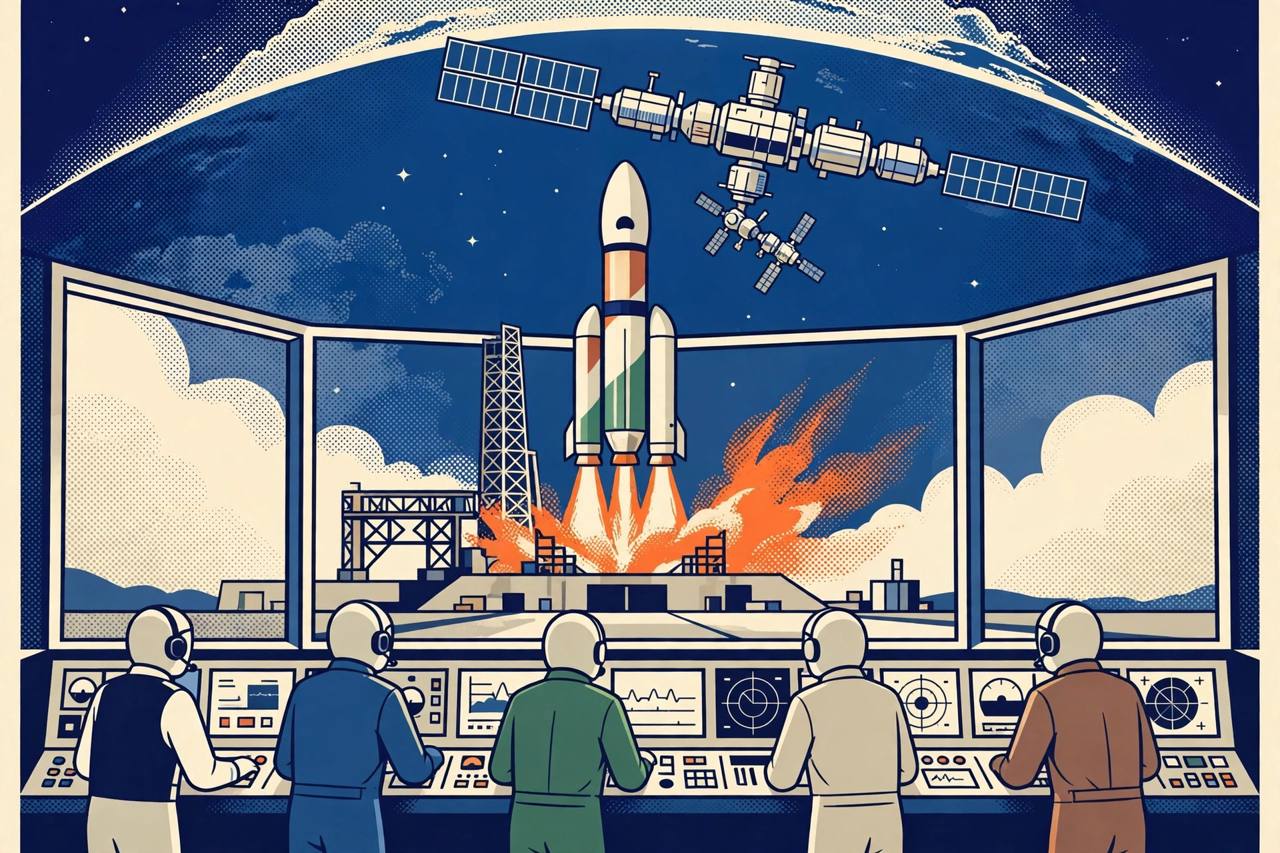
India's space economy is targeted to reach $44 billion by 2033, according to a government factsheet released on Wednesday during the Emerging Science, Technology and Innovation Conclave (ESTIC) 2026 in New Delhi, IANS reports. Space science and technologies were a thematic focus of the conclave, held from October 27 to 29 at Bharat Mandapam, with a session organised by the Department of Space and ISRO.
Source: IANS via HiIndia
The factsheet says the commercial transfer of ISRO's technology is already under way at scale. NewSpace India Limited (NSIL), ISRO's commercial arm, has signed 118 technology-transfer agreements to transfer 83 technologies developed by ISRO to Indian industry, the IndUS Business Journal reports.
Source: IndUS Business Journal
Investor confidence is rising alongside the transfers. Cumulative investment in Indian space start-ups reached approximately $618.5 million as of March 31, 2026, with funding shifting from early-stage seed support to larger, growth-stage rounds, according to the factsheet cited by IANS.
The technologies named as drivers include reusable launch vehicles, air-breathing and electric propulsion, and autonomous in-space docking. Through its SpaDeX mission, India became the fourth country to achieve autonomous docking of two spacecraft in orbit — a capability needed for the planned Bharatiya Antariksh Station and for the Gaganyaan human-spaceflight programme, The News Trust reports.
Source: The News Trust
The heavy-lift centrepiece is the Next Generation Launch Vehicle (NGLV), approved by the Union Cabinet in September 2024 with an outlay of Rs 8,240 crore covering development, three developmental flights and facilities. Designed for a maximum of 30 tonnes to low Earth orbit — three times the LVM3's 10-tonne capability — the NGLV also has a partially reusable variant with a 14-tonne payload capability being developed to cut launch costs. ISRO has separately demonstrated autonomous runway landing through its Pushpak reusable launch vehicle demonstrator.