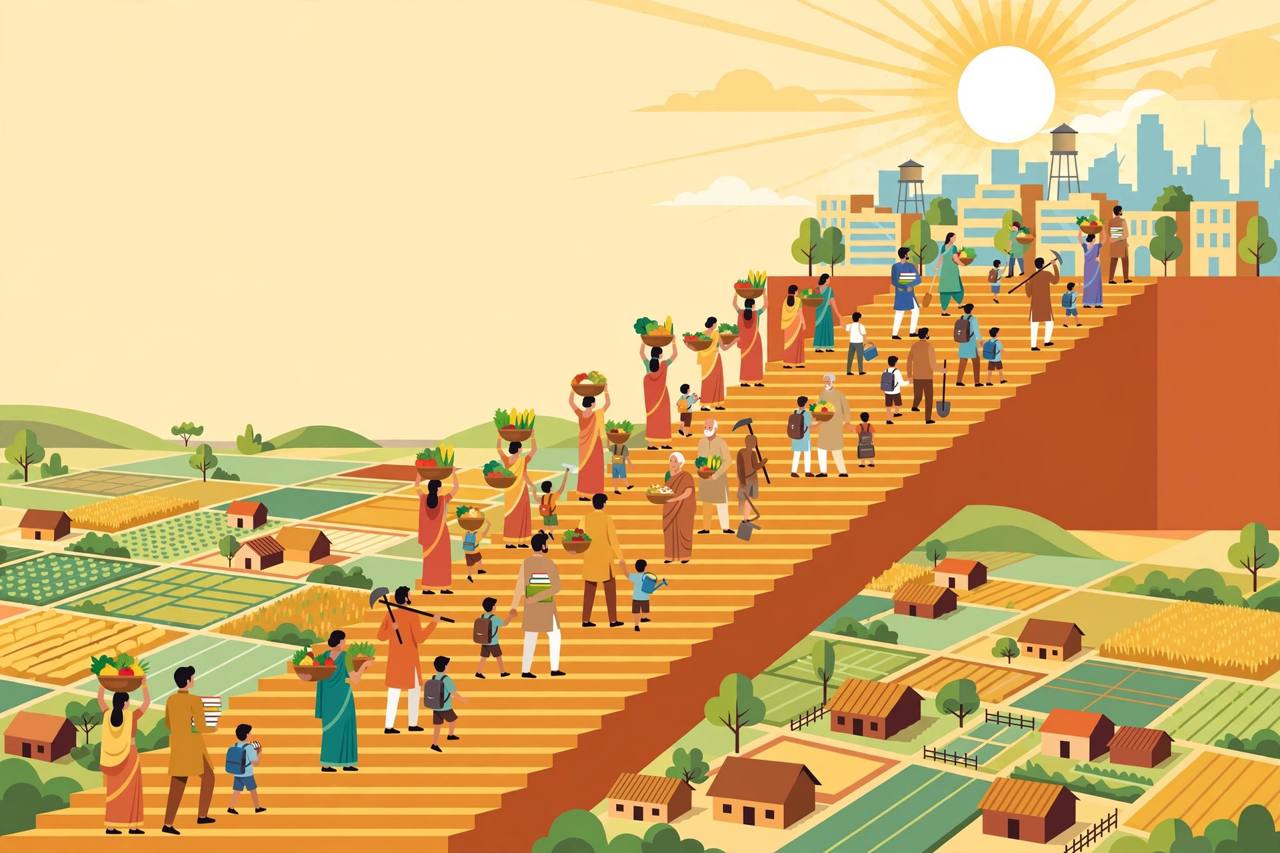
New Delhi, October 30 — India lifted an estimated 496 million people out of poverty between 2011 and 2023, with the share of the population living in extreme poverty falling sharply from 27.1 per cent to 2.6 per cent, according to the World Bank's October 2026 Poverty and Equity Brief. The Bank described India's progress as one of the fastest poverty declines in the world, with improvements across both monetary and non-monetary measures.
Source: The Hindu BusinessLine
The proportion of Indians living below the lower-middle-income poverty line of $4.20 a day, measured at 2021 purchasing power parity, also fell from 57.7 per cent in 2011 to 16.1 per cent in 2023. Extreme poverty is measured against the international line of $3 a day. Policy Circle's reading of the same brief notes that the 496 million figure counts people who moved above the $4.20-a-day line over the period.
Source: Policy Circle
The World Bank attributed the decline mainly to strong consumption growth, rising employment — particularly among women — and expanded social transfers, including food subsidies. Employment rose by around 134 million people between 2017 and 2023, nearly twice the growth in the working-age population, and much of that increase came from rural women entering paid employment.
The cautions behind the headline
The Bank cautioned that its forward projections are indicative estimates based on microsimulations and could change as new labour market and macroeconomic data become available. It projects the poverty rate at the $4.20-a-day threshold could fall further, from 14.2 per cent in 2026 to 12.1 per cent by 2028. It also noted that poverty estimates are based on household consumption surveys, and that some recent gains may reflect improvements in measurement alongside genuine welfare improvements.
Challenges remain concentrated and structural. Around 57 per cent of India's poor population lives in a contiguous belt stretching from Uttar Pradesh to West Bengal, making productive employment in those states decisive for further reductions. Youth unemployment rose from 14.6 per cent to 15.9 per cent, real earnings remained broadly unchanged, and much of the new employment was concentrated in relatively low-productivity activities. Around 80 per cent of the population still lived below the higher $8.30-a-day upper-middle-income line in 2023.
Non-monetary poverty also fell. The multidimensional poverty rate measured through the Oxford Poverty and Human Development Initiative's index dropped from 53.8 per cent in 2005-06 to 16.4 per cent in 2019-21, while the World Bank's own multidimensional measure stood at 15.5 per cent in 2022-23. The brief's message, in short, is that the decline is historic — but turning higher consumption into secure earnings and productive jobs is the work that remains.