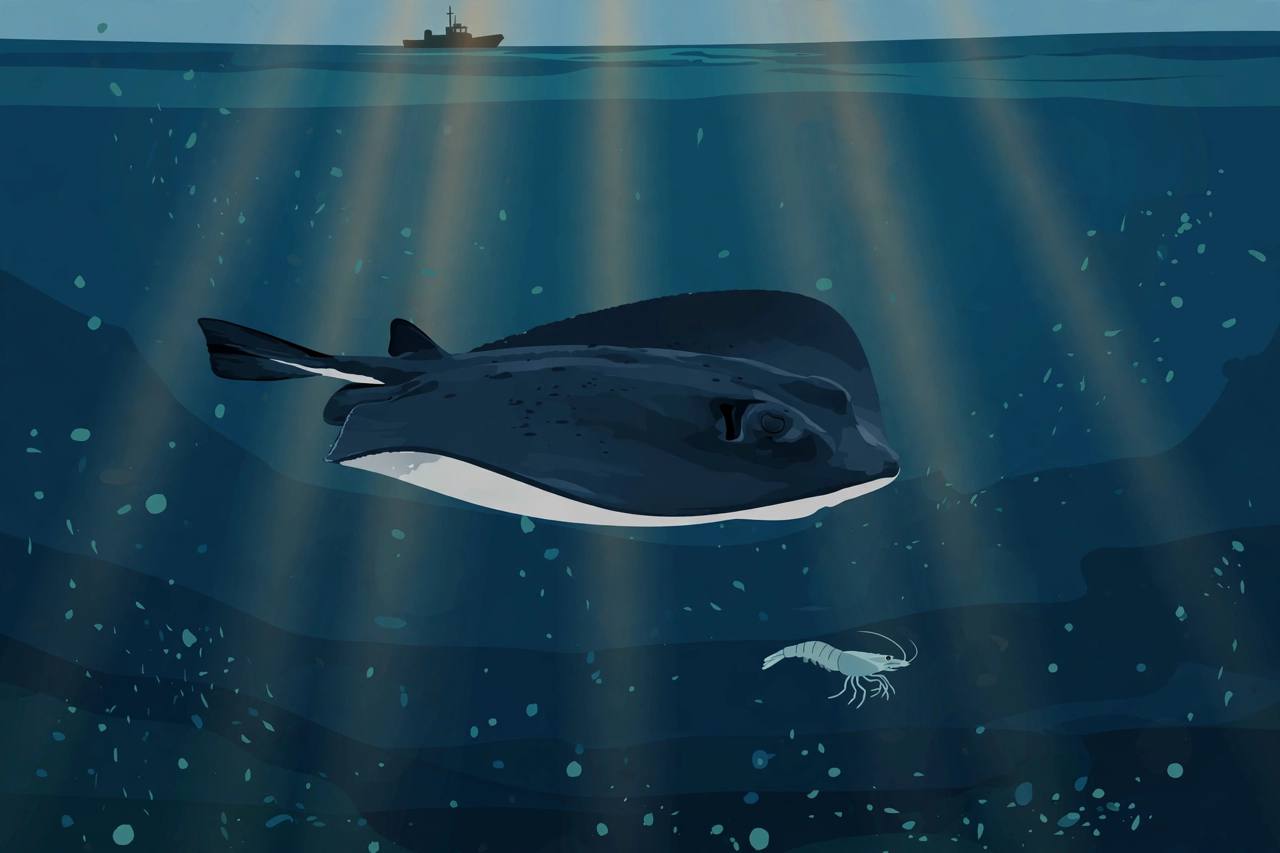
Scientists from the Zoological Survey of India (ZSI) have discovered a new species of electric ray from the deep waters of the southeastern Arabian Sea in the northern Indian Ocean, a ZSI statement said on Tuesday, October 27.
Source: ZSI statement via Jammu News Portal
The new species, commonly named the Arabian Black Electric Ray and scientifically named Tetronarce ramanamurthyi, marks the first confirmed record of the genus Tetronarce in the northern Indian Ocean, the statement said, shedding new light on the biodiversity of India's deep-sea ecosystems.
Research Matters, reporting the description in detail, said fishermen accidentally hauled the rays up as bycatch from deep-sea trawl fisheries targeting deep-sea red shrimps at depths ranging from 400 to 700 metres, and that researchers collected the specimens during fish-landing surveys at the Sakthikulangara Fishing Harbour in Kerala.
Source: Research Matters
Named for the Deep Ocean Mission director
The species has been named in honour of Dr M V Ramana Murthy, Mission Director of the Deep Ocean Mission of the Ministry of Earth Sciences, recognising his contributions to marine science, ocean engineering and marine hazard mitigation in India, according to the ZSI statement. The research was carried out under the Deep Ocean Mission project on the taxonomy, distribution, biology and status of deep-sea chondrichthyans in Indian waters, and the findings have been published in the international taxonomy journal Zootaxa.
The discovery was led by Dr K K Bineesh, a scientist, and Anil Kasinath, a Junior Research Fellow, from the Marine Biology Regional Centre of ZSI in Chennai, in collaboration with Dr David A Ebert of the Pacific Shark Research Center at Moss Landing Marine Laboratories, San Jose State University, USA, the statement said. Research Matters said the wider team also included researchers from the South African Institute for Aquatic Biodiversity and the California Academy of Sciences.
What sets the new ray apart
The Arabian Black Electric Ray has a uniform dark bluish-black or dark brown upper body surface with a whitish belly, and lacks the skin bumps, or papillae, around its breathing holes, or spiracles, that are seen in relatives, Research Matters reported. Its disc is wider than it is long, and it has relatively large spiracles and smaller kidney-shaped electric organs.
Genetic testing using mitochondrial DNA, the COI and ND2 genes, confirmed that the fish forms an independent evolutionary lineage well separated from all other known electric ray species globally, the report added.
Deep-sea marine habitats remain among the most difficult ecosystems to study, the research team noted in the ZSI statement, adding that by integrating classical morphological taxonomy with modern molecular tools, scientists can uncover hidden marine life, clarify evolutionary relationships and establish critical baselines for ocean conservation.