1. The demand, defined
“Khalistan” — from Khalsa, the community of the initiated Sikhs founded by Guru Gobind Singh in 1699, and -stan, land — is the name given to a proposed sovereign state for Sikhs, separate from India. The name itself was first used for the idea in print in the 1940s, but the demand in its modern form dates from the violence of the 1980s: on 29 April 1986, a five-member “Panthic Committee” formed at a Sarbat Khalsa (a general assembly of Sikhs) held at the Akal Takht in Amritsar issued a formal “Declaration of Khalistan.”
What territory is claimed depends on who is claiming it. The core claim, common to nearly all versions, is the present Indian state of Punjab. Maps circulated by Sikhs for Justice (SFJ), the US-based organisation that runs diaspora “referendum” events, claim a larger area that also takes in parts of present-day Haryana and Himachal Pradesh and the city of Chandigarh. Historical-maximalist versions of the claim reach further still. There is no single agreed map, and no government anywhere recognises any version of the claim.
Who raises the demand today? In India, its most visible electoral face is the Shiromani Akali Dal (Amritsar), led by Simranjit Singh Mann, which openly advocates Khalistan and contests elections on that platform. In the diaspora, the loudest voice is SFJ and its legal adviser Gurpatwant Singh Pannun; SFJ has been banned in India since 2019 (Section 10). A newer Punjab-based current gathers around Amritpal Singh, head of Waris Punjab De, who styles himself on the militant preacher Jarnail Singh Bhindranwale and whose supporters were mobilised in 2022–23; Indian authorities describe Amritpal as a separatist, while he has publicly framed his campaign as a fight for the Panth (the Sikh community), against drugs and for Punjab's rights — the precise distance between those two descriptions is itself contested. The mainstream parties that actually govern Punjab — currently the Aam Aadmi Party (AAP), and historically the Shiromani Akali Dal (Badal) and the Congress — all oppose secession; the SAD (Badal) demands greater state autonomy within India. Sikh religious institutions such as the SGPC have not endorsed the Khalistan demand.
2. 1947 and the promises
The grievance at the heart of the Khalistan argument is not, at its root, theological. It is a claim about promises — that the Sikh leadership of the 1940s was given assurances by the Indian National Congress in exchange for throwing in its lot with a united India rather than seeking a separate arrangement at Partition, and that those assurances were never honoured. Whether the assurances amounted to what supporters say they did is a matter of historical dispute; that assurances of some kind were given is documented.
The record most often cited runs as follows. At its Lahore session in December 1929, the Congress passed a resolution assuring “the Sikhs, the Muslims and other minorities that no solution thereof in any future constitution will be acceptable to the Congress that does not give full satisfaction to the parties concerned” — a formulation reproduced in B. Shiva Rao's standard documentary history, The Framing of the Indian Constitution. Gandhi, speaking at Gurdwara Sis Ganj in Delhi in 1931 (reported in Young India, 19 March 1931), told Sikhs they had “no reason to fear” betrayal by the Congress. In July 1946, with the British Cabinet Mission's plan for a grouped, loosely federal India on the table — a plan Sikh leaders feared would leave them a permanent minority inside a Muslim-majority north-western group — Jawaharlal Nehru told a press conference in Calcutta, as reported in The Statesman of 7 July 1946 and reproduced in standard accounts since: “The brave Sikhs of Punjab are entitled to special consideration. I see nothing wrong in an area and a set-up in the North wherein the Sikhs can also experience the glow of freedom.” In December 1946, moving the Objectives Resolution in the Constituent Assembly, Nehru pledged “adequate safeguards” for minorities, calling the pledge “a contract with millions of Indians.”
What the Sikh leadership did not get is also a matter of record. The Cabinet Mission Plan collapsed; Punjab was partitioned in August 1947, with the western half — including Lahore and the sacred city of Nankana Sahib, Guru Nanak's birthplace — going to Pakistan, amid massacres and the displacement of millions, Sikhs among them in proportion far beyond their share of population. The 1950 Constitution made India a union with a strong centre, not the loose federation Sikh politicians had hoped for; separate electorates and the weightage Sikhs had enjoyed under the British disappeared. When the States Reorganisation Commission redrew India's map on linguistic lines in 1955–56, it rejected a Punjabi-speaking state — uniquely, Punjab's linguistic claim was refused, largely because census returns in which many Punjabi Hindus recorded Hindi as their mother tongue made the linguistic boundary contestable. A compromise, the 1956 Regional Formula, tried to run one Punjab with separate Punjabi- and Hindi-speaking regional committees of the legislature; it satisfied neither side and collapsed in practice.
Supporters of Khalistan read this sequence as a contract broken. The Indian government's historical position, and that of most mainstream historians, is that the Congress assurances were pledges of minority safeguards and fair treatment within a united India — not a promise of a Sikh state or a veto over the Constitution — and that Nehru's “glow of freedom” remark envisaged exactly the Punjabi-speaking state that was eventually created in 1966. Both readings rest on the same documents; readers should know that the documents exist and that the argument is over what they meant.
3. Punjabi Suba and what stayed unresolved in 1966
The Punjabi Suba movement — the Akali Dal's long campaign, led first by Master Tara Singh and then Sant Fateh Singh, for a state where Punjabi (in the Gurmukhi script) was the language of administration — was finally conceded after the 1965 war with Pakistan, in which Sikh soldiers and Punjab's border farmers had played a conspicuous part. Under the Punjab Reorganisation Act, the new Punjab came into being on 1 November 1966: the Hindi-speaking south-east became Haryana, the hill areas went to Himachal Pradesh, and the remaining Punjabi-speaking state had, for the first time, a Sikh majority.
Three things were left undone, and all three remain live grievances nearly sixty years later:
Chandigarh. The new capital built for undivided Punjab was made a Union Territory and the shared capital of both Punjab and Haryana in 1966, as what was presented as a temporary arrangement. It is still both, today. Punjab claims Chandigarh as its own capital by right; Haryana claims a share and demands compensation in territory if it lets go.
River waters. The Ravi and Beas rivers flow through Punjab, but their waters were allocated by agreements and tribunal awards among Punjab, Haryana and Rajasthan — Rajasthan being a non-riparian state, a fact Punjab's politicians cite constantly. Punjab's position, restated by every government in Chandigarh since, is the riparian principle: a state through which a river flows should have first claim on its waters. Haryana and Rajasthan rely on the agreements as signed.
Punjabi-speaking areas. The 1966 boundary, drawn by the Shah Commission largely on tehsil-level census figures, left some Punjabi-speaking areas in Haryana and Himachal. The Akali Dal has claimed them ever since; successive commissions have failed to settle the exchange.
These were the unfinished files of 1966. They became the agenda of the 1970s — and the kindling of the 1980s.
4. The Anandpur Sahib Resolution, 1973 — what it actually says
If one document anchors the modern Punjab argument, it is the Anandpur Sahib Resolution, adopted by the Shiromani Akali Dal's working committee in October 1973 (and endorsed at a larger session in Ludhiana in 1978). It is quoted by all sides and read carefully by few.
The Resolution's political core is federal, not secessionist, on its face. It demands that the Indian Constitution be recast on “truly federal” lines: the central government's jurisdiction confined essentially to defence, foreign affairs, communications and currency, with all residuary powers vested in the states, and equal authority and representation for all states at the centre. Around that core sit the Punjab-file demands carried over from 1966: transfer of Chandigarh to Punjab; merger of Punjabi-speaking areas left in neighbouring states; control of headworks and a re-settlement of river-water sharing; plus religious and community demands — an all-India Gurdwara Act, protection of Sikh minorities in other states, Punjabi as a second language in neighbouring states, and revision of army recruitment quotas that had cut the Sikh share of the armed forces.
The meaning of the document has been contested from the day it was passed. The Akali Dal's stated position — then and since — is that the Resolution seeks autonomy within India: the word “Khalistan” does not appear in it. Prime Minister Indira Gandhi's government treated it as separatist in tendency, pointing to passages evoking the idea of a distinct Sikh qaum (nation) and arguing that a centre reduced to four subjects was a confederation in all but name. Historians note that the Resolution was drafted as a bargaining platform by a party out of power, that its 1978 version leaned harder on federalism and softer on religious separatism, and that the Sarkaria Commission on centre–state relations, to which the Resolution's federal demands were later referred, rejected its approach in its 1987 report. What is not in dispute is the text: a demand to restructure the Indian Union, not a declaration of independence. The slide from the Anandpur Sahib platform to an open demand for Khalistan came later, and it came through blood.
5. The road to 1984
13 April 1978. On Baisakhi day in Amritsar, a procession of Sikhs from the Akhand Kirtani Jatha and the following of the young Damdami Taksal preacher Jarnail Singh Bhindranwale marched to protest a convention of the Sant Nirankari sect, whose living-guru doctrine orthodox Sikhs regarded as heresy. In the clash that followed, 13 Sikhs and 3 Nirankaris were killed (figures carried consistently across accounts, including the South Asia Terrorism Portal's Punjab backgrounder). The Nirankari chief Gurbachan Singh and dozens of followers were charged with murder and acquitted, the court accepting self-defence. For many Sikhs, the acquittals became the first exhibit in a case they still make: that the Indian justice system does not deliver for them. Gurbachan Singh was assassinated in 1980. Bhindranwale, who had led the protest to the venue's gates, emerged from 1978 as a major figure.
Through the early 1980s, Punjab's politics radicalised on parallel tracks: the Akali Dal's Dharam Yudh Morcha (from August 1982) agitated for the Anandpur Sahib platform; assassinations and killings of officials, journalists and Hindu civilians mounted; and Bhindranwale, now the dominant voice in the Golden Temple complex, moved his armed following into the Akal Takht building itself in December 1983. Historians and journalists have extensively documented the claim — repeated by the Akali Dal and by Bhindranwale's supporters — that Congress politicians had initially encouraged Bhindranwale to weaken the Akalis; Congress figures of the period denied any such sponsorship in later accounts, and the extent of it remains debated. What is not debated is the outcome: by mid-1984 the Indian government had decided to remove him by force.
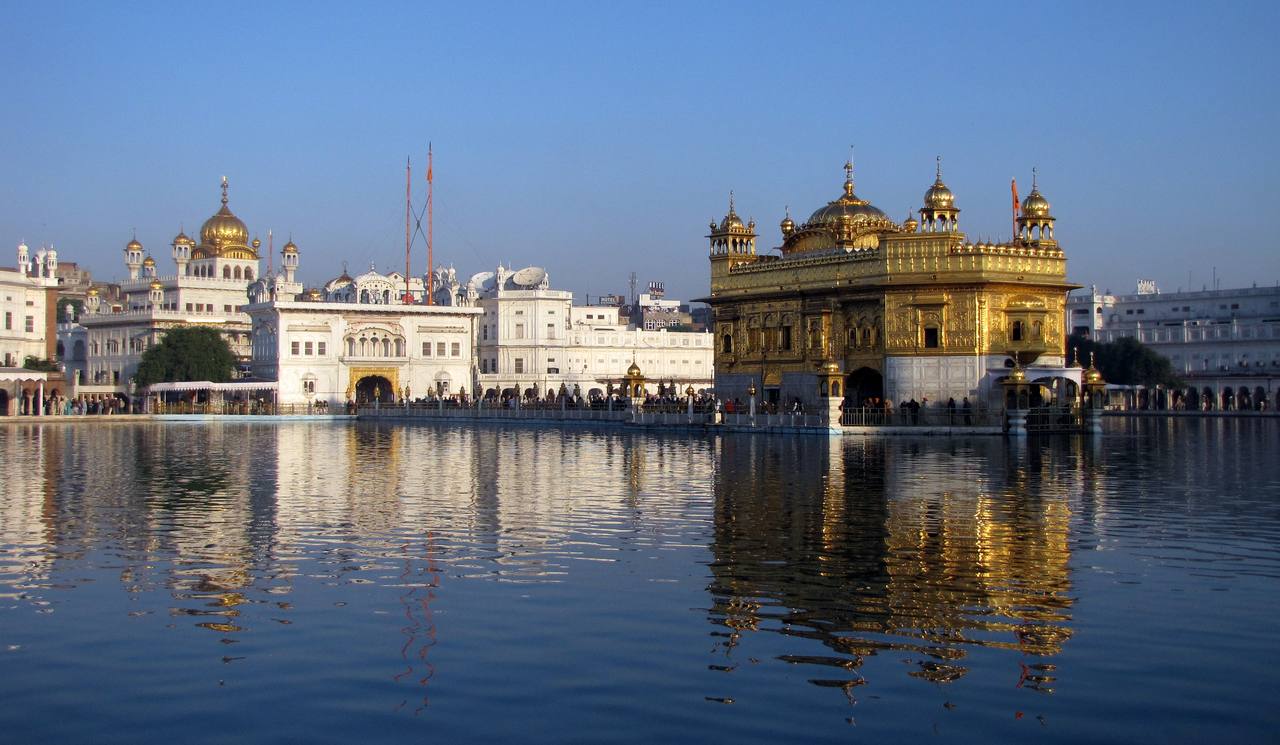
Operation Blue Star, 1–10 June 1984. The army's assault on the Golden Temple complex was launched in the first week of June, with the main attack on 3–6 June — days when the complex was crowded with pilgrims gathered for the martyrdom day of Guru Arjan (3 June). Bhindranwale and his leading fighters were killed, the Akal Takht was shattered by tank fire, and the Sikh Reference Library was burned out (its contents, Sikh organisations maintain, were removed and never returned — an allegation the army has denied). The casualty figures remain irreconcilable because no independent count was ever made. The government's White Paper recorded 83 soldiers killed and 249 wounded, and 493 “civilians/terrorists” killed, a category that included, on the White Paper's own reading, some 309 Sikh pilgrims. Eyewitness-based and community estimates are far higher: journalists present, including Mark Tully, estimated civilian deaths in the thousands, and Sikh organisations cite figures of 4,000 to 5,000 or more killed in the complex. The honest statement is the one this article will keep making: the official figure is 493; independent and community estimates run to several thousand; the true number is not knowable from the surviving record. A parallel operation, Woodrose, swept through Punjab's villages in the same weeks, detaining thousands of young Sikh men — an experience seared into a generation's memory.
31 October – 4 November 1984. On 31 October 1984, Prime Minister Indira Gandhi was assassinated by two of her Sikh bodyguards, Beant Singh and Satwant Singh. Over the following four days, organised mobs attacked Sikhs across Delhi and in cities including Kanpur, Bokaro and Indore — burning men alive, destroying homes, businesses and gurdwaras, in violence that survivors and multiple official commissions describe as having been facilitated by the failure, and in places the participation, of police and local political workers. The official toll, given by the Union Home Ministry on the basis of the Ahooja Committee, is 3,325 killed across India, of whom 2,733 were in Delhi — figures the Delhi High Court itself used in its 2018 judgment (“2,733 Sikhs were brutally murdered”). Sikh organisations have long maintained that the Delhi figure alone exceeded 3,000 and that the nationwide toll was substantially higher than the official count. The accountability record is thin and late: the Nanavati Commission recorded 587 FIRs in Delhi, of which about 240 were closed as “untraced”; an Indian Express count found that only 28 riot cases ended in conviction. The most senior figure convicted, former Congress MP Sajjan Kumar, was sentenced to life imprisonment by the Delhi High Court in December 2018 for the killing of five men in the Palam Colony/Raj Nagar area, and received a second life sentence in February 2025 in the Saraswati Vihar case; he was acquitted in a third case in January 2026, and was reported to have died in custody in August 2026. Charges against another former Congress MP, Jagdish Tytler, were framed in September 2024; he has pleaded not guilty and his trial is ongoing. Prime Minister Manmohan Singh apologised for the violence in Parliament on 11 August 2005. For the Khalistan case, November 1984 is the emotional centre: supporters argue that a state that could not — or would not — protect Sikhs in its own capital forfeited their trust permanently. The Indian state's answer is that the violence was a criminal breakdown, prosecuted albeit inadequately, and cannot define the Union.
6. The insurgency decade and the human-rights record
Between the mid-1980s and the mid-1990s, Punjab lived through an armed insurgency and a counter-insurgency, both of which killed Punjabis in large numbers. Militant groups — the Khalistan Commando Force, Babbar Khalsa, the Khalistan Liberation Force and others — assassinated officials, journalists, political workers and ordinary civilians, Hindu and Sikh; they massacred bus and train passengers (32 Hindu passengers near Lalru in 1987; some 80 train passengers near Ludhiana in 1991), extorted money, and enforced dress and behaviour codes at gunpoint. The single deadliest attack of the era was carried out beyond Punjab: the bombing of Air India Flight 182 on 23 June 1985, which killed 329 people, most of them Canadian citizens. Canadian proceedings attributed the bombing to Babbar Khalsa-linked militants; the only person convicted, Inderjit Singh Reyat, pleaded guilty to manslaughter in 2003 for assembling the bombs.
The death toll of the Punjab conflict, on the data compiled by the Institute for Conflict Management (the South Asia Terrorism Portal, founded by the state's former police chief K.P.S. Gill), is 21,532 killed between 1981 and 1995: 11,696 civilians, 8,090 militants and 1,746 security personnel. Two features of that official-adjacent data deserve emphasis because they cut against easy narratives on both sides. First, SATP attributes the killing of 11,694 civilians to militant groups — and 7,139 of those civilians were Sikhs; Gill himself put the Sikh share of the victims of terrorist violence at roughly 61 per cent. The insurgency's largest victim group was the community in whose name it was fought. Second, the figure of ~21,500 is itself contested from the other direction: Sikh human-rights organisations maintain that state forces killed or disappeared many thousands more than the recorded militant toll, and cite claims running into the tens of thousands; those larger figures have not been substantiated by documented, case-by-case records, and the documented official count stands at roughly 21,500 — but one part of the state's own record is not contestable, because India's own institutions established it.
The cremations. In January 1995, human-rights activist Jaswant Singh Khalra of Amritsar published municipal records showing that Punjab Police had been cremating large numbers of bodies as “unclaimed” and “unidentified” through the militancy years. Khalra spoke, in his own estimate, of more than 6,000 such cremations in Amritsar district. On 6 September 1995, Khalra was abducted outside his home by Punjab Police personnel; he was never seen again. The CBI, acting on Supreme Court orders, found he had been held and killed in police custody; six police officials were convicted of his abduction and murder in November 2005, all six ultimately sentenced to life imprisonment, upheld by the Supreme Court in 2011. The police chief of the era, K.P.S. Gill — named by witnesses as a conspirator, a charge he denied — was never prosecuted, and died in 2017.
The CBI's final report on the cremations, placed before the Supreme Court in December 1996, confirmed 2,097 illegal cremations at three crematoria in Amritsar district — 585 bodies fully identified, 274 partially identified and 1,238 unidentified. The Supreme Court called it a “flagrant violation of human rights on a mass scale” and handed the matter to the National Human Rights Commission with special powers. The NHRC process ran for fifteen years and closed in April 2012: monetary compensation was ordered in just over 1,500 cases — and no one was criminally convicted for the cremations themselves. The police position, stated by Gill throughout his life, was that the counter-insurgency saved Punjab from civil war and that his men fought a ruthless enemy under impossible conditions; the human-rights position, stated by groups such as Human Rights Watch and Ensaaf in their 2007 report Protecting the Killers, is that the state answered terror with systematic, unpunished crimes of its own, and that the absence of accountability — thousands of families paid compensation, no officer convicted for 2,097 illegal cremations — is the single strongest fuel the Khalistan argument still burns. Punjab returned to electoral normality (the 1992 assembly election, boycotted by mainstream Akali factions, drew only about 24 per cent turnout, according to the NCERT's standard textbook account; the 1997 election restored competitive politics), and the insurgency was over by the mid-1990s. The argument was not.
7. The unresolved file today
Ask a room of Punjabis why anger at Delhi persists, and the answers in 2026 are mostly not about 1984. They are about a file of specific, current, unresolved items:
River waters and the SYL canal. The Sutlej–Yamuna Link canal — 214 km meant to carry Punjab's allocated water to Haryana — was begun in 1982; Haryana built its roughly 92 km share; Punjab's roughly 122 km was never completed. The Rajiv–Longowal Accord of 24 July 1985 promised Chandigarh's transfer to Punjab by January 1986 and a tribunal on waters; the Eradi Tribunal's 1987 award increased Haryana's share and cut Punjab's below its then-current use; the transfer was suspended in July 1986 and never happened. In 2004 the Punjab assembly passed a law terminating the state's water agreements; in 2016 the Supreme Court held that Act unconstitutional. Punjab's present position, restated by Chief Minister Bhagwant Mann, is that the state has “not a single drop” to spare, citing collapsed groundwater. As of 2026 the dispute remains exactly where it was: in January 2026 the Supreme Court adjourned execution proceedings to allow settlement talks, chief ministers met through the year, and on 12 August 2026 the Attorney General told the Court the two states were “inching closer” to a settlement. No settlement has been reached.
Chandigarh. Sixty years after the “temporary” arrangement of 1966, Chandigarh is still a Union Territory and a shared capital. Every central administrative move touching the city — service rules, appointments, the shared High Court — is read in Punjab's politics as either a step toward or away from the promised transfer, and Punjab's demand for the city anchors the Qaumi Insaaf Morcha protest that has sat at the Chandigarh–Mohali border continuously since January 2023.
Bandi Singhs. The “Bandi Singh” (prisoner) issue concerns Sikh prisoners convicted for militancy-era offences who, their supporters say, have completed their sentences or served decades beyond what co-accused received, and remain jailed because release requires inter-state and central clearances. In September 2019, for Guru Nanak's 550th birth anniversary, the Centre announced special remission for eight named Sikh prisoners and processed the commutation of Balwant Singh Rajoana — the back-up bomber in the 1995 assassination of Chief Minister Beant Singh — from death to life imprisonment. Implementation then stalled on jurisdiction and process; Rajoana remains in prison, Jagtar Singh Hawara (whose death sentence for the same assassination was reduced to life in 2010) remains in prison, and the Qaumi Insaaf Morcha's demand list begins with their release. To supporters, the Bandi Singh file proves that even court-completed sentences do not free Sikh prisoners; to the governments involved, each release is a law-and-order and legal-process decision, not a collective one.
Drugs. Punjab's drug crisis is the grievance that needs no history. The Punjab Opioid Dependence Survey conducted by AIIMS's National Drug Dependence Treatment Centre (2015) estimated about 2.32 lakh opioid-dependent people in the state and roughly 8.6 lakh opioid users, with over three-quarters of the dependent aged 18–35. Heroin — chitta — arrives across the Pakistan border, in recent years increasingly by drone drops, as regular BSF seizure reports attest. Every Punjab election since 2017 has been fought partly on drugs; AAP's government has run successive anti-drug drives, including its 2025 “Yudh Nashean Virudh” campaign. The political charge, made by opposition and supporter voices alike, is that the supply chain runs on official protection — an allegation governments deny while making arrests by the thousand. Either way, a generation's addiction is the daily evidence many Punjabis cite for systemic failure.
The farm laws, 2020–21. In September 2020 Parliament passed three farm-marketing laws. Punjab's farmers — who saw in them the beginning of the end of the MSP procurement system on which the state's economy rests — formed the core of a year-long protest that camped on Delhi's borders. The Samyukt Kisan Morcha (SKM) says about 700 protesters died during the agitation; the Union agriculture minister told Parliament the government had “no record” of deaths, and therefore no compensation question arose. On 19 November 2021 Prime Minister Modi announced repeal; Parliament repealed the laws within the month. The protest's other central demand — a legal guarantee of MSP — remains unmet, and farm unions returned to the Shambhu border in 2024. The farm movement was not a Khalistan movement — the SKM repeatedly rejected the “Khalistani” label that some ruling-party politicians and television channels applied to it, pointing to its all-India, multi-religious composition — but its effect on the Punjab–Delhi relationship was profound: it convinced a large middle ground of Punjabis that Delhi legislates for Punjab without listening to it, which is precisely the emotional ground on which the older grievances grow.
Work, and leaving. Layered over all of this is economics: stagnant farm incomes, indebted households, scarce government jobs, and an exodus of the young — Punjab sends a disproportionate share of India's students and migrants abroad, to Canada above all, a flow documented in official data and reporting for years. For the Khalistan argument, migration is both a symptom (no future at home) and a mechanism (the diaspora it creates becomes the movement's loudest base). For its critics, the same migration is ordinary economics, visible from Kerala to Gujarat.
8. The current situation, 2020–2026
In Punjab's electoral politics, the demand's footprint is real but narrow. The clearest data points come from the Election Commission. In the June 2022 Sangrur Lok Sabha by-election, Simranjit Singh Mann — running on an openly pro-Khalistan platform — won with 253,154 votes, defeating the AAP candidate by 5,822 votes, on a turnout of just 45.30 per cent (against 72.44 per cent in 2019). In the 2024 general election, two independents associated with the separatist current won: Amritpal Singh took Khadoor Sahib with 404,430 votes and a margin of 197,120 over the Congress candidate, campaigning from a jail cell in Assam; and Sarabjeet Singh Khalsa — son of Beant Singh, one of Indira Gandhi's assassins — won Faridkot with 298,062 votes and a margin of 70,053. Punjab's other eleven seats went to the Congress (7), AAP (3) and the SAD (1); the BJP won none. Both winning campaigns were locally rooted — Majha-belt organisation, anti-drug messaging, sympathy over detention — and both men ran as independents, not as a party slate; how much of their vote was for Khalistan as such, no honest analyst can separate from the record. Punjab's government since 2022 is AAP's, under Chief Minister Bhagwant Mann, which opposes separatism and has itself run the state's coercive apparatus against Amritpal's organisation.
Amritpal Singh's story is the decade's sharpest case study. A Dubai-returned activist who took over Waris Punjab De after its founder Deep Sidhu's death, Amritpal rose through 2022 preaching against drugs and for Sikh discipline in Bhindranwale's idiom. On 23 February 2023 his supporters stormed the Ajnala police station to free an arrested associate. After a month-long manhunt, he was arrested on 23 April 2023 and detained under the National Security Act in Dibrugarh jail, Assam. He won his parliamentary seat from detention in 2024; in January 2025 his family and supporters launched a political party, Akali Dal (Waris Punjab De). His detention litigation then ran its course: in November 2025 the Supreme Court declined to intervene directly and asked the Punjab and Haryana High Court to decide his challenge expeditiously; the High Court upheld the detention. In April 2026, after three years, his NSA detention ended; by the High Court's order of 17 April 2026 he remains in Dibrugarh jail in criminal custody in the Ajnala case, attending hearings by video link, the court citing the risk to public order if he were produced in Punjab. He is, as of this writing, a sitting Member of Parliament who has never attended Parliament — a fact each side reads its own way.
In the diaspora, the movement is louder than it has been in decades — and its numbers cannot be checked. Since 31 October 2021, SFJ has run at least 28 voting days in its self-organised “Khalistan Referendum” across eight countries, most recently in Edmonton on 18 October 2026, where SFJ claimed more than 23,000 votes — reported by host media only as “according to organizers.” Awaaz Punjab's own Investigation Report #3 examined the full record and found: no Yes/No result has ever been published for any city; no election authority anywhere has counted or recognised any vote; SFJ's cumulative claims contradict its own per-event figures (a claimed “over one million” by July 2023 against per-event claims summing to roughly 472,000); and SFJ's own rules — Sikhs only outside Punjab, no residency requirement, registration run by SFJ itself — mean the exercise cannot measure opinion even in the diaspora, let alone in Punjab. Canada's stated position, given by Consul General Patrick Hébert in September 2022 — “Canada does not recognize the recent unofficial Sikhs for Justice referendum” — remains the position of every host government: the events are tolerated as political expression and recognised as nothing more. In August 2026 Pannun said tallying “may take another 2–3 years,” and on 18 October 2026 he announced a drive from 1 November 2026 to register two million referendum voters inside Punjab — an announced target, not a count, in a country where SFJ is banned.
The diplomatic fallout is the other current fact. Hardeep Singh Nijjar, a Canadian Sikh activist designated a terrorist by India, was shot dead in Surrey, British Columbia, on 18 June 2023. In September 2023 Prime Minister Justin Trudeau told Canada's Parliament there were “credible allegations” of a potential link between Indian government agents and the killing; India rejected the allegation as absurd and has since maintained it has been shown no evidence — High Commissioner Dinesh Patnaik repeated the demand publicly in October 2026 (“Where is the evidence?”). Four Indian nationals are charged in Canada in connection with the killing; their trial in Surrey is ongoing, and nothing in it has yet determined any question of state involvement. Relations collapsed in October 2024 with mutual expulsions of diplomats, then were rebuilt under Prime Minister Mark Carney from 2025 — high commissioners restored in August 2025, security dialogue resumed, trade talks relaunched — even as Canada's intelligence service CSIS continued to list India among foreign-interference concerns in its 2025 report, a designation India rejects. In the parallel American case, the allegations are further advanced in court: Nikhil Gupta, an Indian national, pleaded guilty in February 2026 in New York to murder-for-hire and related conspiracy charges in the alleged plot against Pannun; US prosecutors allege he was recruited by Vikash Yadav, then an Indian government employee, who has been charged but is not in US custody. Gupta's sentencing is scheduled for 20 November 2026. India denies any official role in either matter, says a high-level enquiry committee examined the US allegations, and has described Yadav in reporting on the case as a “rogue operative.” As of October 2026: one guilty plea by an individual, one accused official at large, two governments' positions unreconciled — and the underlying trials still to run. These are allegations and one individual's plea, not findings against the Indian state, and this article reports them as such.
9. How much support? What the evidence can and cannot say
Here is the plainest fact in this entire explainer: there has never been a scientific, representative survey of Punjab's residents on Khalistan. No credible polling organisation has put the question to a proper sample inside Punjab. Anyone who tells you “most Punjabis want Khalistan” or “almost no Punjabi wants Khalistan” is asserting something that has never been measured.
What exists instead is fragmentary evidence, and it should be reported as exactly that:
Elections. Openly pro-Khalistan candidates have won individual parliamentary seats — Mann in 2022; the sympathy-and-organisation victories of Amritpal Singh and Sarabjeet Singh Khalsa in 2024 — while explicitly pro-Khalistan parties have remained electorally marginal in Punjab's assembly politics, and the state's governments have been formed successively by the Congress, the SAD–BJP alliance and AAP, all running against secession. The 2024 results show a real constituency, concentrated in the Majha belt, willing to vote for men associated with the demand; they simultaneously show that constituency electing two of thirteen MPs, on campaigns in which Khalistan was one strand among several.
Diaspora visibility. Referendum crowds, gurdwara politics and social media give the demand a presence in Canada, Britain, the US and Australia far larger than its measurable electoral footprint in Punjab — but, as Section 8 sets out, the diaspora numbers are organiser claims with no verified count behind them, and diaspora Sikhs are a self-selected, migration-filtered population whose views cannot be projected onto Punjab's 30 million residents.
The claims of each side. SFJ claims a silent majority for Khalistan and says only fear of the Indian state suppresses its expression. The Indian government and Punjab's mainstream parties claim the demand has negligible support in Punjab and survives on diaspora funding and Pakistani patronage. Neither claim is currently testable — which is itself the finding. The one instrument that could settle the question, a free vote or a credible survey inside Punjab, has never been held: Punjab's residents have expressed themselves only through ordinary elections, and in those, for forty years, they have mostly chosen parties that oppose the demand — while periodically electing, in particular places and moments, men who embody its grievances.
10. India's legal position
Indian law on secession is not ambiguous, and any honest explainer has to say so plainly.
The Constitution. India is, under Article 1, a “Union of States.” Dr B.R. Ambedkar explained the choice of words to the Constituent Assembly: the Union is indestructible; the states are not — Parliament may redraw, divide or rename them under Article 3 without their consent being binding. No provision of the Constitution contemplates any part of India seceding, and none provides for a referendum on the question. The Sixteenth Amendment (1963) — passed in the context of secessionist politics of that era — wrote “sovereignty and integrity of India” into the permissible grounds for restricting speech, association and assembly, and into the oaths of office. That oath matters in practice: every MP and MLA, including every pro-Khalistan candidate who has ever taken a seat, must swear to “bear true faith and allegiance to the Constitution of India” and to “uphold the sovereignty and integrity of India.”
The criminal law. Two statutes do most of the work. Under the Unlawful Activities (Prevention) Act (UAPA), the central government may declare an association unlawful and an individual a terrorist. SFJ was declared an unlawful association in July 2019; the ban was extended for five more years by a notification dated 8 July 2024, effective 10 July 2024; and the UAPA Tribunal — Justice Anoop Kumar Mendiratta of the Delhi High Court — confirmed the extension on 3 January 2025, on the government's evidence, which cited FIRs against SFJ rising from 11 in 2019 to 122 by 2024 and alleged links to Babbar Khalsa International, the Khalistan Tiger Force and Pakistan's ISI. SFJ denies wrongdoing; the tribunal's findings are findings on the government's evidence under a statute whose process civil-liberties lawyers have criticised for decades, and they are reported here as exactly that. Separately, Section 152 of the Bharatiya Nyaya Sanhita, 2023 (in force 1 July 2024), which replaced the colonial sedition law (IPC s.124A), makes it an offence — punishable with life imprisonment, or up to seven years and a fine — for whoever “purposely or knowingly,” by words, signs, visible representation, electronic communication or financial means, “excites or attempts to excite secession or armed rebellion or subversive activities” or “encourages feelings of separatist activities” endangering India's sovereignty, unity and integrity.
Where does peaceful advocacy stand? The honest answer is: narrower in the statute book than in the case law, and unsettled under the new code. Under the old sedition law, the Supreme Court in Kedar Nath Singh (1962) read the offence down to speech that incites violence or public disorder, and in Balwant Singh (1995) it acquitted men who had raised “Khalistan Zindabad” slogans hours after Indira Gandhi's assassination, holding that mere slogan-raising, without incitement or public response, was no offence. Section 152 is drafted more broadly than the law it replaced, it expressly names “secession,” and as of October 2026 it has not been tested in a reported Supreme Court ruling — lawyers disagree about how much of the Kedar Nath/Balwant Singh protection survives it. What is certain is the practical line: organising for a banned association is prosecuted under UAPA regardless of method; speech alone has historically been protected only where courts found no incitement; and no Indian court has ever recognised a legal right to campaign for secession as such. This is a factual description of the law, not a commentary on it.
11. International law
Supporters of Khalistan typically rest their international-law case on self-determination: the UN Charter's reference to “equal rights and self-determination of peoples,” and common Article 1 of the ICCPR and ICESCR, which provides that “all peoples have the right of self-determination” and may “freely determine, without external interference, their political status.” India is a party to both covenants. The counterweight sits in the same body of law: the 1970 UN Friendly Relations Declaration, which both authorises self-determination and provides that it shall not be construed as authorising the dismemberment of states “conducting themselves in compliance with the principle of equal rights and self-determination of peoples... and thus possessed of a government representing the whole people belonging to the territory without distinction as to race, creed or colour.” Each side quotes its half of that paragraph. In practice, the UN system has applied external self-determination — independence — to colonial territories and peoples under foreign occupation or alien subjugation, and no UN organ has ever applied it to Punjab.
The two court authorities most often invoked deserve precise statement, because both are routinely overstated:
The Quebec Reference (Supreme Court of Canada, 1998). Asked whether Quebec could secede unilaterally, the Court held: no — under neither the Canadian Constitution nor international law. The people of Quebec, it found, are not a colonised or oppressed people denied meaningful access to government, so international law gave no unilateral right. But a clear majority voting on a clear question in favour of secession would create a reciprocal constitutional duty on the rest of Canada to negotiate in good faith — though secession itself would still require constitutional amendment, and negotiation would not guarantee agreement. It is the strongest judicial statement anywhere that a democratic vote can create a duty to talk. It is also, on its own terms, a decision about Canada's constitution, conferring no rights in India's.
The Kosovo Advisory Opinion (ICJ, 2010). The International Court of Justice held, 10–4, that Kosovo's 2008 declaration of independence “did not violate international law” — because general international law contains no prohibition on declarations of independence as such. The Court expressly declined to decide whether any people has a positive right to secede, whether “remedial secession” exists, or whether Kosovo had achieved statehood. The opinion says declarations are not per se illegal; it does not say secession is a right.
Remedial secession — the theory that a people subjected to grave, persistent oppression and denied all internal remedies acquires a right to secede as a last resort — is precisely that: a theory, advanced by a strand of academic writing and a few state statements, never adopted by the ICJ, and contested by other scholars who note the Quebec court mentioned it only as an arguendo possibility even in extremis. This article labels it as contested theory because that is what it is.
12. The lawful routes that exist — and the gap
Strip away rhetoric and the lawful landscape, as of October 2026, is this:
Routes that exist and are in actual use:
Electoral politics. Advocacy parties and candidates may register, campaign and sit in legislatures — Mann and others do — subject to the constitutional oath, election law, and the UAPA line at banned organisations. The Anandpur Sahib tradition itself travels this route: greater federal autonomy, state control of waters, transfer of Chandigarh are all demands that can be legislated within the Constitution, and commissions (Sarkaria, Punchhi) exist to examine them.
Courts. Rights violations — illegal detention, custodial death, compensation for the cremations — are litigable, and Punjab's own record shows courts sometimes deliver (the Khalra convictions; the NHRC compensation process; Amritpal's release from NSA detention through court orders in 2026).
Human-rights mechanisms. Complaints can go to the NHRC and the Punjab State Human Rights Commission, which can investigate and recommend compensation but cannot convict. Internationally, documentation can be put to UN special rapporteurs and the Universal Periodic Review; note one hard limit — India has not accepted the individual-complaints procedure of the UN Human Rights Committee, so no individual “case” against India can be filed there.
Diaspora expression. In Canada, Britain, the US and Australia, referendum-style events, marches and advocacy are lawful political expression protected by those countries' free-speech law — and, as every host government has stated, legally non-binding and unrecognised.
The gap, stated plainly: Indian law today contains no mechanism whatsoever for a secession referendum — no provision to call one, no authority competent to hold one, and no legal effect one could have if held. Creating such a mechanism would require Parliament to amend the Constitution — and whether even Parliament could do so is itself an open legal question scholars debate, since the Supreme Court's basic-structure doctrine (Kesavananda Bharati, 1973) holds that Parliament may not amend the Constitution's essential features, and the Court has never ruled on whether the Union's indestructibility is one of them. That is a political hypothetical, not a procedure. It follows — as a matter of law, not opinion — that “who to approach” has three honest answers, for three different things: elected representatives and Parliament, for any change to the constitutional order or for the within-Constitution demands (autonomy, waters, Chandigarh, prisoner releases); the courts, for violations of rights as the law stands; and human-rights bodies, Indian and international, for documentation and pressure. No other lawful addressee exists. Anyone who tells Punjabis there is a form to file, a petition that triggers a vote, or an international body that can order one, is telling them something that is not true.
13. The other side: the Indian government's and critics' case
Fairness requires the strongest version of the opposing argument, in its own terms. It runs as follows.
India's government holds that Punjab is an integral part of the Union whose people have been full participants in the Indian state — Sikhs have served as Prime Minister (Manmohan Singh, 2004–2014), President, service chiefs and chief justices, and Punjab's farmers feed the national food pool while its soldiers guard the borders; a claim of alien subjugation, the government argues, does not survive contact with that record. The critics' case then turns to the insurgency itself: the movement for Khalistan, they argue, was tried in practice between 1984 and 1995, and its principal victims were Punjabis — on the official-adjacent count, more than 7,000 of the civilians killed by militants were Sikhs — alongside massacred bus passengers, assassinated moderates such as Akali leader Harchand Singh Longowal (killed in August 1985, weeks after signing his accord), and the 329 dead of Air India 182. Punjab's voters, they point out, returned to electoral politics the moment peace allowed and have never given a separatist party a governing mandate. On the diaspora campaign, Indian officials allege — and attribute the allegation, as this article does — that Pakistan's ISI sponsors and shelters Khalistani networks as an instrument against India; the UAPA Tribunal's 2025 findings record the government's evidence to that effect, and India regularly presents dossiers on this to Western governments, whose own police have at times acted on Khalistan-linked violent plots on their soil. The economic argument completes the case: landlocked Punjab's trade, water treaties and prosperity are woven into India's, and a separate state would inherit the river disputes as international ones, minus the bargaining weight. The government's conclusion — that the grievances are real but are grievances of citizens within a democracy, answerable by politics, courts and federal negotiation, and that secession answers none of them — is the position every Indian government, of every party, has held since 1947. Readers now have both cases, which is all an explainer owes them.
Timeline: 1946 → 2026
Jul 1946 — Nehru's Calcutta “glow of freedom” statement on Sikh special consideration, as reported in The Statesman.
Aug 1947 — Partition of Punjab; eastern Punjab joins India amid mass violence and displacement.
1956 — Regional Formula adopted; States Reorganisation leaves Punjab bilingual, its linguistic claim refused.
1 Nov 1966 — Punjab Reorganisation Act: Punjabi-speaking Punjab created; Haryana and Himachal carved out; Chandigarh made a Union Territory and joint capital.
Oct 1973 — Anandpur Sahib Resolution adopted by the Akali Dal.
13 Apr 1978 — Amritsar Nirankari clash: 13 Sikhs and 3 Nirankaris killed.
1982 — SYL canal construction begins; Akali Dal launches the Dharam Yudh Morcha.
1–10 Jun 1984 — Operation Blue Star; Bhindranwale killed. Official toll: 83 soldiers, 493 “civilians/terrorists”; community estimates far higher.
31 Oct 1984 — Indira Gandhi assassinated by her Sikh bodyguards.
1–4 Nov 1984 — Anti-Sikh pogroms; official toll 3,325 India-wide, 2,733 in Delhi; Sikh organisations claim higher.
23 Jun 1985 — Air India Flight 182 bombed; 329 killed.
24 Jul 1985 — Rajiv–Longowal Accord: Chandigarh transfer promised by Jan 1986; water tribunal promised. Longowal assassinated the following month; the transfer never occurs.
29 Apr 1986 — Panthic Committee issues a “Declaration of Khalistan” at the Akal Takht.
1987 — Eradi Tribunal award on Ravi–Beas waters; Sarkaria Commission rejects the Anandpur Sahib approach to centre–state relations.
Jan 1995 — Jaswant Singh Khalra publishes evidence of mass “unclaimed” cremations; 6 Sep 1995 he is abducted by police and killed (six officers convicted 2005).
Dec 1996 — CBI confirms 2,097 illegal cremations in Amritsar district; Supreme Court hands the matter to the NHRC (compensation ordered in 1,500+ cases; process closes 2012, no convictions for the cremations).
11 Aug 2005 — PM Manmohan Singh apologises in Parliament for the 1984 violence.
Dec 2018 — Delhi High Court sentences Sajjan Kumar to life for 1984 killings (second life sentence Feb 2025).
Jul 2019 — India bans SFJ under UAPA (extended 2024; tribunal-confirmed Jan 2025).
Sep 2019 — Centre announces special remission for eight Sikh prisoners; Rajoana's death sentence commutation processed.
Sep 2020 – Nov 2021 — Farm laws passed, year-long protest at Delhi's borders (SKM: ~700 deaths; Centre: no record), laws repealed; MSP-guarantee demand remains open.
Jun 2022 — Simranjit Singh Mann wins the Sangrur Lok Sabha by-election on a pro-Khalistan platform (ECI figures).
18 Jun 2023 — Hardeep Singh Nijjar killed in Surrey, Canada; Sep 2023 Canada alleges a potential Indian-agent link; India denies; Oct 2024 mutual diplomat expulsions; relations rebuilt from 2025.
Apr 2023 – Apr 2026 — Amritpal Singh detained under NSA in Dibrugarh; wins Khadoor Sahib from jail in 2024 (404,430 votes, ECI); NSA detention ends Apr 2026; remains in custody in the Ajnala case by court order.
31 Oct 2021 – 18 Oct 2026 — SFJ runs at least 28 diaspora “referendum” voting days; no result ever published; no turnout independently verified; Edmonton, 18 Oct 2026: 23,000+ claimed “according to organizers.”
13 Feb 2026 — Nikhil Gupta pleads guilty in New York in the alleged plot against Pannun; sentencing set for 20 Nov 2026; India denies any state role.
12 Aug 2026 — Attorney General tells the Supreme Court Punjab and Haryana are “inching closer” on SYL; no settlement as of Oct 2026.
Sources
Every major fact above rests on at least two independent sources where the record allows; the principal ones used are:
Election Commission of India results, as reported: Sangrur by-election 2022; Lok Sabha 2024 (Khadoor Sahib, Faridkot, Punjab statewide).
Government of India, White Paper on the Punjab Agitation (1984) — Operation Blue Star official casualty figures.
Union Home Ministry figures (Ahooja Committee) as cited in the Delhi High Court's 2018 Sajjan Kumar judgment: 3,325 killed India-wide, 2,733 in Delhi — https://www.livelaw.in/1984-anti-sikh-riots-delhi-hc-awards-life-term-to-congress-leader-sajjan-kumar
Nanavati Commission record and conviction counts, via Indian Express tallies summarised at https://aitimeline.in/anti-sikh-riots-timeline-17331/ ; second Sajjan Kumar life sentence, Feb 2025: http://lawchakra.in/other-courts/anti-sikh-riots-congress-sajjan-kumar-2/
South Asia Terrorism Portal (Institute for Conflict Management), Punjab backgrounder and data sheets — 1981–95 toll (21,532) and 1978 clash: https://www.satp.org/backgrounder/india-punjab ; insurgency narrative: https://satp.org/faultline-chapter-details/volume-1/endgame-in-punjab-1988-93
CBI/NHRC mass-cremations record (Supreme Court proceedings, Dec 1996); Human Rights Watch/Ensaaf, Protecting the Killers (2007).
Jaswant Singh Khalra case record — abduction 6 Sep 1995, CBI findings, 2005 convictions and 2011 Supreme Court outcome: https://en.wikipedia.org/wiki/Jaswant_Singh_Khalra ; Ensaaf's summary of the 2005 judgment: https://docslib.org/download/9545949/summary-of-order-convicting-six-punjab-policemen-in
Congress assurances 1929–46: B. Shiva Rao, The Framing of the Indian Constitution; Young India, 19 Mar 1931; The Statesman, 7 Jul 1946 — as reproduced at https://sikhheritageeducation.com/aspirations-for-equality/ and in Inderjeet Singh Chawla, “The Fractured Compact” (2025): https://www.academia.edu/144842409/The_Fractured_Compact_Nehru_the_Sikhs_and_the_Betrayal_of_Post_Partition_Promises_Written_by_Inderjeet_Singh_Chawla
Punjab Reorganisation Act 1966; Rajiv–Longowal Accord 1985 and its implementation record: https://www.liquisearch.com/khalistan_movement/rajiv-longowal_accord (accord text summaries) and NCERT, Politics in India Since Independence (incl. 1992 turnout).
Anandpur Sahib Resolution (text as adopted 1973, endorsed 1978); Sarkaria Commission report (1987).
1978 clash: https://en.wikipedia.org/wiki/1978_Sikh%E2%80%93Nirankari_clash and SATP backgrounder (above).
1986 Sarbat Khalsa and the 29 Apr 1986 declaration: https://en.wikipedia.org/wiki/1986_Sarbat_Khalsa ; declaration text: https://1984tribute.com/declaration-of-independence-of-khalistan/
Punjab Opioid Dependence Survey (AIIMS NDDTC, 2015) — ~2.32 lakh opioid-dependent: http://web.stanford.edu/~rm89/Punjab_AIIMS_Report.pdf ; summarised at https://opioidcrisiscollective.ca/publications/opioid-crisis-in-punjab
Farm laws and repeal: Samyukt Kisan Morcha statements, 19 Nov 2021 — https://www.thehindubusinessline.com/news/national/samyukt-kisan-morcha-welcomes-repealing-of-farm-laws/article37573879.ece ; Union agriculture minister's “no record” reply to Parliament: https://madhyamamonline.com/india/no-data-on-farmers-who-died-so-no-compensation-says-centre-883391
MHA notifications on SFJ under UAPA (Jul 2019; extension notification 8 Jul 2024); UAPA Tribunal confirmation, 3 Jan 2025 (court reporting).
Bharatiya Nyaya Sanhita 2023, s.152 (text); Kedar Nath Singh v. State of Bihar (1962); Balwant Singh v. State of Punjab (1995).
Amritpal Singh detention litigation 2025–26: Supreme Court order (Nov 2025), ANI — https://news.webindia123.com/news/articles/india/20251110/4382080.html ; Punjab & Haryana High Court order of 17 Apr 2026 (India Today reporting): https://news89.com/amritpal-singh-to-remain-in-assam-jail-after-nsa-detention-ends-on-apr-22-court/ and https://northdesk.in/amritpal-singh-nsa-over-high-court-virtual-trial-dibrugarh/
Nijjar case and India–Canada relations to Oct 2026: IANS, 13 Oct 2026 — https://ianslive.in/where-is-the-evidence-indian-envoy-asks-canada-on-nijjar-case--20261013220903 ; security-cooperation reporting: https://www.fact.net.in/nation/india-canada-step-up-security-cooperation-on-terror-extremism-and-extradition
Nikhil Gupta guilty plea (13 Feb 2026) and sentencing date (20 Nov 2026): SDNY proceedings as reported (court/wire reporting, Feb–Oct 2026).
SFJ referendum record: Awaaz Punjab Jaanch Report #3 dossier (internal); Canada statement (Consul General Patrick Hébert, 30 Sep 2022).
Quebec Secession Reference, [1998] 2 SCR 217: https://www.constitutionalstudies.ca/2019/07/reference-re-quebec-secession-2/?print=print ; analysis: https://ideas.repec.org/a/oup/publus/v29yi2p135-151.html ; ICJ, Accordance with International Law of the Unilateral Declaration of Independence in Respect of Kosovo, Advisory Opinion, 22 Jul 2010; comparative discussion: https://www.springerprofessional.de/the-reference-re-secession-of-quebec-the-kosovo-advisory-opinion/16330574
SYL litigation and 2026 settlement talks: Supreme Court proceedings as reported (Jan–Aug 2026, incl. ANI reporting of 12 Aug 2026).