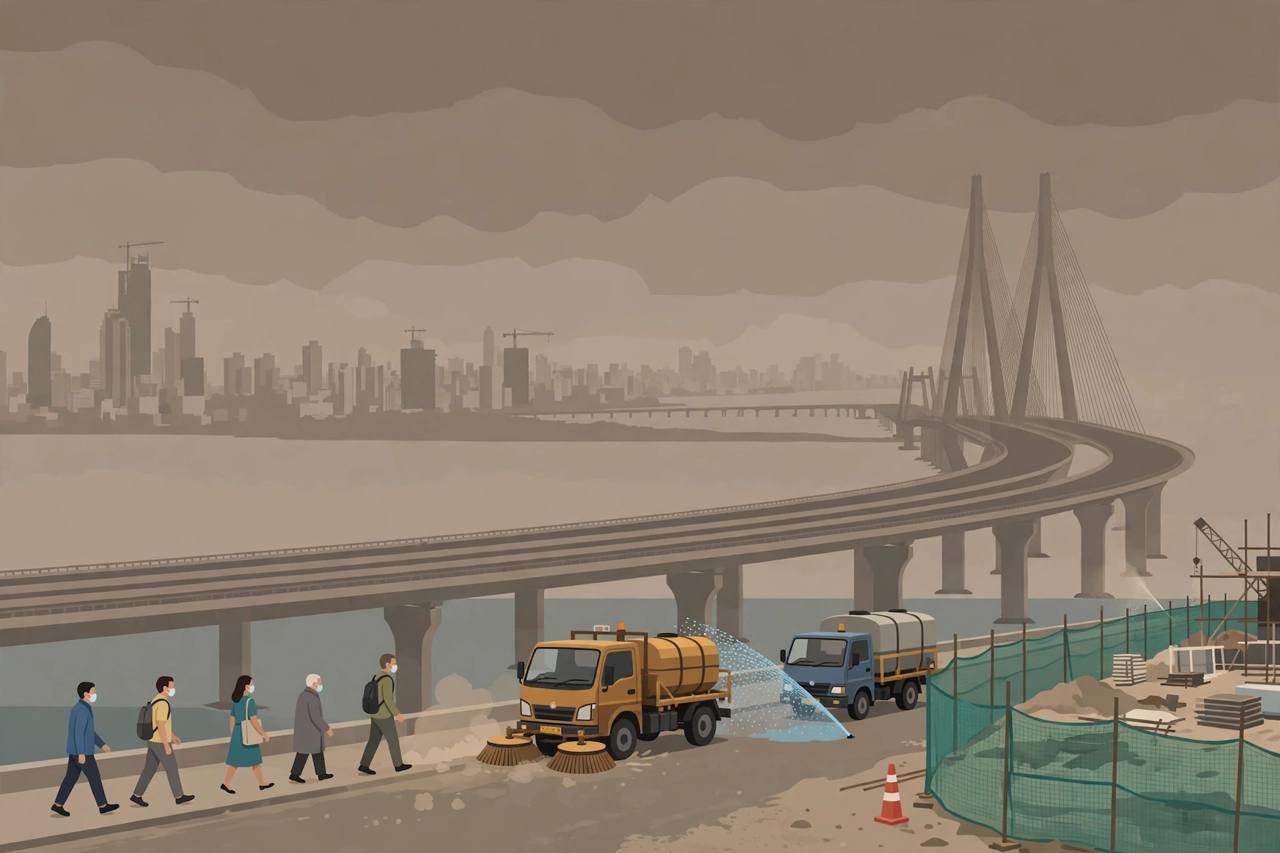
Mumbai, October 24 — Mumbai's air quality deteriorated sharply on Saturday, with the Air Quality Index (AQI) touching 322 in the 'very poor' category, triggering widespread health complaints among residents, IANS reported. The thick haze blanketing the city led to a rise in cases of headache, sore throat and eye irritation, with doctors advising vulnerable groups, including children and the elderly, to limit outdoor exposure.
Source: IANS via NewKerala
According to the air quality monitoring data cited in the report, Mumbai's pollution levels were driven by a combination of construction dust, sluggish wind speed, garbage burning, emissions from crop fires in surrounding regions, and residual smoke from firecrackers. Civic officials acknowledged the sudden spike and said multiple factors had converged to push the city's air into the hazardous zone. Environmental activists and citizens have called for stricter monitoring of construction sites, a complete ban on open garbage burning, and better coordination to control regional emissions.
Source: IANS via hi INDiA
The Brihanmumbai Municipal Corporation (BMC) said on Saturday that Mumbai has recorded 231 days of 'good' and 'satisfactory' air quality up to October 22, 2026 — up from 185 such days in 2023, 216 in 2024 and 218 in 2025 — and that a special action plan has been prepared to control air pollution during the coming winter. Additional Municipal Commissioner Avinash Dhakane said data on the Union Environment Ministry's PRANA portal shows particulate matter pollution in Mumbai declined by approximately 48 per cent between 2017-18 and 2025-26.
Source: DCN News Network
Under the winter plan, the BMC has issued 28-point guidelines to control dust from construction activities and deployed 76 ward-level inspection teams, each required to inspect at least two construction sites daily, with routine and surprise inspections. Violations can invite show-cause notices, stop-work orders and sealing of construction sites, with photographs, videos and inspection reports maintained as evidence. Sensor-based air-quality monitoring systems have been installed at 3,166 construction sites and connected to the BMC's central dashboard, and 29 multipurpose vehicles are being used for deep cleaning and regular road sweeping, Dhakane said.
Source: DCN News Network
Of Mumbai's 593 bakeries, 209 were already operating on cleaner fuels and another 175 have completed the transition, the BMC said, with conversion work under way at 69 more; bakeries account for approximately 3.5 per cent of the city's particulate matter emissions. The civic body has also launched awareness campaigns about air and noise pollution from firecrackers and clarified that bursting firecrackers is prohibited on public roads, footpaths and in designated silence zones.
Source: DCN News Network
Experts cited by IANS noted that Mumbai's sudden decline underscores the need for year-round pollution control strategies in coastal cities that traditionally enjoyed better air quality, and that public pressure continues for stronger and more consistent enforcement of environmental norms. A 'very poor' AQI reading means prolonged outdoor exposure can aggravate respiratory conditions, which is why doctors have advised children, the elderly and people with existing conditions to limit time outdoors until the index improves.