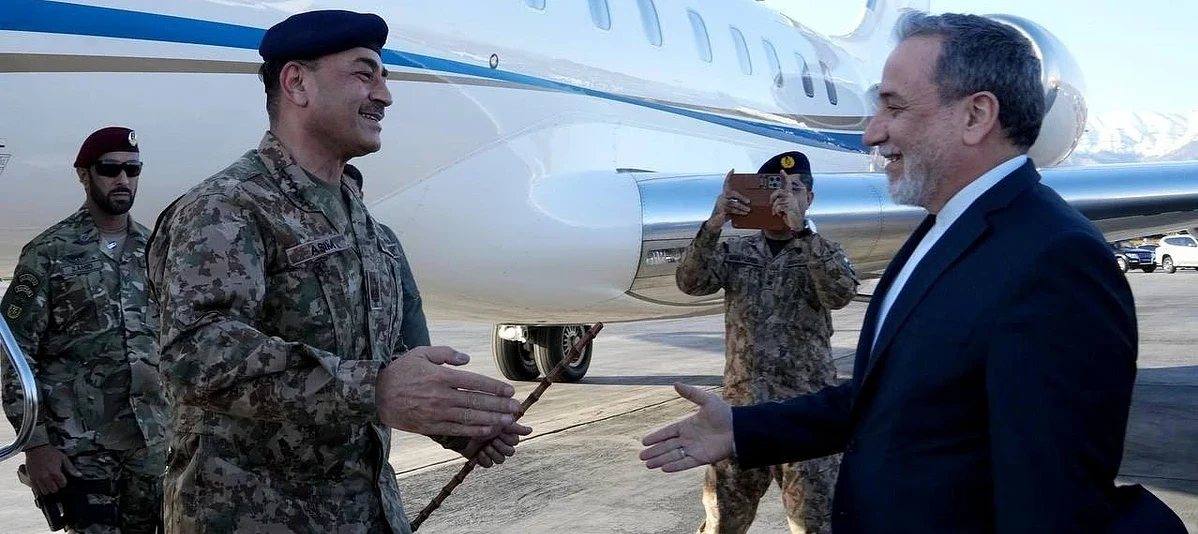
Pakistan's army chief, Field Marshal Asim Munir, arrived in Tehran on Tuesday for talks with senior Iranian officials, Iran's state news agency IRNA reported, in a visit Reuters said was confirmed by a Pakistani official and Iranian media. Pakistan has played a key mediating role between the United States and Iran this year, and Munir's earlier talks with Iranian leaders in the summer focused on preventing further escalation, reopening the Strait of Hormuz and ending the conflict, Reuters reported.
According to a proposal reported by The New Arab and Al-Araby Al-Jadeed and carried by several outlets on Tuesday, Munir brought Tehran a Pakistan-Qatar 'middle-ground' plan: Iran would allow a confidential, unannounced visit by International Atomic Energy Agency (IAEA) inspectors to its nuclear sites, and in return the US would allow Iran to receive the interest earned on $6 billion in frozen Iranian funds held in Qatar. (Yaani: $6 billion is 6 arab dollars — about 600 crore dollars.) Qatari sources involved in the mediation were quoted as saying the plan was designed to prevent further escalation and bring both sides back to negotiations, and reports suggested Washington had responded positively while Iran had given a preliminary consent — but neither government has publicly confirmed the specific terms, and the IAEA has not publicly confirmed the reported inspection arrangement.
Iranian Foreign Ministry spokesperson Esmail Baghaei confirmed the talks with Munir would also touch on the negotiations, while stressing that the main focus was bilateral relations and expanding cooperation between Iran and Pakistan. Analyst Andreas Krieg of King's College London told Al Jazeera that Qatar increasingly provides the diplomatic machinery behind the talks while Pakistan offers political access, particularly through Munir, in both Washington and Tehran. Pakistan brokered a ceasefire on April 8 and a 14-point memorandum of understanding in Islamabad in June, under which about $24 billion in frozen Iranian assets was to be released in phases (yaani: $24 billion is 24 arab dollars); that period expired in mid-August without an extension, and Iran has kept the Strait of Hormuz closed, insisting Washington first lift its blockade, Al Jazeera reported.
The core demands remain far apart: the US continues to insist Iran dismantle its nuclear programme, while Tehran wants the immediate release of all its assets frozen abroad, according to The New Arab's reporting. The mediation push comes amid fresh fears of renewed fighting — Russian Foreign Minister Sergei Lavrov was also in Tehran on Monday, and US Defense Secretary Pete Hegseth made an unannounced visit to Israel the same day. Analyst Umer Karim told Al Jazeera the Islamabad MoU may be 'politically alive' but 'operationally dead', and that a new mechanism may be required to restart negotiations.
Sources: Reuters; Al Jazeera; IRNA via AAP; The New Arab / Al-Araby Al-Jadeed (proposal details as reported by those outlets).