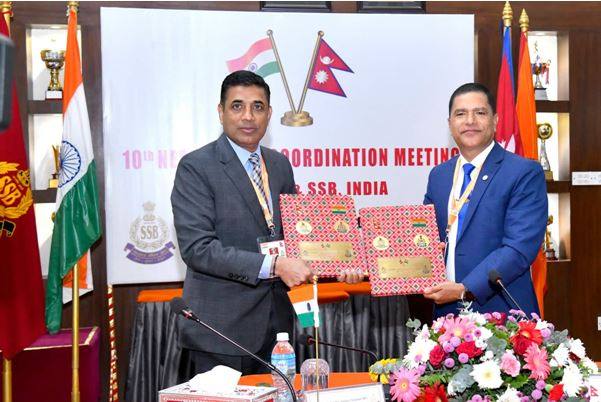
The border security leaderships of Nepal and India have agreed to bolster cooperation to control illegal activities and cross-border crimes, as the two-day 10th Nepal-India Coordination Meeting concluded in Kathmandu on Friday.
Source: Radio Nepal (RSS)
The meeting, attended by the chiefs of Nepal's Armed Police Force (APF) and India's Sashastra Seema Bal (SSB), reviewed the progress of previous decisions and agreed to strengthen cooperation at strategic, operational and field levels, according to APF spokesperson Netra Bahadur Karki.
The Nepali delegation was led by APF Inspector General Narayan Datta Paudel, while the Indian delegation was led by SSB Director General Sanjay Singhal. The coordination meetings have been held alternately in the two countries since 2012, and the next meeting will be held in India.
Source: Press Trust of India
Focus on Dashgaja and border pillars
Both sides agreed to continue joint efforts to manage the 'no-man's-land' (Dashgaja) area by removing unauthorised cultivation, encroachments and illegal structures. In line with the decisions of the Boundary Working Group and the Survey Officials Committee, the two forces also agreed to enhance field coordination for the ongoing maintenance, repair and reconstruction of border pillars, Karki said.
The two sides committed to continuing the timely exchange of information on cross-border criminal networks, illegal trafficking, human trafficking, counterfeit currency and the illegal movement of third-country citizens. To prevent illegal entry of third-country nationals through the open border, the agencies will step up checking and document verification at border points, carry out coordinated patrols in the no-man's-land and promptly share information on suspicious individuals.
CCTV, scanners and drones discussed
Karki told RSS that detailed discussions were held on installing CCTV cameras to monitor the no-man's-land, deploying luggage scanners and walk-through metal detectors at major checkpoints, and further use of drones within their respective territories, along with modern technology and specialised training support.
Joint water rescue exercises, help desks at checkpoints, regular exchange visits and friendly sports matches and joint cultural programmes were also discussed as ways to build trust between the two forces.