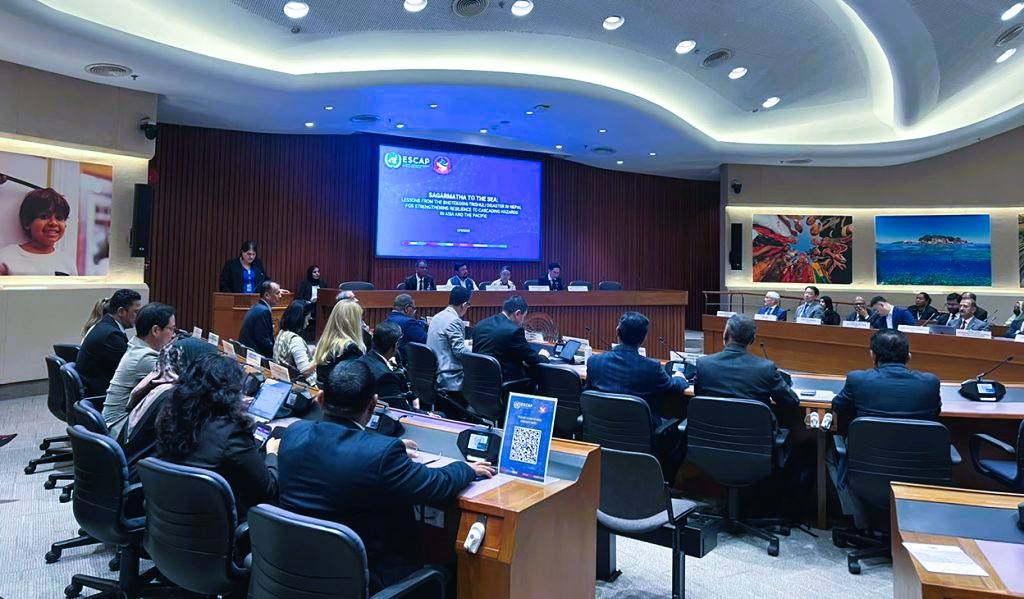
Nepal's four proposals for Himalayan climate cooperation have won the support of 53 countries at a high-level regional dialogue in Bangkok, Energy, Water Resources and Irrigation Minister Biraj Bhakta Shrestha said. The proposals cover sharing space technology and data, exchanging information through a Himalayan Climate Resilience Mechanism, fast grant-based climate finance, and investment in a green future for mountain communities.
Source: Peoples' Review
The dialogue, titled 'From Sagarmatha to the Sea: Lessons from Nepal's Bhotekoshi-Trishuli Disaster to Prevent Cascading Disasters in the Asia-Pacific Region', was held on Thursday at the United Nations Conference Centre in Bangkok, on the sidelines of the fifth ministerial conference of the United Nations Economic and Social Commission for Asia and the Pacific (UN ESCAP). Nepal jointly organised the event with UN ESCAP, and ministers, diplomats, scientists and disaster-management experts from across the Asia-Pacific attended.
Source: Koligram Post
The four proposals
Under the first proposal, international space agencies, scientific institutions and governments would work together to build a multi-hazard early warning system using satellites, artificial intelligence and advanced technology to monitor vulnerable mountain slopes, glaciers and glacial lakes. The second proposal focuses on sharing information and knowledge, including the Himalayan Climate Resilience Mechanism proposed by Prime Minister Balendra Shah to facilitate data exchange, monitor glacial lakes and coordinate early warning systems across the mountains.
Source: Peoples' Review
The third proposal calls for financial support that can be mobilised at the speed of disasters. Shrestha said monitoring the Himalayas may cost millions of dollars, while failure to monitor them could result in billions in losses, and he urged accessible, grant-based financing for monitoring, preparedness and recovery, including a permanent window for rapid response to loss and damage. The fourth proposal calls for investing in mountain communities through clean energy, sustainable agriculture, medicinal herbs and responsible tourism, along with duty-free market access for Himalayan products.
Source: Peoples' Review
"Cooperation always begins with data. Let that data flow in every direction and in every season, before disasters strike, not after. Let the Himalayas become a vast laboratory for cooperation," Shrestha told the dialogue, according to Peoples' Review. He said Nepal contributes less than 0.1 percent of global greenhouse gas emissions but suffers directly from the impacts of climate change, and that what happens in the mountains does not remain confined to the mountains because rivers flow all the way to the sea.
Source: Peoples' Review
Participants were briefed on a major avalanche in Nepal's high Himalayan region in August, which triggered a series of severe disasters along the Bhotekoshi and Trishuli river corridors, causing substantial damage to hydropower projects, road infrastructure, border mechanisms and local livelihoods, according to the information presented at the dialogue. Scientists warned that, as global warming pushes temperatures beyond the 1.5-degree Celsius threshold, Himalayan disasters are increasingly emerging as cascading risks that can extend beyond national borders and affect downstream communities.
Source: Koligram Post
Nepal was represented at the dialogue by National Planning Commission member Sanjay Acharya, National Disaster Risk Reduction and Management Authority Chief Executive Dharmaraj Upreti, and Department of Hydrology and Meteorology Director General Archana Shrestha. Ministers from Thailand, Bhutan, Fiji, Samoa, Sri Lanka and Kyrgyzstan also participated, along with representatives of China's National Development and Reform Commission, the Indian Space Research Organisation, the World Meteorological Organization, the International Centre for Integrated Mountain Development and the Asian Development Bank, Koligram Post reported. Nepal expects the dialogue to support its reconstruction and recovery efforts while helping Asia-Pacific countries develop shared strategies for managing cascading disasters.
Source: Koligram Post