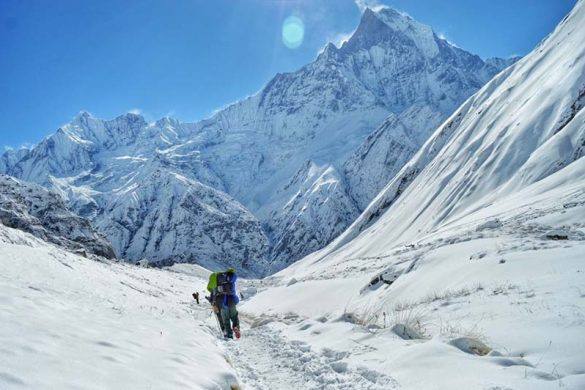
Nepal's government has announced a complete ban on trekking in the country's high hilly and Himalayan regions for three days, from October 29 to October 31 (Kartik 12 to 14), in an urgent advisory issued on Tuesday, October 27.
Source: Himalini
The decision follows meteorological forecasts of extreme conditions in high-altitude areas — heavy rainfall, severe snowstorms and a high risk of avalanches triggered by a cyclonic system originating in the Bay of Bengal.
The Department of Immigration and the National Disaster Risk Reduction and Management Authority (NDRRMA) urged all domestic and international trekkers to halt their journeys immediately. The Department of Immigration has temporarily suspended the issuance of trekking permits for high-risk zones during this period.
Immigration Director Surya Prasad Chapagain said in the official release that all tourists and trekkers, even those who already hold permission for restricted areas, are requested not to start trekking, or to stop at safe places, for the three days from October 29, in view of possible natural disasters.
Agencies told to move trekkers to safety
The Trekking Agencies' Association of Nepal (TAAN) has instructed affiliated travel and trekking agencies to suspend expeditions toward high-altitude passes immediately, to relocate trekkers currently in vulnerable locations to secure zones, and to halt further ascents until the weather clears.
A separate TAAN advisory issued on October 27, following alerts from Nepal's Department of Hydrology and Meteorology and the NDRRMA, said the system is expected to begin affecting Nepal from the night of October 29, with adverse conditions forecast for October 30 and 31, and flagged Gandaki Province as an area of particular concern.
Source: Tourism Info Nepal (TAAN advisory)
Reuters also reported on Tuesday that authorities in Nepal cautioned tourists against venturing into high-altitude areas, fearing the cyclone could trigger torrential downpours, snowstorms and avalanches in the Himalayan region from Thursday night through Saturday.
Source: Reuters
Transport disruption and emergency numbers
The severe weather is also expected to disrupt transport, with flight delays and cancellations highly likely at mountain airports such as Lukla and Jomsom, alongside a risk of landslides on hilly roadways, according to the advisory.
Tourists are advised to monitor official weather advisories and coordinate with their trekking agencies for safe accommodation. The authorities gave these toll-free hotlines for the alert period: weather updates from the Nepal Meteorological Department on 1155, the National Emergency Operation Centre on 1234, Tourist Police on 1144, Nepal Police on 100, and the Armed Police Force on 1114.