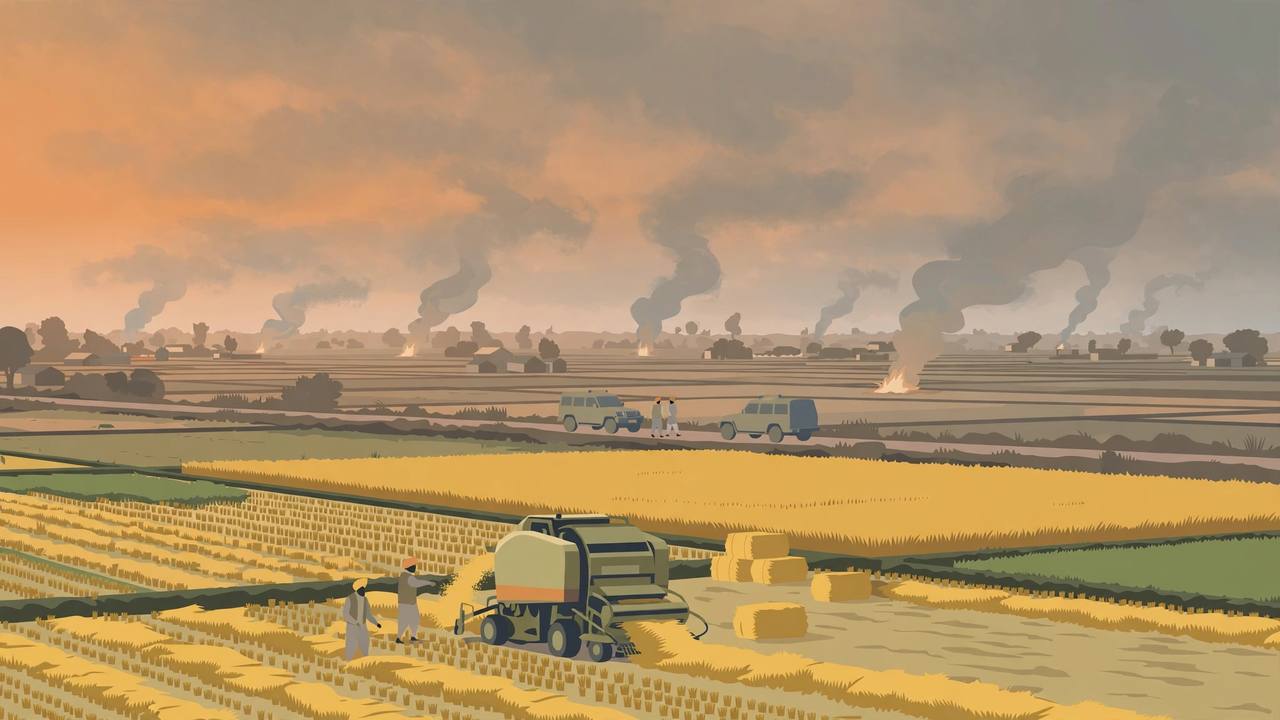
Chandigarh: Stubble-burning incidents in Punjab this paddy season have reached 1,514, and the Commission for Air Quality Management (CAQM) has directed seven district administrations to strengthen surveillance and enforcement. The figures are from the CAQM's monitoring report dated November 1, as reported by Punjab Khabarnama.
Tarn Taran accounts for the highest number with 472 incidents, followed by Amritsar with 191 and Ferozepur with 186 — together, the three border districts contribute more than half of the state's reported farm fires. The report also records the enforcement side: authorities inspected 1,205 of the 1,514 reported locations and physically verified crop burning at 584 sites; environmental compensation was imposed in 518 cases amounting to Rs 26.15 lakh, of which Rs 17.60 lakh had been recovered; and 389 FIRs and 422 red entries in land records were recorded in connection with stubble-burning cases. All of these are the CAQM report's figures, as carried by Punjab Khabarnama.
The direction was issued at a review meeting on Sunday, November 1, chaired by CAQM Member Secretary Tarun Pithode with Deputy Commissioners, District Magistrates and Senior Superintendents of Police from Faridkot, Firozpur, Barnala, Bathinda, Patiala, Malerkotla and Sangrur. The commission placed special emphasis on surveillance during evening hours, when fires may occur outside usual monitoring periods, called for a greater police role, directed that Crop Residue Management (CRM) machinery — balers in particular — be deployed effectively, and asked for intensified farmer awareness. Particle News independently confirms the same seven-district direction by Pithode and the commission's line that written targets alone are insufficient without verified machinery availability and coordinated police and agriculture-department action.
The CAQM has stressed surveillance during evening hours, when stubble fires can be lit outside usual monitoring periods, alongside a greater police role and effective use of CRM machinery, balers in particular.
Background: Awaaz Punjab has previously reported the season tally at 1,339 up to October 31 and the CAQM team's field review in Sangrur, Patiala and Malerkotla; this report is the next data point — the November 1 tally of 1,514 and the new seven-district direction. CAQM flying squads are deployed across 18 Punjab districts from October 1 to November 30. Farm fires are rising as paddy harvesting progresses, and stubble smoke contributes to poor air quality across northern India, including Delhi-NCR. The reports read carried no response from any farmer union or district administration.
What happens next: with harvesting set to speed up, the tally is likely to climb further in the coming days; whether evening surveillance and machinery deployment change the picture on the ground in the seven named districts is the point to watch.