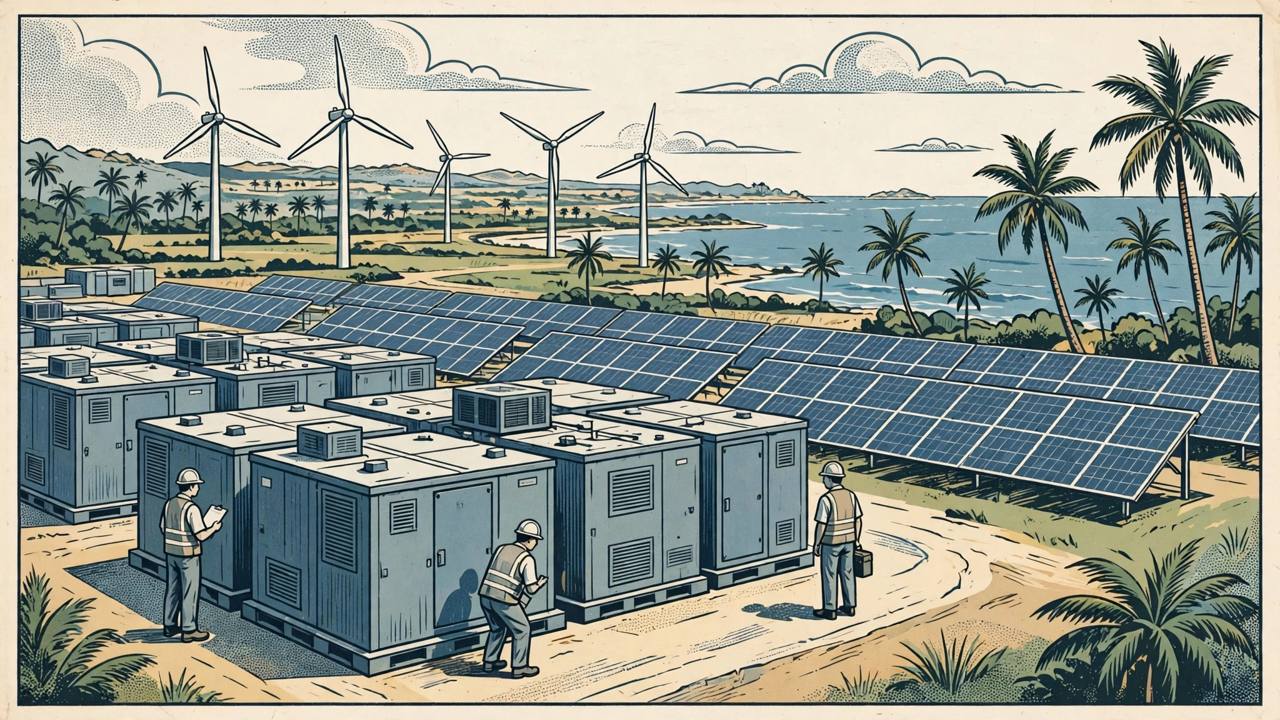
Tamil Nadu has notified a dedicated Battery Energy Storage Systems (BESS) Policy, 2026, targeting at least 2.5 GW / 10 GWh of battery storage capacity during the policy's validity period, The Hindu BusinessLine reported. The policy, dated October 28, will remain in force for three years from notification or until 10 GWh of BESS capacity is commissioned under it, whichever is earlier.
Source: The Hindu BusinessLine
Under the policy, new solar and solar-hybrid projects of 1 MW and above must install battery storage with discharge power equal to at least 10 per cent of the project's installed capacity, with a four-hour discharge duration. The requirement applies to projects that apply on or after the notification date or are commissioned on or after April 1, 2027.
Source: Saur Energy
Waiver for standalone and co-located storage
Eligible projects — both standalone BESS of 1 MW and above and storage co-located with solar, wind or hybrid plants and charged exclusively from the associated renewable plant — will be considered for a 100 per cent waiver of transmission and wheeling charges for 10 years from commissioning, subject to approval by the Tamil Nadu Electricity Regulatory Commission (TNERC) and a cumulative cap of 10 GWh of eligible capacity. The state's distribution utility, TNPDCL, will procure 2,500 MW / 10,000 MWh of BESS capacity through competitive bidding, with the discovered price subject to TNERC approval.
Source: SolarQuarter
Existing renewable-energy pooling substations must also add storage: BESS capacity equal to 5 per cent of the substation's sanctioned capacity by 2027-28, and a further 5 per cent by 2028-29, taking the cumulative requirement to 10 per cent at a four-hour discharge duration. The state says four BESS projects are already under development, including a 500 MW / 1,000 MWh project and a 375 MW / 1,500 MWh project under viability-gap-funding schemes, and two solar-plus-storage projects of 15 MW / 45 MWh each.
Source: Saur Energy
The policy is aimed at grid stability as Tamil Nadu's renewable fleet grows: the state already has about 29.8 GW of renewable capacity, including around 14.5 GW of solar and 11.6 GW of wind, whose output varies with weather and time of day. Storage lets that energy be held back for the evening peak instead of being curtailed or backed up with costly spot purchases — a pressure the state utility has been feeling, with Tamil Nadu this week also projecting a 6,162 MW power deficit for September 2027.