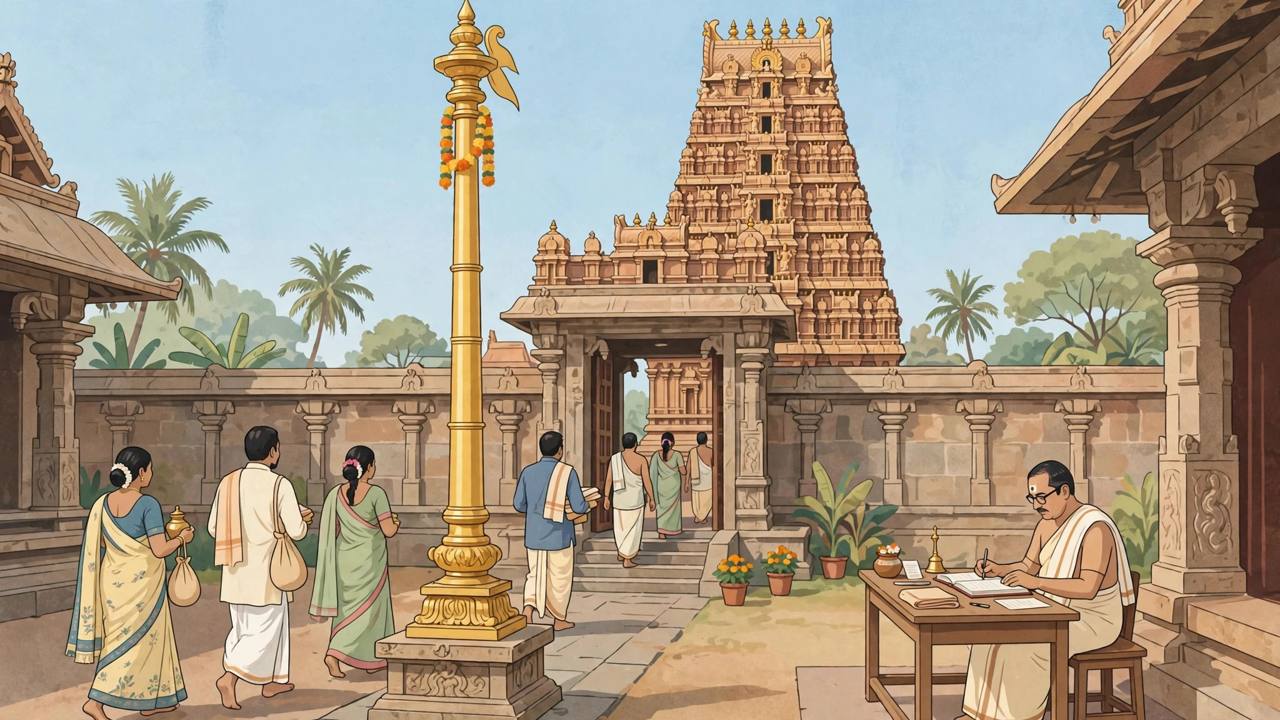
Chennai: The Madras High Court has ruled that non-Hindus cannot enter Agamic temples in Tamil Nadu without affirming their reverence for the presiding deity and agreeing to follow the customs and practices of the temple, Bar and Bench reported. The ruling, in Thangam Venkatesh v. State of Tamil Nadu, was delivered by a Division Bench of Justices G.R. Swaminathan and P. Murugan of the Madurai Bench in a judgment dated October 23.
Source: Bar and Bench
"Even entry into the temple premises cannot be permitted for non-Hindus who sport their religious markers and who do not subscribe their reverence for the deity concerned. This subscription (undertaking) must be in the format prescribed by the institution concerned," the Court held, as quoted by Live Law. A non-Hindu who does not sign the undertaking cannot cross the temple's flag-pole (kodimaram), the Bench said.
Source: Live Law
Confined to Agamic temples
The Court clarified that the ruling is confined to Agamic temples — temples whose construction, rituals and worship follow the Agamas, the traditional scriptures. It contrasted them with institutions linked to Lord Ayyappa and Shirdi Sai Baba, which draw devotees across religions. "Lord Ayyappa has devotees cutting across religions. Shirdi Sai Baba is also beyond religion," the Bench observed.
At the same time, the Bench held that temple-entry restrictions historically imposed on certain Hindu castes under Agamic practice can no longer withstand constitutional scrutiny. "Constitution ranks paramount and such regressive theological injunctions have to necessarily give way," it held — adding, however, that those injunctions "will hold good in respect of non-Hindus who do not sign the undertaking."
Petition, incidents and the 'inclusive' example
The petitioner, Thangam Venkatesh, had sought enforcement of the Tamil Nadu Temple Entry Authorisation Act, 1947 and the HR&CE Act, 1959, and action against people allegedly violating temple-entry restrictions. The Bench referred to recent incidents involving political figures entering temples without the prescribed undertaking, including Madurai Central MLA Badrudeen Mustafa entering the Meenakshi temple premises and climbing its towers during Kumbabishekam, and a Christian minister entering the Thiruchendur temple without an undertaking.
By contrast, the Court praised Tamil Nadu Chief Minister Joseph Vijay, who is Christian by faith, for signing the undertaking before worshipping at a Meenakshi temple. "He was not asked to convert to Hinduism. He was only requested to affirm his reverence for the deity. This is what we call as an inclusive approach," the Bench said. It also criticised devotees' protests being ignored at the Thiruvannamalai Arunachaleswarar temple, where, it noted, HR&CE staff "stood as mute spectators" while people wearing skull caps pushed into the premises, and remarked that temple usages and customs "cannot kneel down before such display of Chamchagiri and optics."
Verdictum, which also reported the judgment, noted the Bench reiterated that trustees are duty-bound to maintain customary usage and protect the shrine, and that the undertaking must follow the format prescribed by the institution concerned.
Source: Verdictum