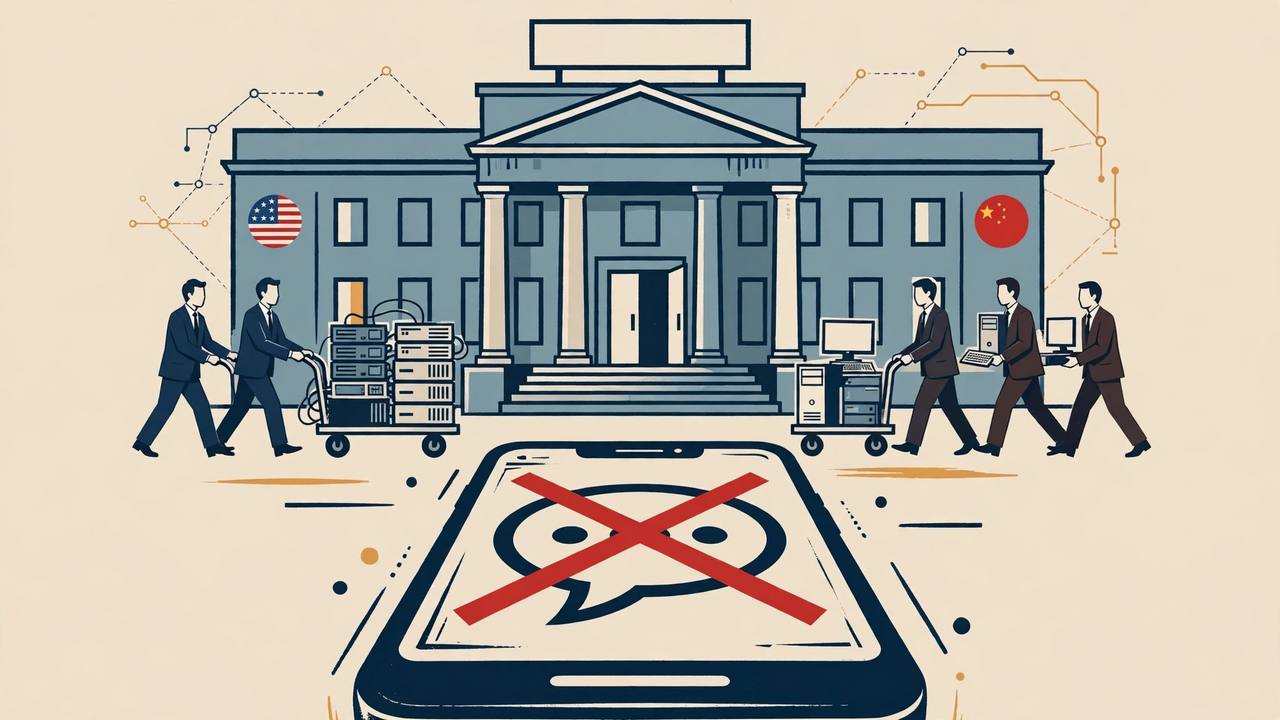
The US Department of Homeland Security has ordered federal civilian agencies to remove all products and services from Chinese AI company DeepSeek and its affiliates from their IT systems and to stop buying them, with the order also covering third-party products and services "developed using DeepSeek implementations" — tools built on top of DeepSeek's open-weight models, though agencies can request exceptions with a written justification.
The notice was made public on October 19 on public inspection and published in the Federal Register on October 20; the underlying order is dated late July 2026, making this a public disclosure of an earlier directive rather than a newly signed ban, according to AP reporting. DHS acted under the Federal Acquisition Supply Chain Security Act of 2018 following a review by the Federal Acquisition Security Council, and the order covers civilian agencies such as the Treasury, State and Justice departments — not the Defense Department or intelligence systems, which were already covered by a December 2025 law restricting DeepSeek.
DHS set out its concerns in the order — presented here as the department's claims, not proven facts. DHS said DeepSeek's models present "multiple threat vectors": its servers are located in China, where national security laws allow the government to demand access to company data, and the order warns sensitive government information could potentially be transferred to China. It also cites possible malware and security flaws, pointing to publicly available research that found vulnerabilities in DeepSeek's iOS app.
China pushed back on Tuesday, October 20: Foreign Ministry spokesperson Mao Ning said Beijing opposes "overstretching the concept of national security and politicizing technology and trade issues," adding China will "resolutely safeguard the legitimate rights and interests of Chinese enterprises"; China's Commerce Ministry said the ban "disregards important consensus" reached between the two countries' leaders and urged the US to revoke what it called discriminatory restrictions, Reuters reported. Separately, Washington has accused DeepSeek and other Chinese AI labs of using large-scale model distillation to extract capabilities from American AI systems — an allegation Beijing rejects — while Bloomberg reported last week that China is considering export restrictions on 23 AI-related technologies, including chip designs and certain advanced AI models.
The clash lands just before US President Donald Trump and Chinese President Xi Jinping are expected to meet on the sidelines of the APEC summit in Shenzhen on November 18–19, where AI is expected to be on the agenda; the FCC will also vote on October 29 on barring Chinese laboratories from testing US electronic devices.
Sources: TechCrunch; AP News; Reuters; China's Foreign Ministry briefing; Federal Register notice DHS-2026-0628.