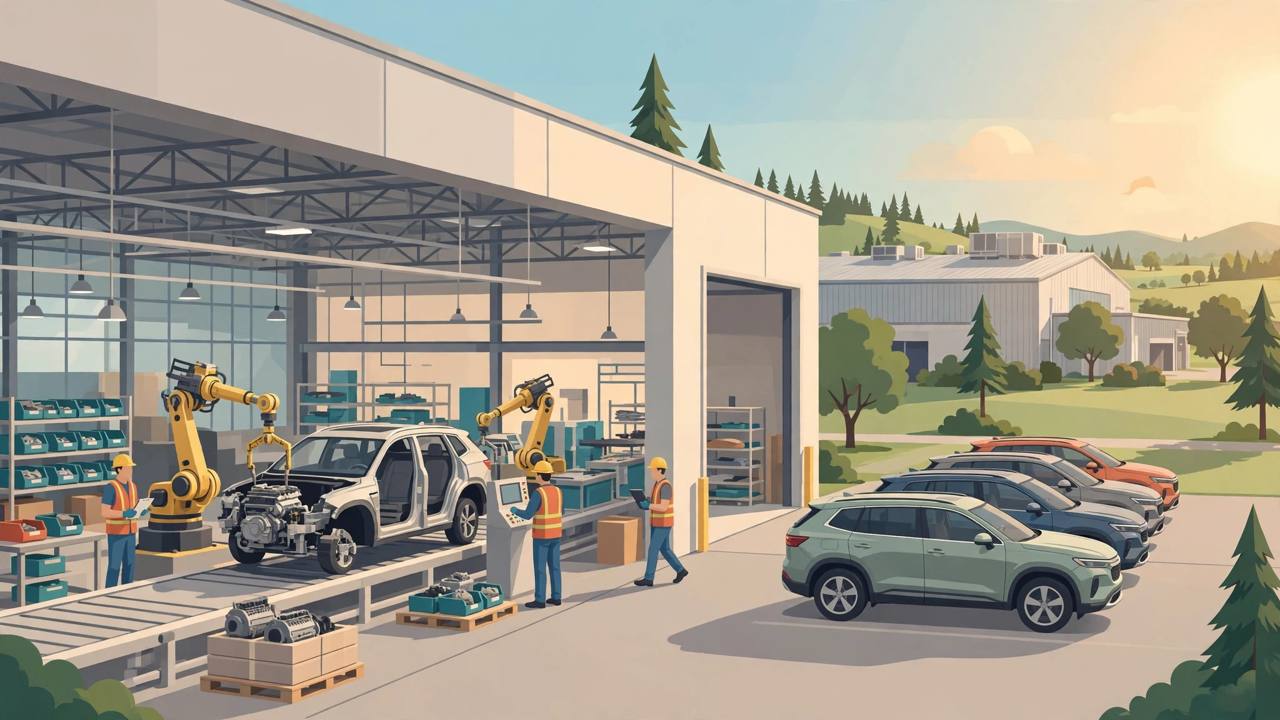
Hyundai Motor Manufacturing Alabama (HMMA) announced on Wednesday, October 28, at its plant in Montgomery, Alabama, that it will invest nearly $450 million to expand the factory for hybrid and extended-range electric vehicle (EREV) production — a package the state calls Project Game Changer.
Source: Aju Business Daily — Hyundai to invest $450 million to expand plant in Alabama (Oct 29, 2026)
The money goes to three things, the company said at the Montgomery event: new facilities to produce a wider range of engines, including powertrain variants designed for hybrid and EREV applications; equipment and tooling for the all-new Tucson SUV; and manufacturing infrastructure for a refreshed Santa Fe. Hyundai Motor Manufacturing Alabama president and CEO Mark Rader announced the program alongside Alabama Governor Kay Ivey, state Commerce Secretary Ellen McNair and South Korean Ambassador to the United States Kang Kyung-wha.
“These investments strengthen our manufacturing capabilities, support future vehicle production, and ensure HMMA remains a cornerstone of Hyundai's North American manufacturing operations for years to come.”
Two headline figures — and why they differ
Readers will see two numbers for this deal, and both are on the record. Hyundai values the full package at approximately $450 million. The Alabama governor's office, which calls the project Project Game Changer, lists a capital investment of $412.9 million and 53 new full-time positions. The reports do not explain the roughly $37 million gap between the company's package figure and the state's capital figure, so this story keeps the two numbers separate rather than merging them. What is not in dispute is the direction: the cumulative Hyundai investment at Montgomery rises to about $2.2 billion with this round, the company said.
The Tucson moves to Alabama — hybrid included
Production of the all-new Tucson at Montgomery is scheduled to begin before the end of 2026, and the governor's office confirms the program includes hybrid variants. That is a significant sourcing change: today, the U.S.-market Tucson Hybrid is built entirely at Hyundai's Ulsan plant in South Korea and imported, while Montgomery builds the gasoline version. Bringing hybrid production to Alabama is expected to ease the tariff burden on the model, and Hyundai President and CEO José Muñoz told the Automotive News Congress in September that the company would build the Tucson Hybrid in Alabama and later add the Santa Fe EREV.
Santa Fe EREV: an electric drive with a gasoline generator
The refreshed Santa Fe will be tooled at the same plant, and it shares the building with Hyundai's first extended-range electric vehicle. In an EREV, the gasoline engine does not drive the wheels — it works as a generator that charges the battery while electric motors drive the vehicle, so daily driving feels electric and the fuel tank covers long trips. Hyundai said at its August CEO Investor Day that the Santa Fe EREV will be built at HMMA and go on sale in the first half of 2027, and the company is targeting a total range of more than 965 kilometres (600 miles) using Hyundai-developed high-output battery cells and less than half the battery capacity of a comparable full EV, Motor Illustrated reported.
The Montgomery plant is already one of the Southeast's big industrial employers. It employs about 4,200 people, and together with its supplier network it is reported to generate more than $5 billion in annual economic impact, along with roughly $100 million a year in state tax revenue and about $12 million locally. Production at the site began in 2005.
Part of a $26 billion American plan
The Alabama expansion is one piece of Hyundai Motor Group's pledged $26 billion investment in U.S. operations for 2025–2028, a plan the group says targets roughly 25,000 new direct jobs. Its bigger components include a $5.8 billion steel mill in Louisiana and the $7.6 billion Georgia Metaplant; Montgomery's role is flexibility — more engine variants and two of the brand's core SUVs. The engine work also feeds Hyundai's wider North American hybrid plan: more than 10 hybrid models by 2030, with hybrids expected to reach 50 percent of the brand's regional sales, sourced from HMMA and the Georgia Metaplant.
At the Montgomery event, Ambassador Kang described the investment as a “key example of the bilateral alliance being realized in practice,” and said it would further strengthen ties between the two countries' automotive industries.
Governor Ivey made the state's pitch in similar terms. “Since its founding in Montgomery 24 years ago, Hyundai Motor Manufacturing of Alabama has become synonymous with cutting-edge design and endless innovation in performance. Alabama and Hyundai are a winning team, and this substantial investment to enhance Hyundai's well-known automotive line will propel our successful partnership to even greater heights. The future of Hyundai in Alabama is brighter than ever,” she said, in the governor's office release.
For diaspora readers in the American Southeast, announcements like this are not abstract corporate news. The region's auto corridor — the Alabama plant, the Georgia Metaplant and the supplier and logistics networks around them — is a major source of factory, supplier, trucking and warehouse work, and model shifts like moving the Tucson Hybrid onshore decide where the next years of that work sit. A hybrid-heavy lineup also changes what rolls through the region's dealerships and service bays.
What happens next
The first test is the calendar the company itself set: all-new Tucson production, hybrid included, starts at Montgomery before the end of 2026, and the Santa Fe EREV follows on sale in the first half of 2027. Hyundai and the state have not published a construction schedule or a detailed hiring timeline for the 53 new positions in the first reports, and Hyundai has not said whether Canadian-market Tucsons will be U.S.-built, Korean-built or a mix. Those answers — and whether the $450 million package grows — will come as the new engine lines are installed.