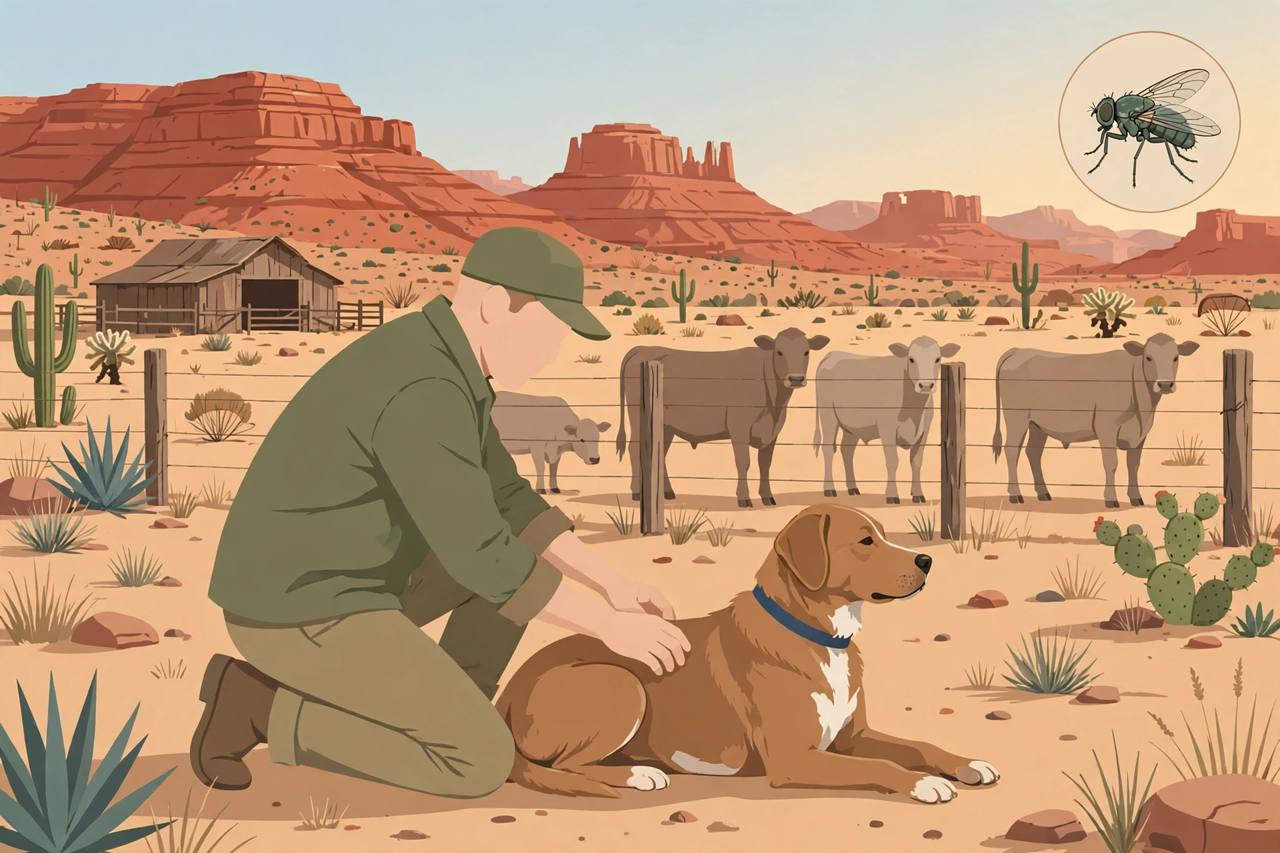
The United States Department of Agriculture (USDA) confirmed on Wednesday, October 28, that New World screwworm — a parasitic fly whose larvae feed on the living flesh of warm-blooded animals — has been found in a dog in Cochise County, Arizona, the first detection of the pest in the state, according to the USDA's Animal and Plant Health Inspection Service (APHIS) and Reuters. Cochise County sits on the border with Mexico in southeastern Arizona, and the case widens confirmed US infestations to a third state.
Source: USDA APHIS (official)
The dog had a wound on its back that was infested with maggots, consistent with screwworm, the Arizona Department of Agriculture said. Samples from the dog were tested and confirmed at the APHIS National Veterinary Services Laboratories in Ames, Iowa, and the dog was receiving veterinary care. “We have been preparing for this possibility for a long while and are acting swiftly,” State Veterinarian Dr. Ryan Wolker said in a statement reported by Reuters.
Source: Reuters
A 20-kilometre control zone around the case
APHIS said it is working closely with the Arizona Department of Agriculture on a joint response under the APHIS New World Screwworm Response Playbook. The measures include establishing a 20-kilometre (about 12-mile) infested zone around the detection with animal movement controls for the area, increasing live-animal surveillance and trapping, releasing sterile flies — the technique used to push the pest out of the United States decades ago — and targeted outreach to local producers, veterinarians and communities.
Source: USDA APHIS (official)
What screwworm does, and what owners are told to watch for
New World screwworm is a serious pest that affects livestock, pets and wildlife, and, less commonly, people, USDA said. The larvae feed on living tissue and can cause severe wounds, animal suffering and significant economic damage if an infestation is not detected and treated quickly — which is why a single confirmed case in a new state triggers a full official response.
Source: USDA APHIS (official)
USDA urged animal owners in the area to inspect their animals daily for draining or enlarging wounds; maggots or egg masses in wounds; signs of discomfort or irritability; and lesions around body openings, including the ears, nose, genital area and umbilicus. Anyone who suspects an infestation should immediately contact a veterinarian, a state animal health official or USDA, the agency said. A complete list of confirmed US detections is published on USDA's public dashboard at screwworm.gov, updated daily at 6:00 p.m. ET.
Source: USDA APHIS (official)
How a pest eradicated decades ago came back
Screwworm was eradicated from the United States decades ago, but it has since advanced north through Latin America and Mexico. To keep it out, USDA halted livestock imports from Mexico last year. The pest was detected in a calf in Texas in June, followed by additional cases in Texas and New Mexico, Reuters reported. Last week, USDA confirmed the first case of screwworm in US wildlife, in an elk in Texas. As of Wednesday the agency had reported 71 cases since June, with 18 active — up sharply from only two active cases last month.
Source: Reuters
The import halt helped tighten US cattle supplies and push beef prices to record highs for American consumers, Reuters reported, raising affordability concerns ahead of the midterm elections. USDA began resuming livestock imports from Mexico in August and has restarted trade at three ports of entry in Arizona and New Mexico. The agency has said it next plans to resume imports at Nogales, Arizona, on November 30, if conditions for safe trade are in place — a timetable the Cochise County detection, in the same state, now puts under fresh scrutiny.
Source: Reuters
Why this matters beyond one county
Cochise County is ranching country, and movement controls inside the 20-kilometre zone mean animals there face checks before they can be transported — a direct cost and delay for local producers, and one more pressure on a cattle supply chain already tight enough to hold beef prices at record levels. For families far from Arizona, including Punjabi diaspora households across the US, the channel is the grocery bill: every new state the pest reaches makes the trade restrictions that keep beef expensive harder to lift.
USDA and Arizona officials will run surveillance and trapping inside the 20-km zone, release sterile flies, and update the public dashboard at screwworm.gov daily at 6:00 p.m. ET. The next fixed decision point is November 30, when USDA plans to resume livestock imports at Nogales, Arizona, if conditions allow. New detections in the coming days would be the clearest sign of whether the Cochise County case was an isolated arrival or the start of an Arizona foothold.
For now, officials are treating the case as contained but serious: one dog, under veterinary care, in a border county — and a response built to make sure it stays that way. Animal owners in southeastern Arizona who find a wound that is draining, enlarging or carrying maggots are being told not to wait: call a veterinarian, a state animal health official or USDA immediately.
Source: USDA APHIS (official)