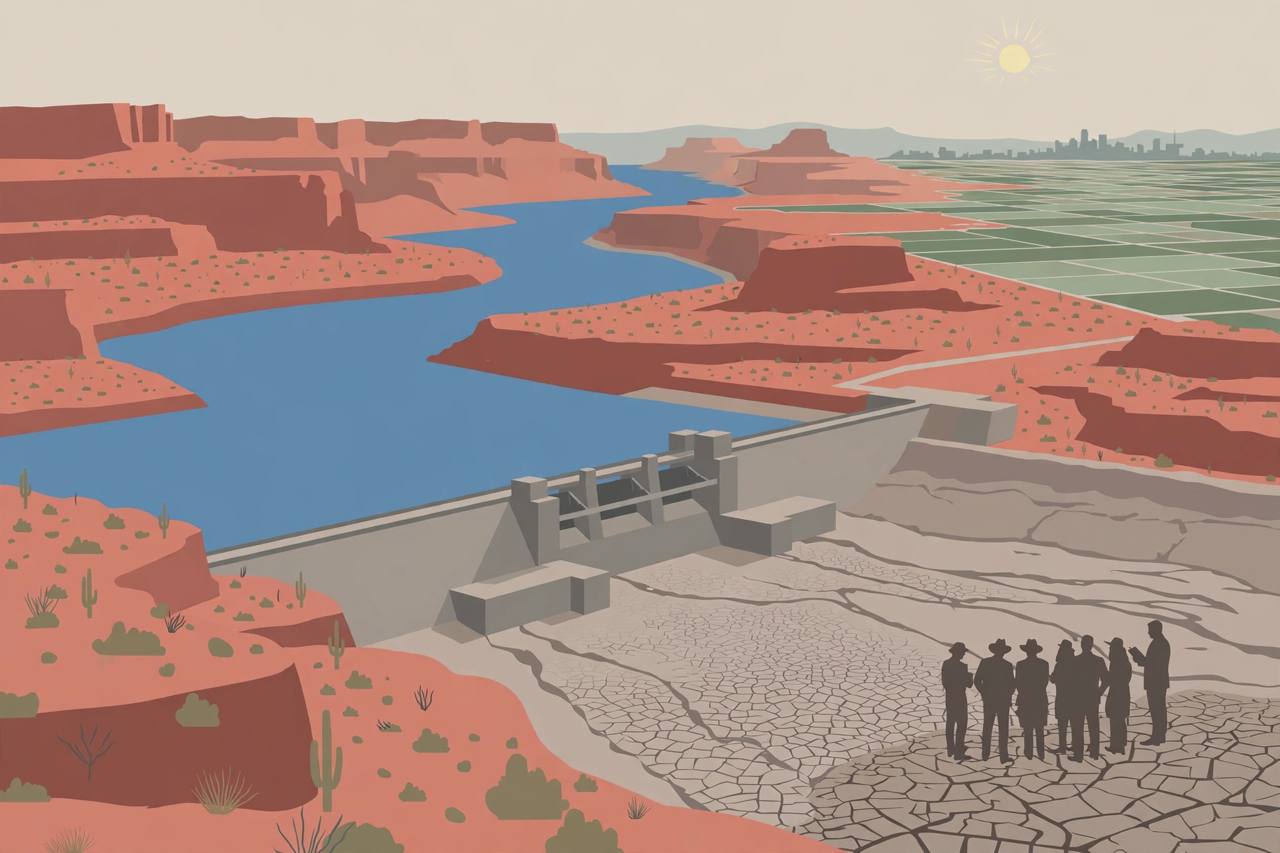
Arizona has taken its fight over Colorado River water to federal court, filing a motion on October 16, 2026 to intervene in Nevada's lawsuit against the U.S. Department of the Interior and the Bureau of Reclamation over how the river will be run after 2026, Governor Katie Hobbs and the Arizona Department of Water Resources (ADWR) announced.
The numbers show why Arizona moved. Under federal operating guidelines issued in August 2026, the three Lower Basin states — Arizona, California and Nevada — face combined reductions of 1.25 million acre-feet a year in 2027 and 2028, and Arizona would absorb the largest share: 760,000 acre-feet, about 60% of the total, against California's 440,000 and Nevada's 50,000, according to the state's court filing reported by Western Water on October 20. (Yaani: one acre-foot is the water needed to cover one acre of land one foot deep — about 3.26 lakh gallons — so Arizona's cut alone is roughly 24,800 crore gallons a year.) Arizona warns the federal framework could eventually produce Lower Basin reductions of up to 3 million acre-feet a year, and that it could reduce the Central Arizona Project's river allocation by 77% over the two-year period.
At the centre of the lawsuit is the Colorado River Compact of 1922. Arizona argues the Upper Basin states — Colorado, New Mexico, Utah and Wyoming — must let at least 75 million acre-feet pass Lee Ferry over any 10-year period, rising to 82.5 million acre-feet when the U.S. water treaty with Mexico is counted, and that federal projections of about 80.4 million acre-feet under average conditions — and 73.9 million in critically dry years — fall below what the state says the law requires. The state also challenges plans that could cut Lake Powell's annual release from the usual 8.23 million acre-feet to 6 million, or as low as 5 million, in dry conditions. These are Arizona's legal arguments, not court findings.
"Arizona has always been willing to do our part to protect the Colorado River, but we will not accept a forced federal plan that solves this crisis on the backs of our families, farmers, and businesses," Hobbs said in her October 16 announcement. ADWR Director Tom Buschatzke said intervention was necessary "to protect its legal rights to Colorado River water while preserving a path forward to achieving a collaborative outcome with California and Nevada." Nevada Governor Joe Lombardo and Southern Nevada Water Authority general manager John Entsminger welcomed Arizona's move, with Entsminger citing shared concerns about flaws in the federal environmental review, according to FOX5 reporting carried by the Vegas Daily Wire. Arizona is not asking the court to scrap the 2027–28 guidelines outright, as Nevada does — it wants them sent back for reconsideration while temporarily staying in effect — and it continues to back a separate two-year Lower Basin conservation agreement under which the three states would conserve more than 3.2 million acre-feet in 2027 and 2028. The case, State of Nevada v. Burgum, No. 2:26-cv-02665 in the U.S. District Court for the District of Nevada, could shape river operations through 2036. (Sources: Western Water, October 20, 2026, reporting Arizona's October 16 motion to intervene and Governor Hobbs's announcement; Office of Governor Katie Hobbs news release, October 16, 2026; FOX5 via Vegas Daily Wire, October 16, 2026; Law360 listing, October 19, 2026.)