Arizona Governor Katie Hobbs has declined to issue a state emergency declaration for Heber-Overgaard, the Navajo County community hit last week by an EF-1 tornado, concluding that the damage does not meet the threshold for a declaration. The decision, made on Monday, October 26, was reported on October 27 by AZFamily (KPHO/KTVK) and closes — for now — a request that State Representative Walt Blackman formally filed last Wednesday and that he has publicly urged the governor to reconsider.
Source: Phoenix Focal / AZFamily reporting
What happened on October 21
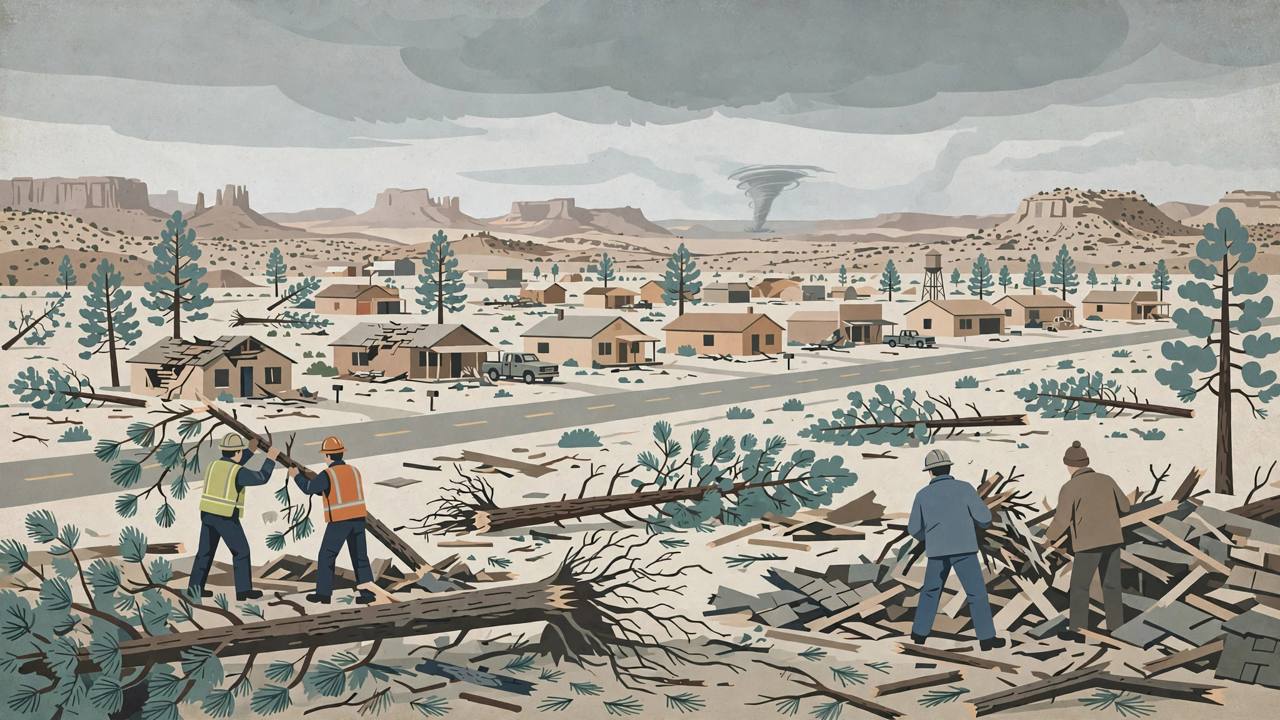
The National Weather Service office in Flagstaff confirmed after ground damage surveys that a tornado rated EF-1 touched down near Heber-Overgaard on the evening of Wednesday, October 21. It developed south of the community, travelled north across Highway 260 through the town and lifted near Highway 277 about eleven minutes later, with peak winds of 110 mph, a path 9.26 miles long and up to 350 yards wide. The most significant damage was on the southern side of Highway 260 and in central Overgaard, where trees and roofs were hit hardest. One person was injured, with non-life-threatening injuries; nobody died. Residents described a 14-foot boat hurled into a tree and a trailer flipped, and local reporting put the number of damaged buildings at roughly 20 to 30.
Source: FOX 10 Phoenix / NWS Flagstaff survey via Iowa State University
It was not the only Arizona tornado that day. Weather Service surveyors who inspected three sites, including in the Bradshaw Mountains of Yavapai County, also confirmed a separate EF-1 tornado near Lookout Mountain, near Prescott, on the morning of October 21, with peak winds of 105 mph and an 8.02-mile path.
Source: FOX 10 Phoenix
The request — and the county's own assessment
State Representative Walt Blackman formally requested a state emergency declaration last Wednesday, calling publicly on the governor to act with urgency and ensure state resources were ready to assist residents. The Navajo County Board of Supervisors also declared a local emergency, a step intended to help the county qualify for any state funds that might become available. But the county's own assessment undercut the case for a state declaration: Board Chairman Daryl Seymour put the damage estimate at about $20,000 so far and said the public side of the community was intact. "Our roads are fine. Our infrastructure is fine. Our schools are fine. Our public buildings are fine," Seymour said.
Source: Phoenix Focal / AZFamily reporting
Why the governor said no — and what the state is still doing
The governor's office concluded that local needs do not meet the threshold for an emergency declaration. The denial does not mean state help has stopped. Hobbs' office said the Arizona Department of Emergency and Military Affairs (DEMA) has activated the State Emergency Operations Center at Level 1 and placed staff alongside emergency managers in Navajo and Greenlee counties, and that state agencies have coordinated with the Department of Public Safety and the Department of Forestry and Fire Management on resident wellness checks and damage assessments. On October 22, the day after the tornado, Hobbs had directed DEMA, the Department of Public Safety and the transportation department to work hand-in-hand with county officials on recovery efforts.
Source: Phoenix Focal / AZFamily reporting
What a declaration would — and would not — have done
Roni Fraser, an assistant professor of emergency management at Arizona State University, explained that a state emergency declaration would not by itself have provided direct payments to homeowners. Such a declaration can create an opportunity for public assistance, such as support for roads and public infrastructure. Individual assistance for residents, by contrast, would require a federal disaster declaration through the Federal Emergency Management Agency (FEMA). Seymour said the county does not plan to seek a federal declaration, citing the condition of public facilities, and the county will not appeal the governor's decision.
Source: Bazaar Daily News America / AZFamily
The cost lands on individual properties
For individual property owners, the bills are far larger than the county's public-damage figure. At one local church, Pastor Eric Woods estimated repairs at about $75,000 — covering trees, signs, fences, windows and a roof he described as the costliest part — with the church expecting to pay about $20,000 of that out of pocket. In the immediate aftermath, a reception centre for displaced residents opened at the Navajo County Heber Complex, and the Red Cross set up a shelter in the gymnasium at Capps Elementary School, where school staff served meals.
Source: HeyDay News
Arizona's system is layered: a county can declare a local emergency, which on its own authorises state agencies to provide mutual aid — people, equipment and support — without any gubernatorial declaration. A state declaration mainly unlocks state public-assistance money for public infrastructure, while help for individual homeowners normally runs through a federal FEMA declaration, which neither the county nor the state is currently pursuing in this case.
What happens next
Cleanup in Heber-Overgaard is expected to last months, AZFamily reported, even as state crews continue damage assessments alongside county officials. Blackman has urged Hobbs to reconsider the decision, arguing that an initial response is not the same as long-term recovery and that a declaration could open a path to further aid. With the county itself not appealing and not seeking a federal declaration, however, recovery funding for now rests with property owners, insurers, charities and the state assistance already on the ground.