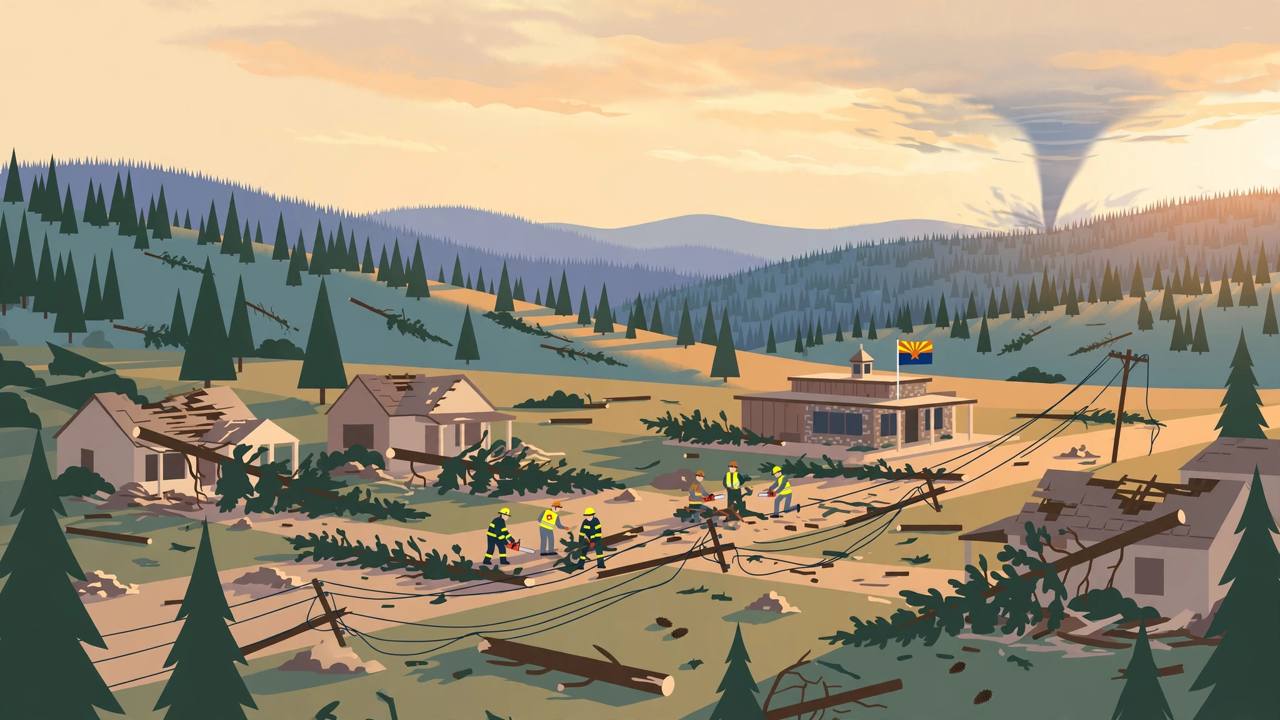
Nine days after an EF-1 tornado tore through Heber-Overgaard — and days after initial reports, covered on this site, said she had declined to act — Arizona Governor Katie Hobbs on Friday, October 30, declared a state of emergency for Navajo and Coconino counties, the two northern Arizona counties hit by the severe storms of October 20–22. The declaration directs $200,000 from the state's general fund to the Arizona Department of Emergency and Military Affairs (DEMA), Division of Emergency Management, to support ongoing response and recovery work in the affected communities, the governor's office announced.
Source: Office of Governor Katie Hobbs, Oct. 30, 2026
The storm that started this: eleven minutes through Heber-Overgaard
The centre of the disaster is Heber-Overgaard, an unincorporated mountain community in Navajo County. The National Weather Service office in Flagstaff, which surveyed the damage, rated the October 21 tornado EF-1 with estimated peak winds of 110 mph. It touched down at 6:59 p.m., travelled 9.26 miles on a path up to 350 yards wide, crossed Highway 260 through town and lifted near Highway 277 about eleven minutes later. The Mountain Daily Star reported the twister uprooted trees, damaged homes and other structures, brought down power lines and left residents facing extensive cleanup — and the wider storm system of October 20–22 brought heavy rainfall, hail and damaging winds across the region, not just the one tornado.
Source: Mountain Daily Star, Oct. 31, 2026
Nine days from 'declined' to declared — the full timeline
The declaration did not come quickly, and the delay became a local controversy in itself. As the damage was still being counted on October 21, Legislative District 7 Representative Walt Blackman publicly called on Hobbs to declare a state of emergency in Navajo County. The Navajo County Board of Supervisors declared a local emergency of its own. Over the following weekend, a widely shared local post claimed the governor had declined the request and that the area would receive no more assistance — a claim local reporting examined and found only partly supported: no state declaration had been issued at that point, but state crews were already working in the area, because a county's local emergency declaration by itself authorises state agencies to provide mutual aid under Arizona law. Blackman subsequently urged the governor to reconsider, emphasising the need for long-term recovery assistance beyond the immediate response.
Source: Mountain Daily Star, Oct. 31, 2026
The formal step that unlocked the declaration came on Wednesday, October 28, when Navajo County officially submitted its application for state financial assistance, citing damage to public and private property, power outages, blocked roadways and potential threats to public health and safety, the governor's office said. On Thursday, October 29, Hobbs travelled to Heber-Overgaard herself and held a roundtable with state, county and local officials to review the damage and the recovery operation. The Mountain Daily Star listed those at the table: Navajo County Board of Supervisors Chairman Daryl Seymore, Vice Chair Dawnafe Whitesinger and Supervisor Jason Whiting, County Emergency Manager Catrina Jenkins, and Heber-Overgaard Fire Chief Jason Payne, alongside state and local emergency agencies. Hobbs also met volunteers from Navajo County Search and Rescue, the Navajo County Sheriff's Posse, the Heber-Overgaard Community Resource Network, Arizona Southern Baptist Disaster Relief and the American Red Cross. The declaration followed the next day, Friday, October 30.
Source: Office of Governor Katie Hobbs, Oct. 30, 2026
“My thoughts are with all of the Arizona communities impacted by last week's tornadoes and storms,” Governor Hobbs said in the announcement. “I am committed to making sure each community has the resources it needs to continue recovering, and am thankful to everyone who is supporting ongoing recovery efforts.”
Source: Office of Governor Katie Hobbs, Oct. 30, 2026
What $200,000 can — and cannot — do
Residents should understand exactly what this declaration is, because its name promises more than its chequebook. The $200,000 goes to DEMA's Division of Emergency Management to support response and recovery operations; the state has not publicly identified specific projects, recipients or dollar amounts within that allocation, and the declaration contains no itemised spending plan, the Mountain Daily Star noted. It does not automatically create direct financial assistance for individual homeowners, and it is not a federal disaster declaration. Local explainers of Arizona's system, published as the 'declined' controversy grew, pointed out that a state declaration's main concrete power is money — and that Arizona law caps a governor's emergency spending at $200,000 for a single disaster unless the State Emergency Council agrees to release more. The bigger prize, a federal FEMA declaration, has a far higher bar: the same analysis put FEMA's yardsticks at roughly $14 million in eligible damage statewide and more than half a million dollars in Navajo County alone.
Source: Bazaar Daily News America, Oct. 25, 2026
That gap between state and federal help is not theoretical in Arizona. The September 2025 flooding in Gila and Mohave counties produced a damage assessment above $30 million and killed three people; it received a state declaration and a formal federal request — and the federal request was denied, a denial upheld on appeal this past July on the grounds that the disaster was not beyond the state's own capability. Heber-Overgaard's residents, clearing debris and repairing roofs in a community where Highway 260 and Highway 277 are lifeline roads, are therefore recovering, for now, on county resources, state mutual aid, volunteers — and this $200,000.
Source: Bazaar Daily News America, Oct. 25, 2026
The declaration sends state money to DEMA for response and recovery operations — it does not, by itself, put assistance cheques in homeowners' hands, and no itemised list of projects has been published. Recovery work on the ground — debris clearing, repairs, volunteer help — is being coordinated locally in Navajo County, where the Board of Supervisors' own emergency declaration remains the working basis for mutual aid. Watch for DEMA and Navajo County announcements on how the $200,000 will be used, and for any move to ask the State Emergency Council for more, or to seek a federal declaration.
What happens next
The immediate work is unglamorous and ongoing: families, volunteers, first responders and local agencies continue to clear debris, repair damaged property and restore the community after one of the most destructive weather events in the area's recent history, as the Mountain Daily Star put it. The open questions are financial and political. Will DEMA's $200,000 be followed by a State Emergency Council top-up or a federal request, now that the governor has seen the damage herself? And will the nine-day path from tornado to declaration — through a public call from the area's own state representative, a county application and a gubernatorial visit — become the template northern Arizona communities expect, or the exception they criticise? For Coconino County, also named in the declaration after the same October 20–22 storm system, the same recovery machinery now applies. Awaaz Punjab will follow the money as DEMA publishes how it is spent.