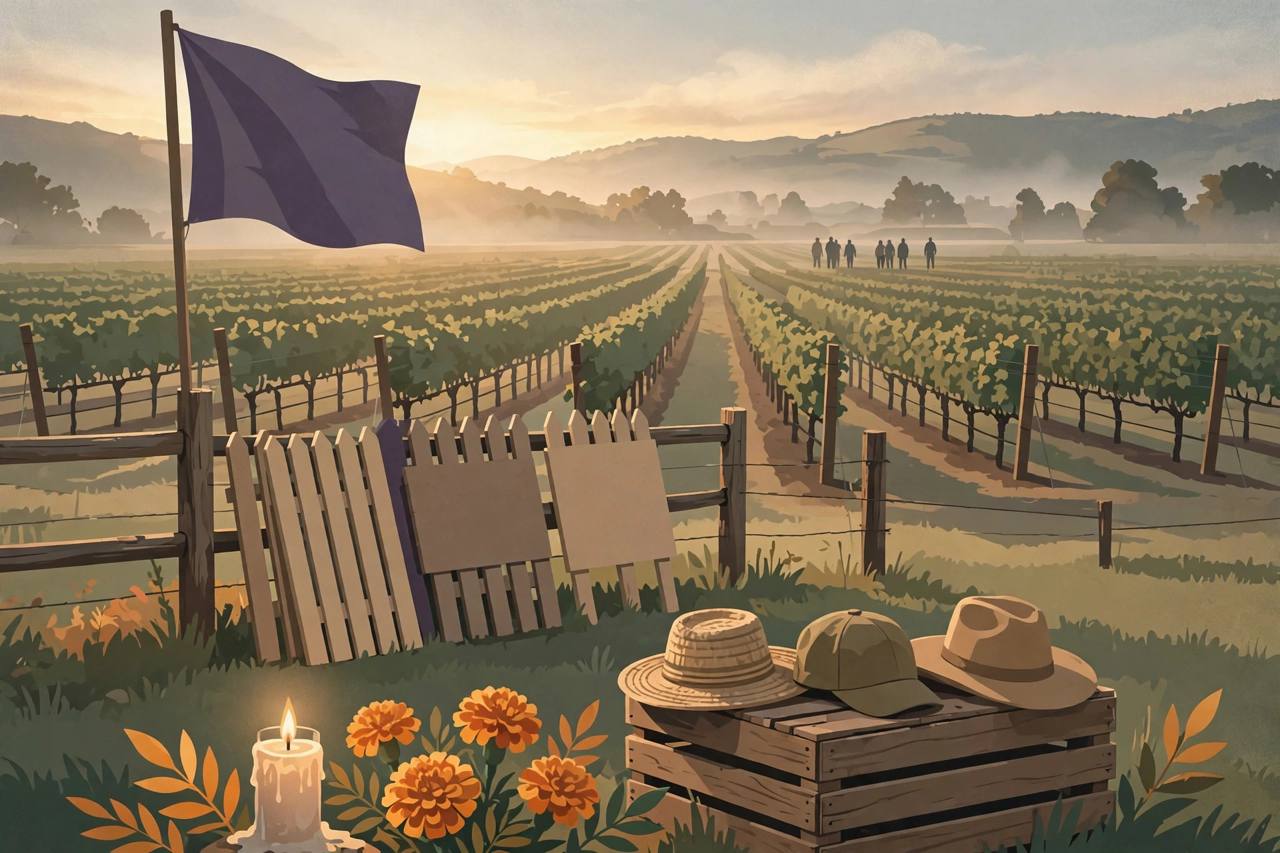
Dolores Huerta, who co-founded the United Farm Workers union with Cesar Chavez and gave American labour one of its most famous rallying cries, “Sí, se puede,” died on Wednesday, October 28, 2026, at her home in Bakersfield, California. She was 96. Her family said she died of cancer, surrounded by family, according to family spokesperson Erik Olvera.
Source: Associated Press via Lookout Santa Cruz
“Her life’s work was to empower her community to face and overcome injustices, and she has left farm workers and the entire Latino community stronger and more organized than she found it,” United Farm Workers President Teresa Romero said in a statement on Wednesday, the Associated Press reported.
Source: Associated Press via Lookout Santa Cruz
From a Stockton classroom to the fields of the San Joaquin Valley
Huerta was born Dolores Clara Fernandez in 1930 in Dawson, New Mexico. Her father was a miner and union activist who won a seat in the state legislature. Her parents divorced when she was 3, and her mother took her and her brothers to California, where she owned a restaurant and a hotel in Stockton and taught her children independence, compassion and activism among the city’s Mexican, Filipino, African American, Japanese and Chinese working families.
Source: Associated Press via Lookout Santa Cruz
She became an elementary school teacher in the agricultural San Joaquin Valley — the same Central Valley where Punjabi farming families have worked and settled for generations, from Fresno and Stockton to Bakersfield itself. Frustrated by her pupils’ living conditions, she later explained: “I couldn’t stand seeing kids come to class hungry and needing shoes. I thought I could do more by organizing farmworkers than by trying to teach their hungry children.”
Source: Associated Press via Lookout Santa Cruz
Delano, the grape strike and the first farmworker contracts
Huerta’s early work with a Stockton civil-rights group, the Community Service Organization, brought her together with Chavez. Wanting to focus on farmworkers, the two started the National Farm Workers Association in 1962 with Gilbert Padilla. Filipino workers of the Agricultural Workers Organizing Committee, led by Larry Itliong and others, began the Delano grape walkout on September 8, 1965; Huerta and Chavez’s association voted to join on September 16. The two organisations merged in 1966 and became the United Farm Workers union in 1972.
Source: Asian Journal
Huerta organised consumer boycotts on the East Coast and negotiated directly with grape companies. By 1970 the campaign had won grape-industry contracts that raised wages and brought health benefits, clean drinking water, field toilets and protections against dangerous pesticides. Her legislative work then helped win California’s Agricultural Labor Relations Act of 1975, the first state law giving farmworkers collective-bargaining rights — rights that still govern field work in California today, for Punjabi, Mexican, Filipino and every other farmworker community in the Valley.
Source: Asian Journal
“Sí, se puede” — and the nation’s highest civilian honour
Huerta is credited with coining the UFW slogan “Sí, se puede” — “Yes, it can be done” — later carried into English as “Yes, we can” and used by Barack Obama’s 2008 presidential campaign. When President Obama presented her with the Presidential Medal of Freedom in 2012, he praised her as a tenacious leader and joked that she was gracious when he stole her slogan: “I’m pleased that she let me off easy — ’cause Dolores does not play.” She was the first Latina inducted into the National Women’s Hall of Fame and received nine honorary doctorates, and April 10, her birthday, is Dolores Huerta Day in California and Washington state.
Source: Associated Press via Lookout Santa Cruz
The secret she revealed in her final year
This year, Huerta revealed a chapter she had kept secret for some 60 years: she said Cesar Chavez sexually abused her in the 1960s, leading to the birth of two children — an account the Associated Press reported from her own public statements in 2026. She said she had stayed silent because she feared coming forward would compromise her life’s work and unravel the progress made for workers. “It was my personal pain, it was my personal problem and, you know, I think it was worth it because it was my cross to bear,” she told Latino USA in a 2026 interview. Chavez died in 1993; after her revelation, his reputation soured and his name was removed from streets, buildings and a holiday, AP reported. Huerta had 13 children in all — seven from two earlier marriages, two she said were Chavez’s, and four with her later life partner Richard Chavez, Cesar’s brother.
Source: Associated Press via Lookout Santa Cruz
Jailed 22 times, beaten in 1988 — and marching into her nineties
Huerta was jailed 22 times for union demonstrating. In 1988, protesting in San Francisco during a visit by Republican presidential candidate George H.W. Bush, she was struck by a police officer’s baton, suffering three broken ribs and a pulverised spleen and requiring more than a dozen blood transfusions; she later reached a settlement with the city. She never retired from the streets: in October 2025 she spoke at a “No Kings” rally in Watsonville, calling aggressive federal immigration enforcement an attack on people of colour, and she told AP in August 2026: “It seems like history continues to repeat itself. You see what’s happening right now in our country, and we know that people have to stand up.”
Source: Associated Press via Lookout Santa Cruz
Tributes from Sacramento and Washington
California Governor Gavin Newsom said California would not be where it is without her “passion for justice and fairness,” and his office ordered flags flown at half-staff in her honour from October 28 to October 31. “Dolores’ fight for gender equity, workers’ rights, and civil rights paved the way for generations to come,” Newsom said. Former President Bill Clinton and former Secretary of State Hillary Clinton called her “a stalwart champion of working Americans” and “a living legend who never stopped pushing for progress.” Maryland Governor Wes Moore said she had led strikes and boycotts, helped pass the landmark collective-bargaining law and inspired generations of organisers.
Source: Reuters
Huerta’s family has asked for privacy, and a family spokesman said plans to commemorate her life will follow. The Dolores Huerta Foundation, which she founded in 2002 and which is based in Bakersfield, continues her voter-registration and community-organising work. For Punjabi and other immigrant farm families across the Central Valley — the fields around Delano, Stockton, Fresno and Bakersfield where she spent her life — the contracts, drinking-water and pesticide rules and bargaining rights she won remain part of everyday working life.
“I hope that my legacy will be one of an organizer that organized to fight injustice,” Huerta said in the 2025 documentary “Seeds of Change: The Life and Legacy of Dolores Huerta.” “We want to give our children an inheritance of justice, right, not jewels or property or money… the main thing to do is to give them this love for justice — and that is the greatest gift I think that any of us can have.”