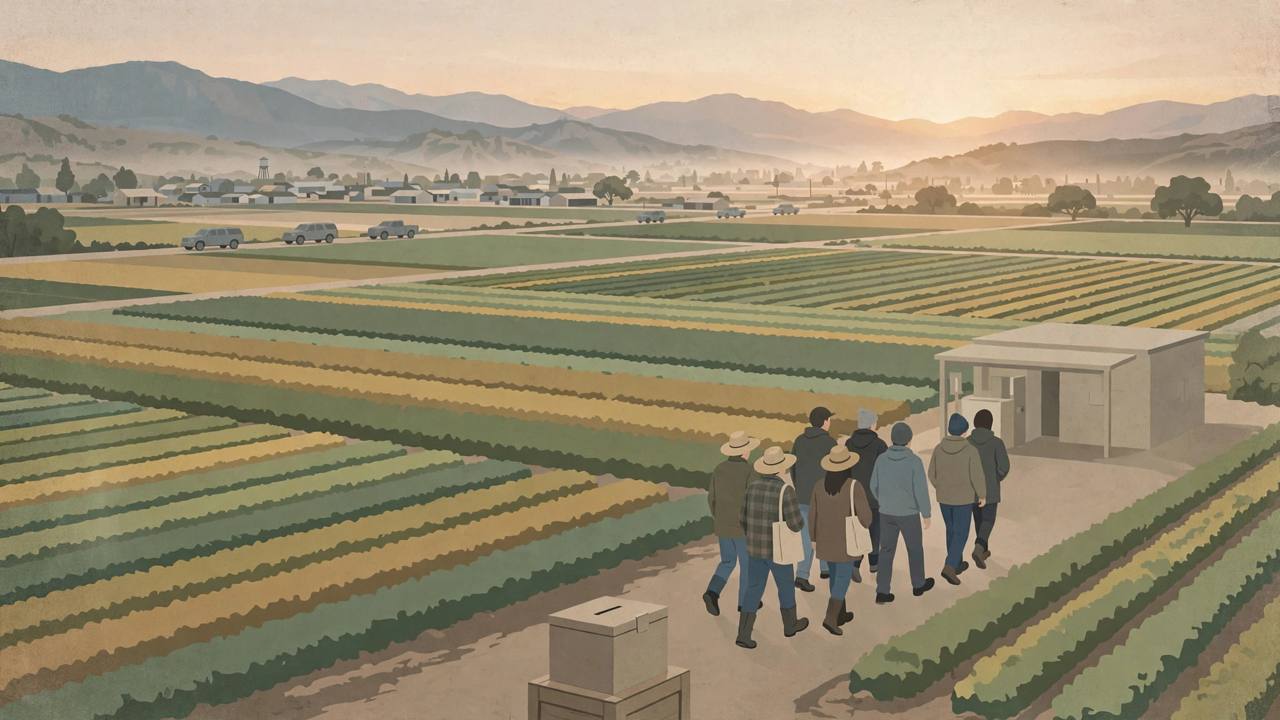
BAKERSFIELD, California — Federal immigration agents have fanned out across California's Central Valley in recent weeks, and new reporting by Reuters, published on October 31, puts hard numbers on a surge that farmworker communities say has emptied streets, thinned work crews and — three days before the November 3 midterm elections — raised allegations of voter intimidation in one of the closest House races in the country.
Source: Reuters via WNFL
In Bakersfield, the Kern County seat, immigration arrests jumped from about one a day for much of the year to nearly 10 per day in mid-October, according to preliminary Department of Homeland Security (DHS) data seen by Reuters. In nearby Wasco, a town of just 26,000 people, U.S. Immigration and Customs Enforcement (ICE) arrested at least seven people in the span of a few days, the data showed.
A White House-directed surge, run town to town
The planned surge in California was announced to agents in an internal email in early October, Reuters reported, and was directed by the White House, according to a U.S. official who spoke on condition of anonymity because they were not authorized to speak to the media. Unlike past operations in big cities such as Minneapolis and Chicago, which put hundreds of armed, masked agents on the streets, the Central Valley surge has been carried out by small groups of officers moving from town to town across the largely agricultural region.
“Agents were given the green light to be out and make as many arrests as possible,” the U.S. official told Reuters, adding that officers are also auditing records at local businesses and using employee information to arrest workers at their homes or on their daily commute. Across the valley, ICE has made arrests outside homes and at busy intersections, in strip-mall parking lots, at gas stations and near schools, according to lawyers, immigration advocates, videos and court records cited by Reuters.
The United Farm Workers (UFW) union said it knew of hundreds of California farmworkers detained in recent weeks. UFW national vice-president Elizabeth Strater told Reuters that the vast majority of the farmworkers detained had no criminal records, and some had legal work authorization.
The race it could decide: Valadao versus Villegas in CA-22
The arrests land in California's 22nd congressional district, which includes Bakersfield and is 73% Latino. Polls have shown progressive Democrat Randy Villegas with a slight edge over six-term Republican incumbent David Valadao, in a race that could help decide control of the U.S. House of Representatives. Republicans are fighting to retain control of both the House and the Senate on Tuesday.
Villegas told reporters last week that the arrests were a “very clear attempt to try and intimidate our communities before this election,” and he has made them a campaign issue, criticizing Valadao for voting to triple ICE's budget and failing, in his words, to “stand up for immigrant communities.” Valadao said in a statement that he understood “the fear and uncertainty immigration enforcement has created for families throughout our communities,” and urged the Trump administration to “prioritize the removal of individuals who pose a threat to public safety.” In an interview with the Sacramento Bee published this week, Valadao said the agency had gone too far in some cases but declined to give examples, while also saying ICE is targeting criminals in the community.
“By all metrics, this should be a very close district,” said Thad Kousser, co-director of UC San Diego's Center for Transparent and Trusted Elections. “Anything that drives voters to or away from the polls could matter.” A Reuters/Ipsos survey last month found just 24% of Hispanic Americans approve of President Donald Trump's performance — the lowest share in either of his presidential terms — after he made historic inroads with Hispanic voters in 2024.
DHS, ICE's parent agency, declined to comment on the California operations, citing concerns for officer safety, and did not respond to the allegations of voter intimidation. White House spokeswoman Lauren Bis said in a statement that Trump's agenda had made Hispanic Americans “more prosperous and safer” and referred questions on ICE operations in California to DHS. Asked separately by NPR about a recent surge, ICE responded: “ICE agents uphold our nation's immigration laws in all 50 states, seven days a week, 24 hours a day.”
“Those who can vote won't do so, because their parents are immigrants”
Maribel Ramirez, a local farmworker, told Reuters the arrests have had a chilling effect on political activity: some young Hispanics with U.S. citizenship have told her they are scared to vote, fearing it could expose the addresses of family members without legal status. “Those who can vote won't do so because their parents are immigrants,” she said, adding that she is urging every U.S. citizen she knows to cast a ballot. In Bakersfield, barber-shop owner Ana Valencia said there are fewer people on the streets and some local businesses are offering free delivery to those afraid to leave their homes. Valencia said she voted early “because I don't want ICE here, or anywhere really.”
The pattern is not confined to California. NPR reported on October 30 that cities and states across the country — including Dover, New Jersey, rural Illinois, Oregon, Detroit and New York City — have reported a notable rise in ICE activity in the weeks before the midterms, even as early turnout surges. “The tactics that the administration has been deploying in communities really appear to be designed to try to intimidate voters,” Wendy Weiser of the Brennan Center for Justice at NYU Law School told NPR — an allegation the administration has not accepted, and one DHS did not answer when NPR asked whether there has been a recent surge.
Source: NPR via Central Florida Public Media
One family's case, now before a federal court
Reuters described a brother and sister from Mexico who were unloading their shopping in a small Kern County town in late October, on a day off from work in the fields, when immigration agents arrested them. According to a relative who spoke on condition of anonymity, the agents were looking for someone else and did not know whom they had picked up until the handcuffs were on. A petition filed by the farmworkers' lawyers in federal court contests their detention as unlawful. The sister arrived in the U.S. as an unaccompanied minor more than a decade ago and the brother arrived as a toddler; neither has a criminal record, the petition says. DHS said it did not have enough information to comment on the case. Awaaz Punjab is not naming the family: Reuters did not name them, and the case involves minor children.
Why this matters in the Central Valley — and to Punjabi readers
The Central Valley is the agricultural engine of California and home to one of the largest Punjabi communities in the United States — farm owners, farmworkers, and truckers who run Highway 99 and Interstate 5 between Bakersfield, Fresno and Sacramento. An enforcement surge that moves town to town, audits business records and makes arrests on work commutes reaches directly into the fields, packing sheds, dhabas and trucking yards that Punjabi families depend on, whichever side of the status line they stand on. Jason Giannelli, 41, a fourth-generation farmer in Kern County who supports Valadao, told Reuters the Republican was “middle of the road” on immigration and “understands that probably ICE is going after the worst of the worst” — a reminder that valley opinion is divided, including among growers who rely on immigrant labour.
What is solid
- Preliminary DHS data reported by Reuters shows Bakersfield immigration arrests rising from about 1 a day to nearly 10 a day in mid-October, with at least 7 arrests in Wasco within a few days.
- The California surge was announced to agents in an internal email in early October; the UFW says hundreds of farmworkers have been detained in recent weeks.
- DHS declined to comment on the California operations, citing officer safety.
What is only claimed
- Whether the surge is intended to intimidate voters before the November 3 midterms — alleged by challenger Randy Villegas and the Brennan Center's Wendy Weiser; DHS did not respond to the allegation, and Rep. David Valadao says enforcement should prioritize people who pose a public-safety threat.
What happens next
Voting in the midterm elections ends on Tuesday, November 3, with control of the House and Senate at stake — and CA-22 among the races that could tip the House. The federal court petition contesting the detention of the Kern County brother and sister will test how the courts treat arrests of people agents were not looking for. And with DHS declining to describe the scope or end date of the California operation, valley advocates say the alerts, business audits and commute arrests are likely to continue past Election Day, whatever the result.