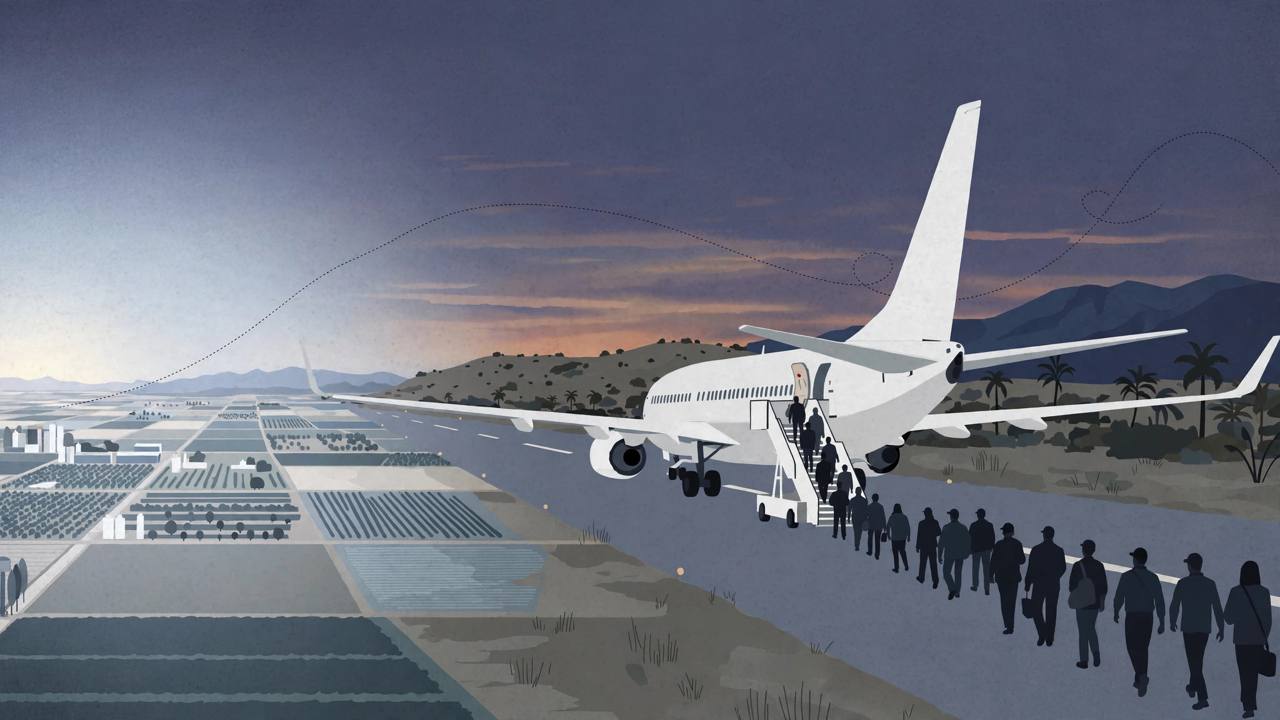
Luis Arreguin, 54, had lived in a small community near Fresno, California, since he was five years old. On the morning of October 1, federal immigration agents pulled him over on his way to work. Fifteen days later he was on a packed deportation flight to Tapachula, in Mexico's southern state of Chiapas, and within 16 days of his arrest he was standing in Mexicali, a border city he had not lived in since childhood, looking at a cathedral he had not seen in decades. “My whole life got destroyed,” Arreguin told CalMatters, which traced his case in a detailed report published on October 28. He is married, has four children, and worked as a skilled laborer and his family's main breadwinner.
Source: CalMatters
Arreguin was among the first of about 130 people who advocates say were taken into custody during the opening days of the Trump administration's latest immigration enforcement surge in the San Joaquin Valley, according to CalMatters. The expanded enforcement later spread to the rest of California and became known as “Operation Safe California.” Arreguin said the agent who stopped him told him, “I've been watching you,” and that agents swept his small farmworker town the same morning. “My whole community works in the fields. They did a sweep on my little town, and my wife called me and said, 'It's empty, babe. It's empty,'” he said. He said he had had no recent interactions with law enforcement, and a public records search by CalMatters returned no recent criminal history.
Fifteen days in custody: Fresno, Bakersfield, then El Paso
After his arrest, Arreguin was held at an ICE office in Fresno and then transferred to Bakersfield, CalMatters reported. He said he was moved back and forth while his blood pressure climbed, until he eventually spent about seven hours in an emergency room in Bakersfield. He said agents asked him, “Are you afraid to go back to your country?” and he answered yes, believing that answer would pause his case and at least give him a chance in court. It did not. Several days later, agents transferred him across state lines to Camp East Montana, a detention facility on the outskirts of El Paso, Texas.
Camp East Montana has been a focal point for lawsuits by civil rights organisations and detainees, who have complained about harsh conditions, including not getting enough to eat and insufficient medical care, CalMatters reported, adding that in September 2025 ICE's own internal watchdogs found dozens of violations at the facility, as the Washington Post reported. Arreguin spent five days there before, he said, his phone communication was cut off and he was put on the plane to southern Mexico. “At least I am safe here, and I'm not behind the walls of a detention center where I could die,” he said after reaching Mexicali.
A crowded flight south — and no response from ICE
Arreguin said his flight carried roughly 300 fellow deportees, all shackled and chained at the wrists and ankles. He counted 22 women and one minor among them. “They shackled a 14-year-old kid,” he said. He described agents restricting people's access to bathrooms and water during 36 hours of travel, and said officers taunted him with news stories and social-media videos about his own case. Other people on the flight who spoke to CalMatters on condition of anonymity corroborated the details he gave. ICE has a long-standing operational policy that mandates passengers in custody are shackled with handcuffs, waist chains and ankle restraints during flights, including during layovers and refuelling stops, CalMatters noted. ICE did not respond to CalMatters' questions about the flight or the conditions Arreguin described. One detail he said he will never forget: “Everybody on that plane had their work clothes on. Every single one of them.”
The speed of Arreguin's removal reflects the national numbers. U.S. Immigration and Customs Enforcement removed more than 356,000 people in the first nine and a half months of the 2026 fiscal year, which began on October 1, 2025, according to agency data cited by CalMatters — already surpassing the roughly 320,000 removals ICE carried out in all of fiscal year 2025. Independent reviews of the same ICE data put the figure at 356,389 removals through July 11, alongside a near three-fold rise in the average daily detention population compared with 2022, showing how much of the growth is coming from arrests inside the country rather than at the border.
Source: Center of the American Experiment (ICE data review)
Why he was flown to Mexico's far south, not dropped at the border
Since this spring, the administration has largely stopped sending Mexican nationals back across the land border, CalMatters reported. Instead, it is flying them deeper into Mexico, where officials believe people dropped near the Guatemala border are less likely to try to cross back into the United States. In Tapachula, Mexican officials fed Arreguin and gave him a debit card loaded with 2,500 pesos, about $130. That money got him as far north as Mexico City; his adult daughter paid for the rest of his bus journey to Mexicali. The shift shows in Mexico's own numbers: in the first seven months of 2026, just 1,567 people came through the Mexicali crossing, less than 2% of the national total, while Tapachula and Villahermosa together took 48,000 people, nearly half of all returns, according to Mexico's Interior Ministry figures cited by CalMatters. In 2024, by contrast, more than 43,000 Mexicans were returned through the Baja California crossings at Tijuana and Mexicali alone, about one in five of all repatriations nationwide.
In Fresno, the consequences are still unfolding. Arreguin and his wife had never spent a night apart in 31 years of marriage until his arrest, he said; last week she drove seven and a half hours to visit him in Mexicali. She is now packing up the family's five-bedroom house to move, because the family does not have the money to stay without his income. His two youngest children, aged 6 and 10, will have to change schools. His daughter Elaina is paying for his motel and food, maxing out her credit cards, and looking for a place in Mexicali big enough for the whole family to visit him at Thanksgiving. “You've supported me for years,” she told him. “Now I can do that for you.”
Fresno and the San Joaquin Valley are home to one of the largest Punjabi communities in the United States, built around farming and trucking. CalMatters' reporting shows that in the current surge, a man with no recent criminal history found in a records search was arrested on his way to work and removed from the country in about two weeks — a timeline Valley families, employers and truck operators are now planning around.
What happens next
Arreguin is working on finding a lawyer to help him fight his deportation and return to his family, CalMatters reported. “I have to fight,” he said. “You know you can't just take people away from their family.” Whether his case can be reopened from Mexico is a legal question his family has not yet answered, and ICE did not respond to CalMatters' questions about his flight or treatment. What is already clear from the agency's own data is the pace: with removals in nine and a half months already above the whole of last year, the enforcement surge that began in the San Joaquin Valley and spread statewide as Operation Safe California is continuing — and families across the Valley, including its large Punjabi community, are measuring its speed in days, not months.