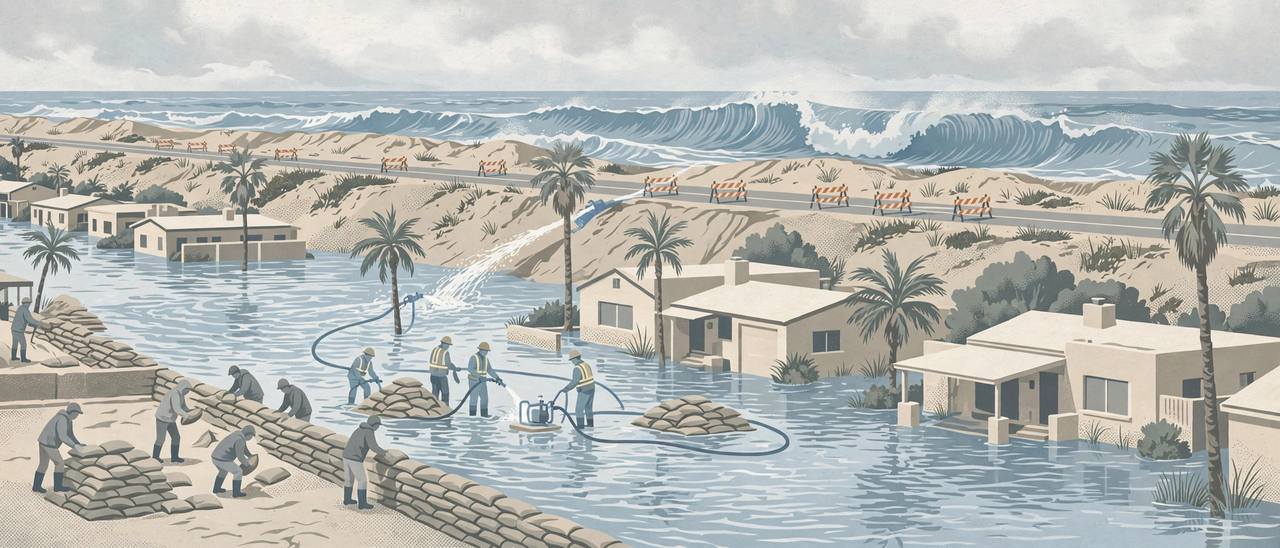
HUNTINGTON BEACH, Calif. — The Huntington Beach City Council voted 7-0 on Thursday, October 30, to ratify a proclamation of local emergency after a week of exceptionally high king tides flooded homes and streets in Huntington Harbour and Sunset Beach, damaged 114 properties and forced repeated closures of the Pacific Coast Highway, according to city documents and local reporting.
Source: City of Huntington Beach / Citizen Portal
The ratification, adopted as Resolution No. 2026-41, confirms the emergency first proclaimed on October 26 by City Manager Travis Hopkins in his capacity as director of emergency services, and authorizes emergency purchases, closures, evacuations and other orders to protect life and property. It is the newest and most serious development in the record-tide week Awaaz Punjab first reported on October 26, when the San Pedro gauge broke its all-time record and streets flooded in Newport Beach — a story that at that point did not yet include a damage toll from Huntington Beach.
The damage count: 114 properties, six homes yellow-tagged
The coastal flooding affected about 114 buildings in Huntington Beach, according to the city, and six homes received yellow tags, which limit access because officials identified safety hazards. In one especially serious incident, saltwater reached a lithium-ion battery and ignited a fire inside a building. Residents in Sunset Beach and Huntington Harbour spent the week in cleanup mode, working to keep seawater out of homes and businesses as street after street filled with water.
Source: Internews Cast / ABC7 Los Angeles
The city said it activated its Mobile Command Post and deployed emergency response resources into the areas expected to be hit hardest, particularly Sunset Beach and Huntington Harbour. Crews built and reinforced sand berms, installed sandbags and protective barriers, positioned pumping equipment and prepared personnel for flood rescue or evacuation. “We have our crews and our swift water teams out in the different neighborhoods just making sure, seeing if there's any assistance that they need,” Huntington Beach Fire Chief Eric McCoy told ABC7. The city also distributed sandbags and advised boaters to avoid unnecessary travel through Huntington Harbour, where boat wakes could worsen flooding and damage docks, bulkheads and private property.
On the roads, flooding forced the closure of Pacific Coast Highway between Warner Avenue and Anderson Street and of Saybrook Lane between Edinger Avenue and Humboldt Drive, the city announced on October 28. At times on Tuesday the highway was closed in both directions between Seal Beach and Huntington Beach, and on Friday, October 30, it closed again in the Sunset Beach area, with a reopening expected at 3 p.m., ABC7 reported. Orange County Metrolink also suspended rail service on Monday between Laguna Niguel/Mission Viejo and Oceanside. For truckers and commuters who use the Pacific Coast Highway corridor, the lesson of the week is to check city and National Weather Service updates before setting out, because closures have opened and shut again with each tide cycle.
Source: The Watchers / ABC7 Los Angeles
Why the water rose so high
King tides are the year's highest astronomical tides, occurring when the moon is closest to Earth and aligned with the sun. This time they arrived on top of an already elevated ocean. The National Weather Service office in San Diego reported on October 29 that observed high tides were running about 1.3 to 1.6 feet above astronomical predictions, and that sea levels near San Diego were about 17 inches higher than a year earlier, linked to thermal expansion in exceptionally warm Pacific waters during a strengthening El Niño. The California Coastal Commission has identified El Niño conditions and oceanic Kelvin waves as factors that can temporarily raise sea levels along the state's coast.
The gauges told the story in numbers. At San Diego, the water reached 8.52 feet above mean lower low water on Tuesday, October 27 — the highest measurement in that station's record, beating the previous day's record of 8.44 feet. In Huntington Beach, tides reached 8.20 feet during the week, producing widespread flooding in Huntington Harbour and Sunset Beach, the city's two most exposed waterfront communities, according to documentation prepared for the City Council.
The flooding was not only a Southern California story. The coastal flood warning for Orange and San Diego counties expired at 1 p.m. on October 29 and was replaced by an advisory until 2 p.m. on October 30; advisories also ran until 2 p.m. Friday for Los Angeles, Ventura, Santa Barbara and San Luis Obispo counties. Farther north, the Weather Service extended its coastal flood advisory for San Francisco, San Pablo and Monterey bays until 6 p.m. on Sunday, November 1, warning that water could reach as much as 1.9 feet above ground level in vulnerable low-lying places. In Marin County, officials confirmed flooding and multiple road closures, including Miller Avenue in Mill Valley, the western Redwood Highway frontage road near Highway 101, Golden Hind Passage in Corte Madera and Larkspur Plaza Drive.
Do not drive through barricaded roads or water of unknown depth, keep clear of sand berms, pumps and emergency crews, and follow city instructions on sandbags and flood barriers. Elevated water continues to threaten parts of the Bay Area into the weekend even as Southern California tides ease.
This week's emergency also had an earlier chapter: Newport Beach declared a local emergency on October 9, after large swells and unusually high tides sent seawater across the Balboa Peninsula, stranding drivers and leaving vehicles partly submerged. Experts cited in local reporting warn that this week's damage could be an early indication of more powerful El Niño-driven storms expected to affect California this winter.
What happens next: city inspections are continuing, and the exact damage totals and recovery costs may change as assessments finish — an emergency declaration is a government response tool and does not by itself establish that every affected property qualifies for financial assistance. The California Coastal Commission's designated winter king-tide periods fall on November 24–26 and December 23–25, 2026, and January 21–22, 2027, and the Weather Service notes the predicted astronomical high tides in those windows are higher than the ones that flooded the coast this week. ABC7 reported experts warning that tides around Thanksgiving and Christmas could reach about nine feet.