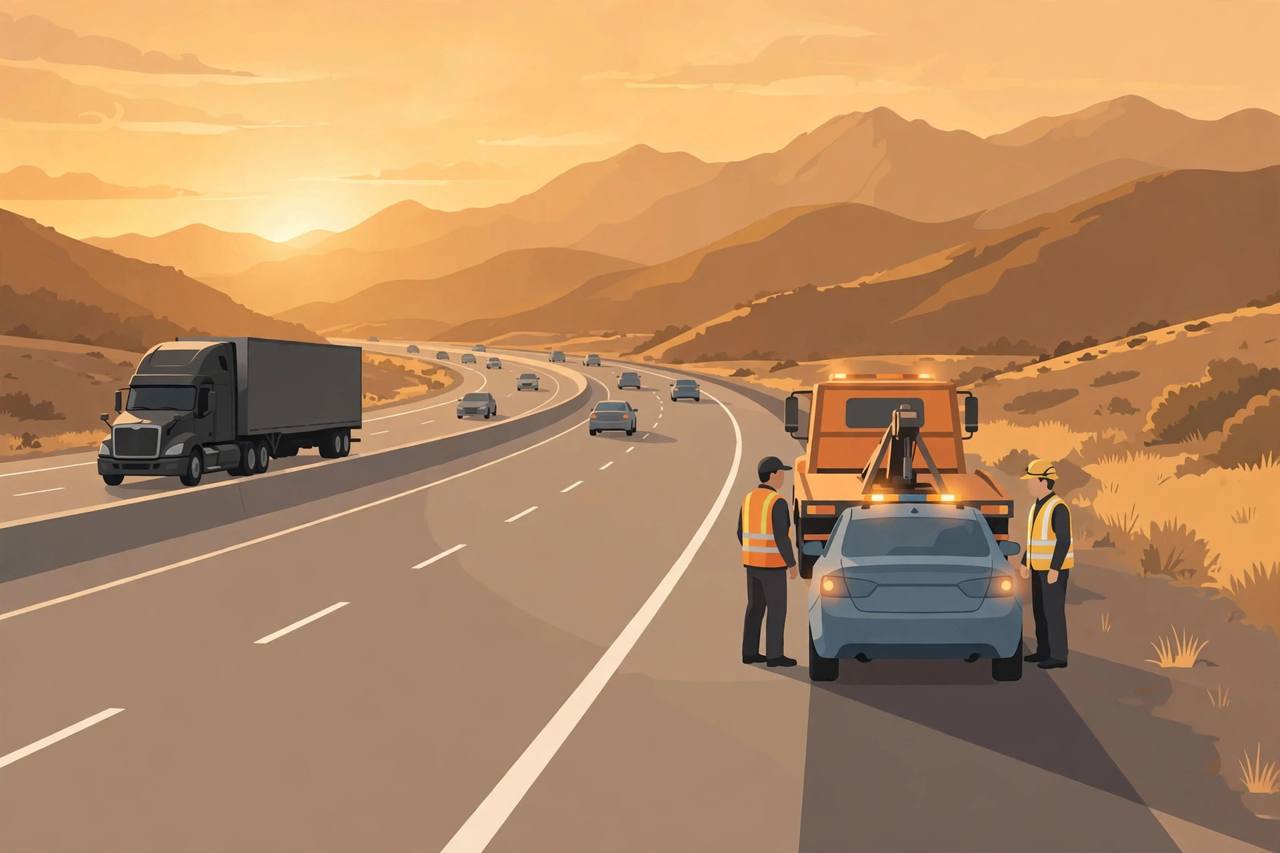
California's top road-safety agencies opened Crash Responder Safety Week on Monday, November 2, with a statewide call to action built around a law many drivers still do not know has changed: under Assembly Bill 390, California's Slow Down, Move Over requirement now covers every stopped vehicle on the side of the road displaying flashing hazard lights or another warning device such as cones or flares — not just police cars, fire trucks and tow trucks. Caltrans, the California Office of Traffic Safety (OTS), the California Highway Patrol (CHP), CAL FIRE, the California Tow Truck Association (CTTA) and AAA issued the joint appeal from Sacramento.
Source: Caltrans news release 2026-023, Nov 2, 2026
The rule itself is simple to state and, the agencies say, is being broken every day. When you approach a stopped vehicle on the shoulder, you must move over one lane if you safely can; if a lane change is not possible, you must slow down to a safe, reasonable speed. The expanded version of the law, authorized under AB 390 and sponsored by AAA, took effect on January 1, 2026, extending the duty from emergency and road-work vehicles to any stranded motorist — the driver with a flat tire, the family in a broken-down car, the trucker stopped on the shoulder with hazards on.
Who stands on the shoulder
Crash Responder Safety Week exists because the shoulder of a freeway is one of the most dangerous workplaces in the state. The responders the campaign names are law enforcement officers, firefighters, emergency medical personnel, tow operators, utility recovery teams and transportation crews — people who clear crashes, treat the injured, pull wreckage out of lanes and reopen roads, often working a few feet from traffic passing at full speed. Every year, responders are injured or killed doing that work, and traffic-related incidents remain a leading cause of death for them, the joint release says. All 50 states have Move Over laws; the problem, the agencies say, is compliance — nearly one-third of the public remains unaware the laws exist at all.
“Too many Californians are losing their lives simply because passing drivers fail to slow down or move over,” CHP Commissioner Sean Duryee said when the expanded law took effect. “This expanded law makes clear that every person on the roadside, whether a driver or a passenger, deserves the same margin of safety. Obeying ‘Slow Down, Move Over’ is not just a courtesy; it is a legal responsibility that saves lives.” Caltrans Director Dina El-Tawansy made the same point from the road-builder's side: “Everyone traveling on California's roads and highways deserves to arrive safely at their destination. The provisions added to the Move Over law will help keep more people safe and continue protecting the highway workers and first responders risking their lives to serve others.”
Source: AAA / Auto Club of Southern California, Jan 2026 — expanded Move Over law takes effect
The tow industry, whose operators are among the most exposed people on any shoulder, put it more bluntly in Monday's joint release: “With California's expanded Slow Down Move Over Law now including vehicles displaying hazard lights, we have another opportunity to remind motorists that roadside safety begins before we arrive. Tow operators and roadside technicians do not have a superhero cape protecting them. Distracted driving, impairment, speeding, and road rage continue to put everyone working along our roadways at extreme risk.”
What the expanded law means for truckers on California corridors
For the Punjabi and other immigrant truckers who run Interstate 5, Highway 99 and Interstate 80 through the Central Valley and across California, the expanded law cuts both ways — and both ways matter. As drivers, truckers are now legally required to move over or slow down for any stopped vehicle showing hazards, including a car on the shoulder at night on Highway 99 between Fresno and Bakersfield. As stopped drivers — and a semi pulled onto a shoulder with a tyre failure or a breakdown is one of the biggest, most exposed objects on any roadside — they and the tow operator or CHP officer standing beside their rig are exactly the people the expanded law now protects by name. With AB 390, California joined 28 other states and the District of Columbia that have extended Slow Down, Move Over protection to all stopped vehicles.
OTS Director Stephanie Dougherty framed the appeal as a thought experiment every driver can run: “As you head out on your next trip, keep in mind that driver with a flat tire or other roadside car trouble could very well be you. Please move over a lane or slow down for highway workers, first responders, tow truck drivers, and other stopped vehicles on the side of the road or shoulder. Make safety the destination we all share by looking out for every vehicle and person on the roadside.” AAA, which has championed Move Over laws for 20 years and sponsored AB 390, added: “Please help protect anyone on the roadside, whether a worker or a stranded motorist: slow down, and if safe to do so, move over, because everyone deserves to get home safely.”
See a stopped vehicle with hazard lights, cones or flares on a California road? Move over one lane if you safely can — or slow down to a safe speed. It now applies to every stopped vehicle, and violations can bring fines of up to $1,000.
What happens next
Crash Responder Safety Week runs through this week, with the partner agencies pushing the message through roadside signs, media events and the state's safety sites — BeWorkZoneAlert (beworkzonealert.dot.ca.gov/move-over) and GoSafelyCA.org carry the law's details, safety tips and current road-work updates. CHP enforcement of the Move Over requirement continues year-round, and the agencies say the measure of the campaign will be behavioural: whether drivers approaching a shoulder scene on I-5, Highway 99 or any California road lift off, slow down and give the people standing there a lane of room. Awaaz Punjab will note any major roadside-responder incidents and enforcement results reported during the week.