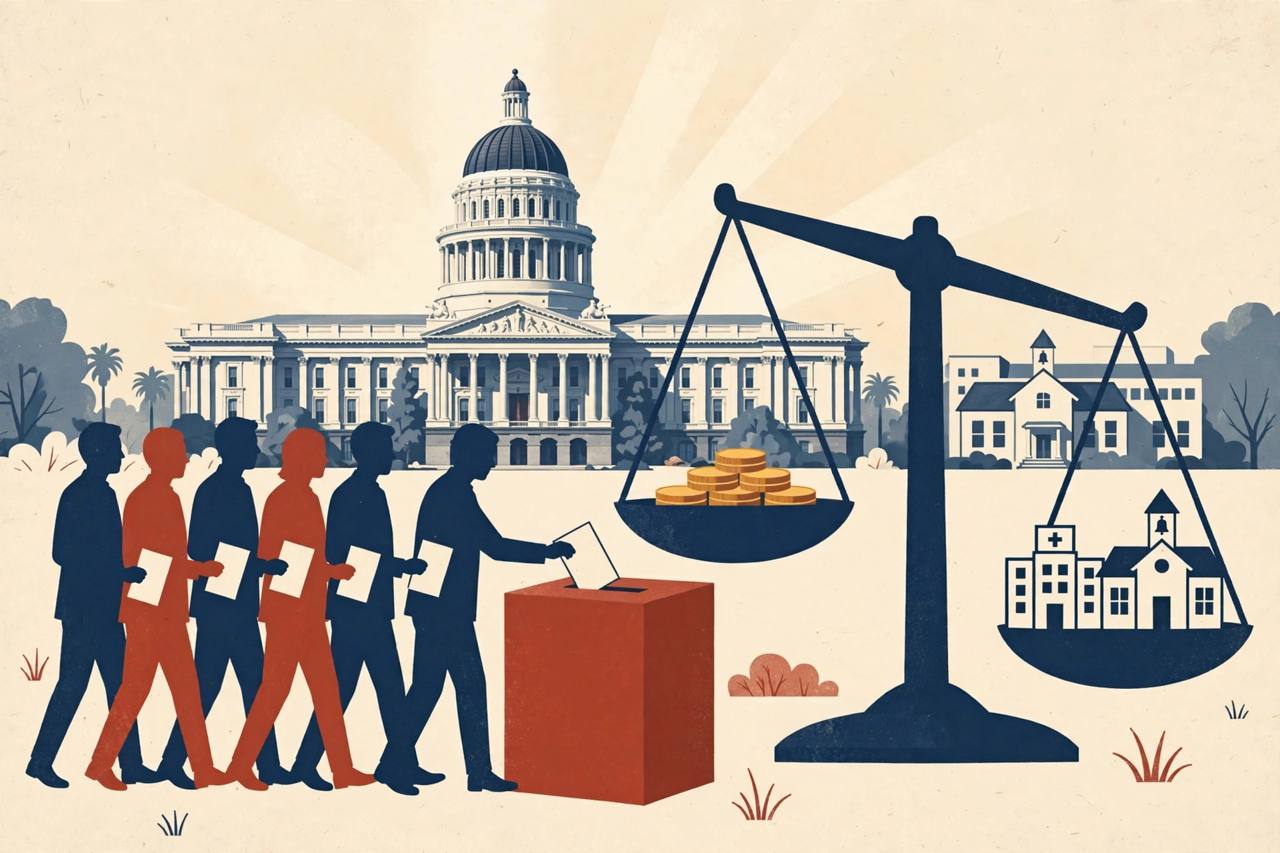
SACRAMENTO, California — California voters are deciding on Tuesday, November 3, whether their state becomes the first in the nation to tax the net worth of billionaires, under Proposition 40, a one-time 5 percent tax on residents worth more than $1 billion that has split the state's Democratic leadership, triggered one of the most expensive ballot fights in California history, and drawn in some of the richest people in the world on the opposing side. Polls are open from 7 a.m. to 8 p.m. Pacific Time, and anyone in line at 8 p.m. can still vote; the Associated Press listed the race as too early to call, with 23,860 precincts to report.
The measure, formally the 2026 Billionaire Tax Act, was put on the ballot by petition. It would impose a one-time state tax of 5 percent on the net worth of any individual who was a California resident on January 1, 2026, and whose net worth reaches $1 billion, with wealth measured as of December 31, 2026 and a married couple counting as one taxpayer. It is not an annual tax: it applies to the 2026 tax year only, and a yes vote does not create a permanent wealth tax.
Source: Associated Press
How the tax would actually work
The tax phases in between $1 billion and $1.1 billion, so a resident worth exactly $1 billion would owe nothing and one worth $1.1 billion would owe the full 5 percent. Covered assets include businesses, securities, art, collectibles and intellectual property, wherever in the world they are held; directly held real property and some pensions and retirement accounts are excluded. The tax would be reported and paid with 2026 income taxes in 2027, or in five equal annual instalments, with each deferred instalment carrying a 7.5 percent annual charge on the unpaid balance, according to the official voter guide summary prepared under the Attorney General.
Of the money raised, 90 percent would go to a new Billionaire Tax Health Account and 10 percent to an Education and Food Assistance Account. The Legislature could spend up to $22.5 billion a year from the health account and $2.5 billion a year from the second account, and could not use the money to replace existing funding. If the act passes, the Franchise Tax Board would receive a start-up loan of up to $50 million to build the assessment and collection machinery.
Why supporters say California needs it
The measure was filed in November 2025 by Suzanne Jimenez, chief of staff of SEIU-United Healthcare Workers West, the union that led the campaign and announced on April 26, 2026, that it had collected 1.6 million signatures, nearly double the 874,641 required to qualify. Its ballot argument says about 200 California billionaires should pay a modest, one-time tax on their global wealth to keep local hospitals and emergency rooms open, and claims the tax will raise about $100 billion, most of it dedicated to replacing federal funding cuts to healthcare that the union estimates at $100 billion over five years. The state's official fiscal analyst is more cautious: the Legislative Analyst's Office estimates the state would probably collect tens of billions of dollars, spread over several years beginning in 2027, while warning the exact amount is very hard to predict because so much of the wealth sits in fluctuating stock prices.
"It's time to collect those taxes so we can ensure that our healthcare system is still safe," said Lorena Gonzalez, president of the California Federation of Labor Unions, the Associated Press reported. Vermont Senator Bernie Sanders, who held rallies in California cities last month urging a yes vote, has framed the proposal as a monumental step toward reining in deep wealth inequality, and Massachusetts Senator Elizabeth Warren and Fremont Representative Ro Khanna also back it, as do the California Democratic Party, the AFL-CIO and the Teamsters.
Why opponents — including the governor — say no
Democratic Governor Gavin Newsom opposes the measure and warns it would prompt the state's wealthiest residents to move out of California and take their tax money with them; he supports a national minimum tax on anyone worth more than $100 million instead, and told reporters that Sanders' focus on wealth inequality was "spot-on" but that "on this issue, we fundamentally disagree." His likely successor, former federal health secretary Xavier Becerra, also opposes it, as do Planned Parenthood and the California Teachers Association, which are part of a coalition concerned about how the revenue would be divided and about the state budget if wealthy taxpayers leave — California's budget relies heavily on the income tax paid by its richest residents. The Legislative Analyst's Office projects a possible ongoing loss of income tax revenue of less than $1 billion a year if some billionaires relocate, and administering the tax itself would cost tens of millions of dollars a year for several years.
The money on the no side dwarfs the yes side. The Associated Press reported the no campaign has raised roughly 10 times as much as the yes side, much of it from tech moguls and venture capitalists; the committee Building a Better California, funded by donors including Google co-founder Sergey Brin, has raised more than $333 million, about 30 percent of it from Brin. Billionaires are already bracing: Brin and Google co-founder Larry Page started cutting ties with the state after the measure was unveiled, the AP reported, while Meta chief Mark Zuckerberg said he would stay in California for eight years and made a deal with Meta that would help him pay the tax without losing his ownership stake. Ordinary voters are split down the middle of the argument: Robert Swonger, an auto glass technician near Sacramento who is politically independent, told the AP he planned to vote no — "Obviously, I would like billionaires not to have as much money as they do. But I don't believe taxing them out of existence is going to work" — while Anthony Serrano, a Democrat in Folsom who works for Kaiser Permanente, said he was leaning yes because he supports "anything that is a positive for healthcare."
The catch: Prop 40 can win and still be blocked
Even a majority yes vote may not settle the question. Two other measures on the same ballot, Propositions 41 and 42, backed by the political action committee Building a Better California, were written to conflict with Proposition 40: one would end exemptions from the state spending limit that Prop 40 relies on, and the other would ban new taxes on financial assets and other personal property, a category that excludes real estate. Under Article II, Section 10(b) of the California Constitution, when provisions of measures approved at the same election conflict, the measure receiving the highest number of yes votes prevails — so if either Proposition 41 or 42 is approved and receives more yes votes than Proposition 40, the billionaire tax could be stopped from becoming law, with the courts deciding whether the measures truly conflict. Prop 40's text requires any validation lawsuit to be filed within 60 days of voter approval. Polling suggests the trap is real: a mid-October Public Policy Institute of California poll found likely voters at 52 percent no and 46 percent yes on Prop 40 — a reversal from early September, when 52 percent said yes — and a Berkeley Institute of Governmental Studies poll found 50 percent opposed and 42 percent in support.
What it means for California's Punjabi community
California is home to the largest Punjabi diaspora in the United States, concentrated in the Central Valley — Fresno, Sacramento, Stockton, Modesto, Bakersfield and Yuba City — and in the Bay Area and Los Angeles. The wealth tax would not touch working families, truck drivers or small businesses directly: it applies only above $1 billion in net worth. What is at stake for diaspora households is the other side of the ledger — the Medi-Cal and hospital funding the measure is designed to protect after federal cuts, in a state where immigrant families rely heavily on safety-net clinics and emergency rooms, and where thousands of Punjabi-owned trucking, farming and retail businesses pay the ordinary income and sales taxes that opponents warn could shrink if very wealthy taxpayers and their spending leave the state.
What happens next
Counting begins when polls close at 8 p.m. Pacific Time (11 p.m. Eastern), and mail ballots postmarked by November 3 will still be counted if they arrive by November 10, so a close result may not be final on election night. If Proposition 40 passes and outpolls both counter-measures, affected residents would value their worldwide covered assets as of December 31, 2026, and file with their 2026 returns in 2027. If it passes but is outpolled by Proposition 41 or 42, expect a court fight within 60 days. And whatever California decides, both sides agree the argument travels: Gonzalez said the campaign is "showing other states that you can look them in the eye — you can look these billionaires in the eye — and take them on." No state has imposed a wealth tax before; after Tuesday, California will either be the first, or the place the idea was tested and beaten.
Source: California Voter Information Guide / Legislative Analyst's Office (via California Today)
A one-time 5% tax on Californians worth over $1 billion on Jan. 1, 2026 — 90% for healthcare — that needs a majority AND more yes votes than Propositions 41 and 42 to take effect.