The U.S. Justice Department asked the Supreme Court on Monday, November 2 — one day before the midterm elections — to order California to set aside the mail ballots of more than 20,000 registered voters whom federal officials allege are likely noncitizens, and not count those ballots until each voter's citizenship is verified, Reuters reported. Solicitor General D. John Sauer filed the emergency application after the department lost the same argument in two lower courts in the past week.
Source: Reuters via KWSN
In its application, the department argued that the order is needed now because, once ballots are mixed together, they cannot be separated again. “Once California commingles the challenged ballots with lawful ones, there is no way to get the challenged ballots back,” the application says. The department called segregation a “modest remedy,” arguing that California's own election laws contemplate setting aside challenged ballots and that segregation is a standard remedy in election cases. It also urged the justices to order the ballots set aside on an interim basis immediately, while the court formally considers the request.
The third court fight in a week — how the case reached the Supreme Court
This is a follow-up to a fight this site has tracked through two earlier rulings. The Justice Department sued California on October 15, 2026, citing a 1996 federal law that makes it a criminal offence for a noncitizen to vote in a federal election, and demanded that ballots cast by people on a list of more than 20,000 registered voters — a list assembled by the Department of Homeland Security and sent to California officials and to Los Angeles County — be segregated and held back from the count. U.S. District Judge David Carter refused the demand, and on Friday, October 30, a divided panel of the San Francisco-based 9th U.S. Circuit Court of Appeals refused it again, 2 to 1.
In the 9th Circuit's Friday decision, Judges Mark J. Bennett, a Trump appointee, and Gabriel P. Sanchez, a Biden appointee, wrote that “there is a material risk that granting the United States its requested relief would result in disenfranchisement and could jeopardize the County's entire election.” Judge Patrick J. Bumatay, also a Trump appointee, dissented. The majority emphasised the states' constitutional power over election procedures and California's “comprehensive statutory scheme to ensure the integrity of its elections,” including a system for cancelling a registration if a voter is shown to be ineligible, Reuters reported. The panel also relied on the Purcell principle — the courts' practice of not changing election rules on the eve of a vote — and on the National Voter Registration Act, which bars states from systematically removing ineligible voters within 90 days of a federal election.
California Attorney General Rob Bonta answered the Supreme Court filing from a position of three straight court wins in a week. “Three legal victories in one week make clear that the Trump administration has zero authority to interfere in California's elections,” Bonta said. California and Los Angeles County officials have argued in court that the federal list is unreliable and that building a new system to identify and separate thousands of ballots while voting is already under way is not feasible. NPR reported that the actual number of ballots in dispute is likely much smaller than 20,000, because county officials have found that many people on the list did not have active registrations and were never mailed a ballot.
Background: a thumb drive, a refusal, and a wider mail-voting fight
Before suing, the department sent California election officials a letter in October instructing them to separate or withhold the ballots of anyone on an attached thumb drive; California refused, and the argument has been in court since. The application lands in a wider national fight over mail voting: the administration had already sought to restrict voting by mail — a method used more often by Democratic-leaning voters — and the Supreme Court rebuffed that effort in September, Reuters reported. No court has yet ruled on the full merits of the California lawsuit itself; every ruling so far has only denied the emergency demand to change how ballots are handled in the middle of an election.
The stakes are personal for California's immigrant communities, including the state's large Punjabi diaspora in the Central Valley, Sacramento, the Bay Area and Los Angeles. The 20,000 names are people the federal government alleges are “likely” noncitizens — an allegation, not a finding — and voting-rights lawyers argue that lists built from government databases can wrongly flag naturalised citizens, who vote by mail in large numbers in California. If the Supreme Court grants the application, ballots from listed voters would be held out of the count until their citizenship is verified; if it refuses, the ballots are counted like any others while the lawsuit continues.
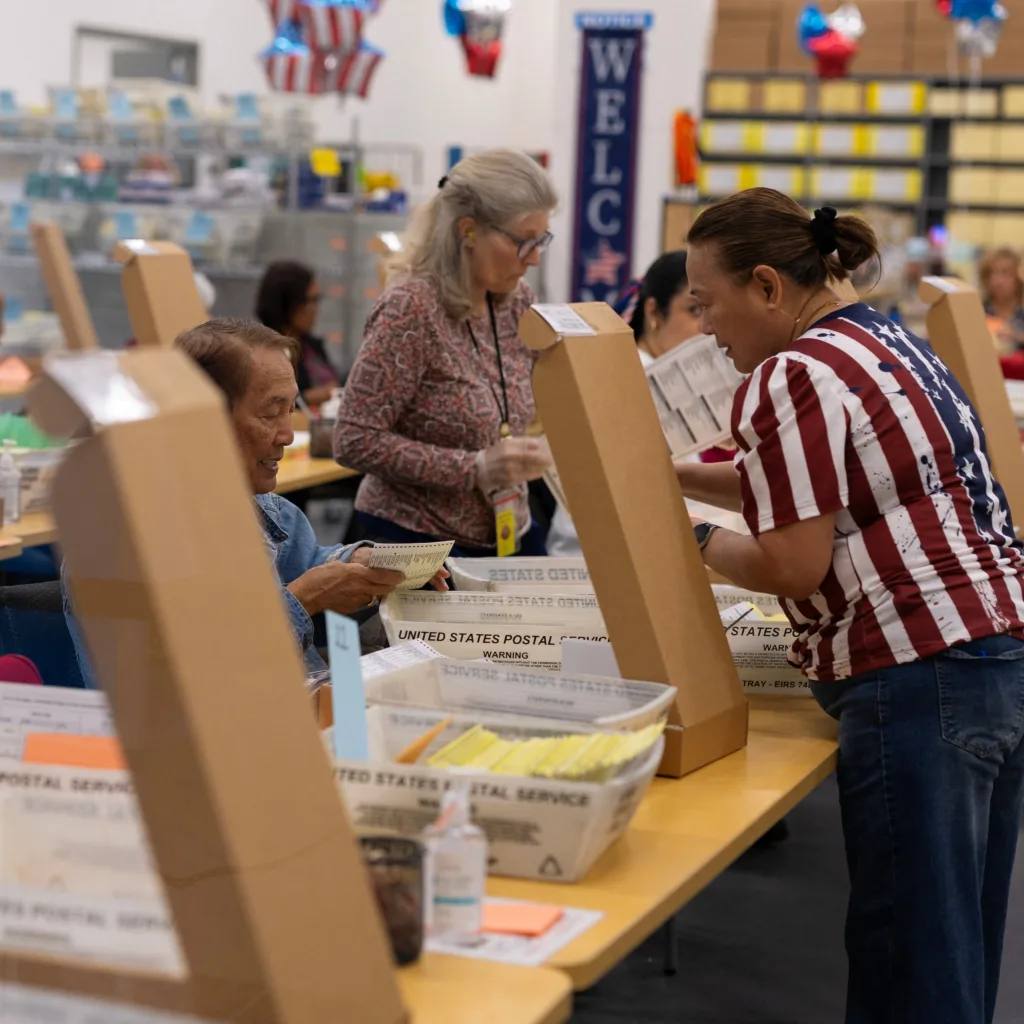
County workers would have to identify ballots belonging to listed voters, keep them physically separate from all other ballots, and leave them uncounted while each voter's citizenship is checked. California officials say no such system exists today and one would have to be improvised in the final hours of the election.
What happens next
An emergency application can be granted or denied without a hearing, and the justices could act before polls close on Tuesday — or not act at all, which would leave the lower courts' refusals in place. Whatever the Supreme Court does on the emergency request, the underlying lawsuit continues in Judge Carter's court. California counts mail ballots that are postmarked by Election Day and arrive within seven days, so any order setting ballots aside could affect results in close races well after Tuesday night.