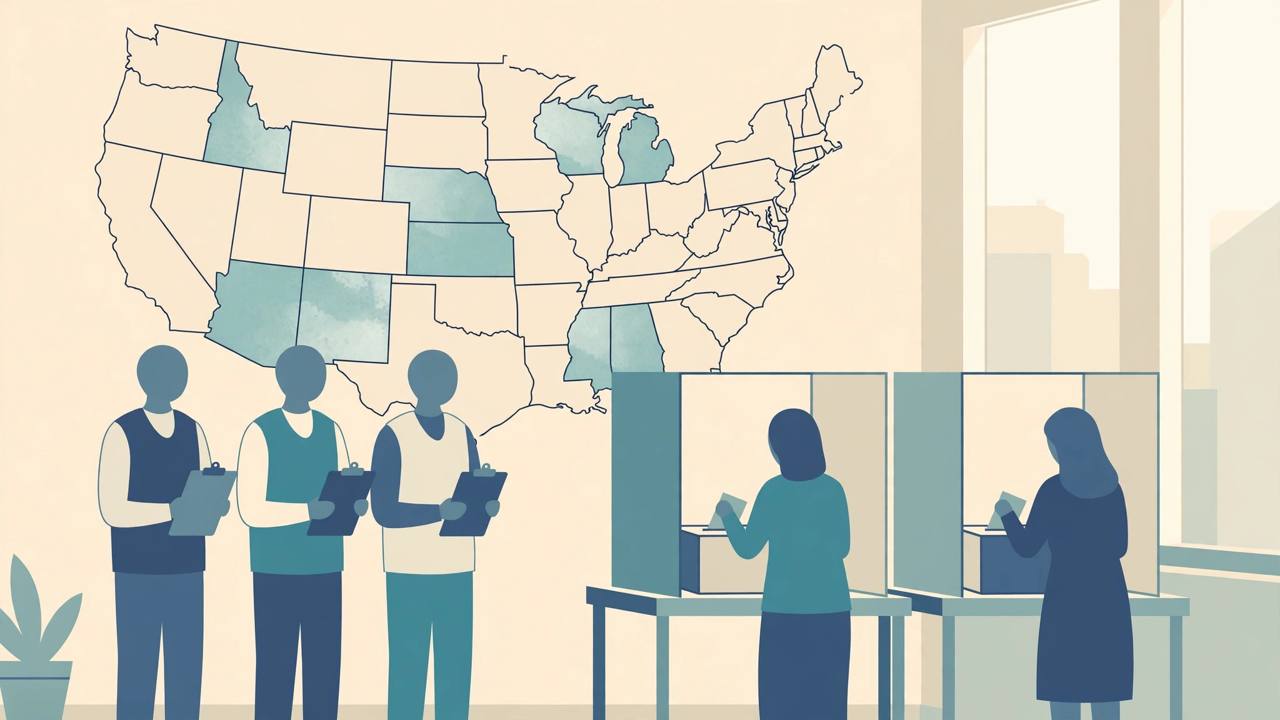
ATLANTA — More than 1,000 trained, nonpartisan citizen observers backed by the Carter Center are watching America's midterm election from inside the process on Tuesday, November 3, in five states — Georgia, Michigan, Montana, Nevada and New Mexico — in the largest domestic election observation effort the Atlanta-based centre has mounted at home. The Carter Center, founded in 1982 by former President Jimmy Carter and former First Lady Rosalynn Carter, has observed elections abroad for nearly four decades; this year it has turned that machinery on the United States itself.
In a statement issued on Election Day, the Center said each state's mission "will assess the quality of the election process, ensuring that applicable local, state, and federal laws are consistently and correctly applied." The work did not begin on Tuesday: observers were present for the pre-election testing of voting equipment, and it will not end when polls close — it continues through the post-election certification of results and audits. Preliminary reports are due later this week, with final reports in the coming weeks.
Source: The Carter Center
What the observers actually do
Before observing, volunteers complete training on state-specific election laws, procedures and safeguards. On the ground, they watch the process unfold, document what they see and put the facts on the record — they do not run polling places, handle ballots or interfere, and what they are allowed to watch varies by state, because the US Constitution leaves election administration to the states. In Georgia, observers can view tabulation and accuracy testing, and the Center will also observe post-election audits; in Nevada, partner observers could monitor early voting as well as Election Day operations. The Center cited a 2022 MIT study finding that most Americans across the political spectrum have higher trust in election outcomes when nonpartisan election observers monitor the process.
"The purpose of our observation is to make sure the process of compiling the results is transparent and verifiable," Jonathan Stonestreet, a senior associate director with the Center's Democracy Program, told CBS Atlanta. "We'll be deploying about 1,000 observers across those states to make sure that the process is transparent and to give citizens an opportunity to engage in the elections in a nonpartisan way." The US elections project is led by Sarah Cooper, a senior associate director in the Democracy Program, under program director Avery Davis-Roberts.
Georgia: the home-state mission
Georgia is the Center's home state — it is headquartered in Atlanta, in partnership with Emory University — and the one place where it leads the mission directly rather than working only through partners. Observers are deployed in 30 Georgia counties. The Center has observed parts of the US process since 2020, when it focused on Georgia's presidential recount, followed by Georgia observation in 2022 and 2024, and it previously published reports on the 2024 elections in Montana, New Mexico and Fulton County, Georgia. Georgia is also where the politics of who watches the vote has been sharpest this cycle: plans for federal monitors in six Georgia counties drew mixed reviews in local coverage in the final week of the campaign, a separate controversy the nonpartisan observers are designed to stand apart from.
Michigan, Nevada, Montana and New Mexico: the partner networks
Outside Georgia, the model is partnership with state-based networks that recruit and train local citizens to observe their own communities. In Michigan, volunteers have been recruited and trained by the Ford-Carter Election Observation Network, a partnership between the Carter Center and the Gerald R. Ford Presidential Foundation, to monitor each stage of the state's election process; veteran observer Terry Hoverter, who spent decades monitoring elections in countries including Nepal, Sri Lanka and Tanzania, said he expected about 200 observers in 15 Michigan counties. In Nevada, the Nevada Election Observation Network (NEON), founded in 2026 with Carter Center funding, trained 217 observers this year, according to its deputy state director Logan Gifford; its observers wear identifiable vests at polling sites, its northern Nevada regional coordinator Luiza Benisano described training in rules of conduct, and NEON says it will release the data its observers collect after the election. Alongside them, Silver State Voices, a member of the 866-OUR-VOTE coalition founded in 2012, planned to cover every polling site in Nevada, including 177 in Clark and Washoe counties, the Las Vegas Sun reported. Partner networks also run the Montana and New Mexico missions.
Source: Las Vegas Sun (via News in Las Vegas)
Why an election-observation group is working at home at all
Nonpartisan election observation is standard practice in much of the democratic world but has historically been uncommon inside the United States, where older election laws in some states do not clearly allow for it — states were selected in part on where observers are legally permitted to work. The Carter Center has conducted 128 full and limited election observation missions in 40 countries and three Native American nations since 1989, mostly in countries emerging from conflict or showing signs of democratic backsliding. This year, as the domestic effort expanded, the international presence shrank: the Organization for Security and Co-operation in Europe (OSCE), which has observed every US federal election since 2002, announced on September 23 that it had not received an invitation to observe the midterms. Civil-society groups have filled other gaps too, with initiatives placing trusted community figures such as faith leaders and teachers at polling places in Georgia, Michigan, North Carolina and Ohio to reassure voters and document intimidation, and Common Cause training more than 400 volunteers in Texas.
What it means for voters, including the diaspora
For immigrant and diaspora voters — including Punjabi-American communities in Atlanta's suburbs, metro Detroit, Las Vegas and Albuquerque — the observers' value is practical rather than symbolic: a trained, nonpartisan witness inside the polling place and the count is one of the few mechanisms that can later establish, from direct observation rather than rumour, whether procedures were followed, whether voters were turned away, and whether the count matched the process the law requires. That record becomes the raw material for the Center's public reports — and for any later dispute about what actually happened.
What happens next
Observers stay through tonight's count and beyond: their mandate runs to the certification of results and post-election audits, which in close states can take days or weeks. The Carter Center says preliminary findings will be published later this week and final reports in the coming weeks, state by state. Those reports will be the first test of whether a model built for fragile democracies abroad can measurably raise trust in an American election at home — the question the Center, by its own account, exists in this project to answer: it says it works "to strengthen democracy by building trust in elections and fostering peaceful civic engagement."
Carter Center-supported nonpartisan observers: 1,000+ volunteers in Georgia (30 counties), Michigan, Montana, Nevada and New Mexico — watching equipment testing, voting, counting, certification and audits, with preliminary reports later this week.