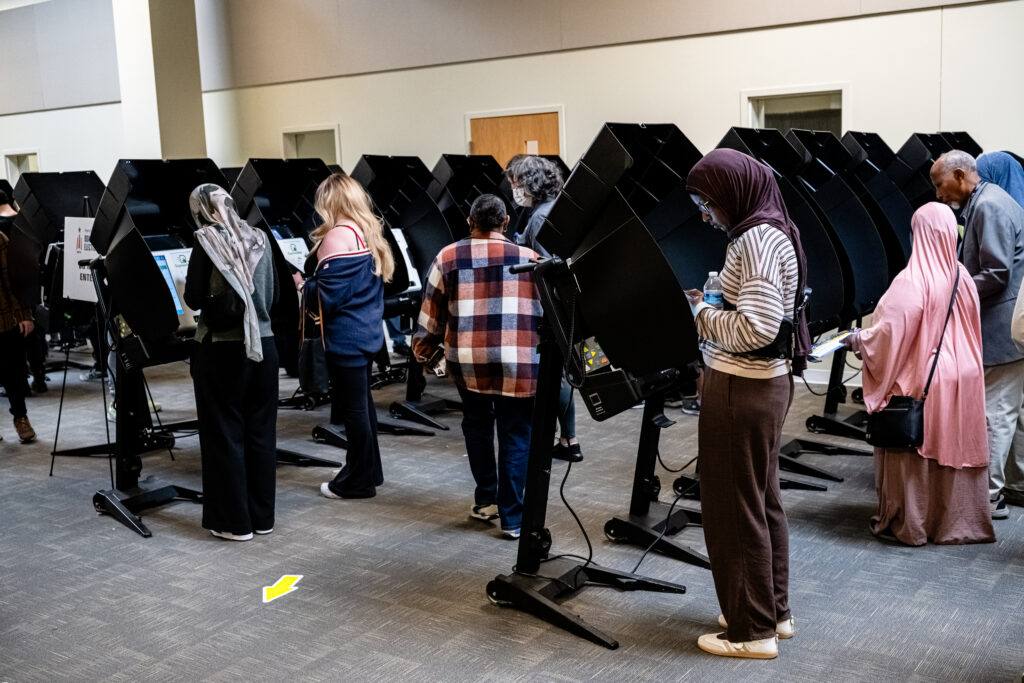
A federal judge in Washington late on Monday temporarily barred the Justice Department and the Department of Homeland Security from sending states lists of registered voters the Trump administration says may not be U.S. citizens, and from pressing election officials to set those voters' ballots aside or refuse to count them until citizenship is proved. The order landed on the eve of Tuesday's midterm elections, in which all 435 House seats and 35 Senate seats are on the ballot.
Source: Reuters
U.S. District Judge Tanya Chutkan ruled in League of Women Voters v. Department of Homeland Security, a case brought by the League of Women Voters, the League of United Latin American Citizens and the Electronic Privacy Information Center. She found the administration likely violated federal privacy and rulemaking laws by creating and disseminating lists it claims contain noncitizens registered to vote.
Source: Democracy Docket
"Federal law places restrictions on how the government may collect, use, store, and disseminate individuals' personal records," Chutkan wrote. She said the administration has "collected millions of voting records — including those of U.S. citizens — in an alleged effort to investigate noncitizen voting," and is now "transmitting selected portions to states and localities responsible for election administration, claiming the individuals are not eligible to vote."
Source: Democracy Docket
What the order does — and does not — do
The order is temporary. It does not establish that every person on a federal list is eligible to vote, and it does not prevent prosecution of a proven violation of the federal ban on noncitizen voting, which is illegal. It limits how the agencies may distribute the disputed lists and ask states to change ballot procedures while the case proceeds, and it bars the government from directing states that already received a list to act on it. State officials can still apply their own registration, challenge and provisional-ballot procedures, and federal authorities keep ordinary tools to investigate evidence of an actual crime.
Source: Reuters / American Quorum
"The public interest and the balance of the equities weigh heavily in favor of protecting the privacy and voting rights of the millions of Americans whose voter data Defendants have already collected," Chutkan wrote. She also invoked the "Purcell principle" — the election-law doctrine that rules should not change too close to an election because of the risk of confusion — saying further transmissions and demands could "cause widespread confusion among voters and election officials, divert election administration resources, and usher in electoral chaos."
Source: Democracy Docket
The lists sent so far: California and Washington
So far, the administration has sent such lists to California and Washington. The Justice Department challenged nearly 21,000 potential votes in California, and has suggested it may have identified another 17,000 alleged noncitizens. In Washington, it demanded that election officials set aside possible ballots from around 400 people it claims are noncitizens.
Source: Reuters
The reliability of those lists is at the centre of the fight. In separate California litigation, two UCLA data scientists who reviewed a Justice Department file of 20,930 names said 8,880 names — 42 percent — could not be found on the current state voter file using their matching method, and reported exact matches between the federal list and 22 people identified as citizens by an immigrant-rights organisation, plus 66 near-certain matches. That analysis came from experts for plaintiffs, not a neutral audit, and their copy omitted voter-identification numbers and other fields that could improve accuracy; it does not determine every listed person's citizenship.
Source: American Quorum
Washington's experience points the same way, according to the Associated Press: state officials said an initial review of the 405 people flagged found cancelled or inactive registrations, people with no recent voting history and apparent U.S.-born citizens. Federal prosecutors argued that state verification was necessary precisely because federal access to state records was incomplete.
Source: American Quorum
A suspected-noncitizen list can trigger action against a named voter, so a false match is especially consequential. Naturalized citizens — including many in the Punjabi diaspora in California's Central Valley and in Washington — can appear as noncitizens in older records, and an immigrant-rights review of the California list found it contained dozens of naturalized citizens. That is why the case turns on the method and the remedy, not on whether noncitizen voting is illegal: that point is not disputed.
How the program grew
The policy traces in part to a March executive order directing DHS, working with the Social Security Administration, to compile state citizenship lists from federal records. The operation challenged now evolved differently: federal officials obtained voter-roll information and matched it against immigration, citizenship and other databases to identify people believed to be noncitizens. A Reuters review reported the Justice Department had acknowledged sending letters to five states by October 30, while DHS had obtained at least partial voter data from at least 47 states. Some states cooperated; others refused or contested the demands in court.
Source: American Quorum
The administration says its program enforces federal law and protects legal voters. In a court filing on Saturday, the Justice Department said its letters to California and Washington were part of an effort to enforce the federal ban on noncitizen voting and did not amount to a distinct policy subject to review by a court. The plaintiffs argue that rushed list matching can misidentify citizens, violate privacy and interfere with state authority at the most sensitive point in the election calendar.
Source: Reuters
The latest in a string of election-law rulings — and one that cuts the other way
Chutkan's order follows a series of rulings Awaaz Punjab has already reported in this fight: a federal judge in Los Angeles rejected the Justice Department's request to order California to set aside mailed ballots from more than 20,000 registered voters it said were likely not citizens; an appeals court on Friday rejected the department's request for an emergency order pending appeal; the Supreme Court on Monday rejected the administration's bid to force California to segregate those ballots; and a San Francisco federal judge on Friday ordered the Justice Department to stop threatening to prosecute state and local election officials who do not comply with its demands over alleged noncitizen voting.
Source: Reuters
Monday also brought a ruling in the opposite direction in a separate case: a panel of the San Francisco-based 9th U.S. Circuit Court of Appeals cleared the government to threaten state and local election officials with prosecution if they did not comply with demands related to voting by alleged noncitizens. Chutkan is not bound by that ruling, and the two rulings together leave the legal boundary unsettled as votes are counted.
Source: Reuters
What happens next
Voting proceeds on Tuesday under the states' existing rules, without federal lists dictating how ballots are handled. An appeal or a later merits decision could alter that boundary, and courts must still decide which federal records may be combined, what correction rights affected people receive, and whether agencies may pressure states based on probabilistic matches. Awaaz Punjab will follow the appeal and the underlying case, and the count in the California and Washington races those lists touched.