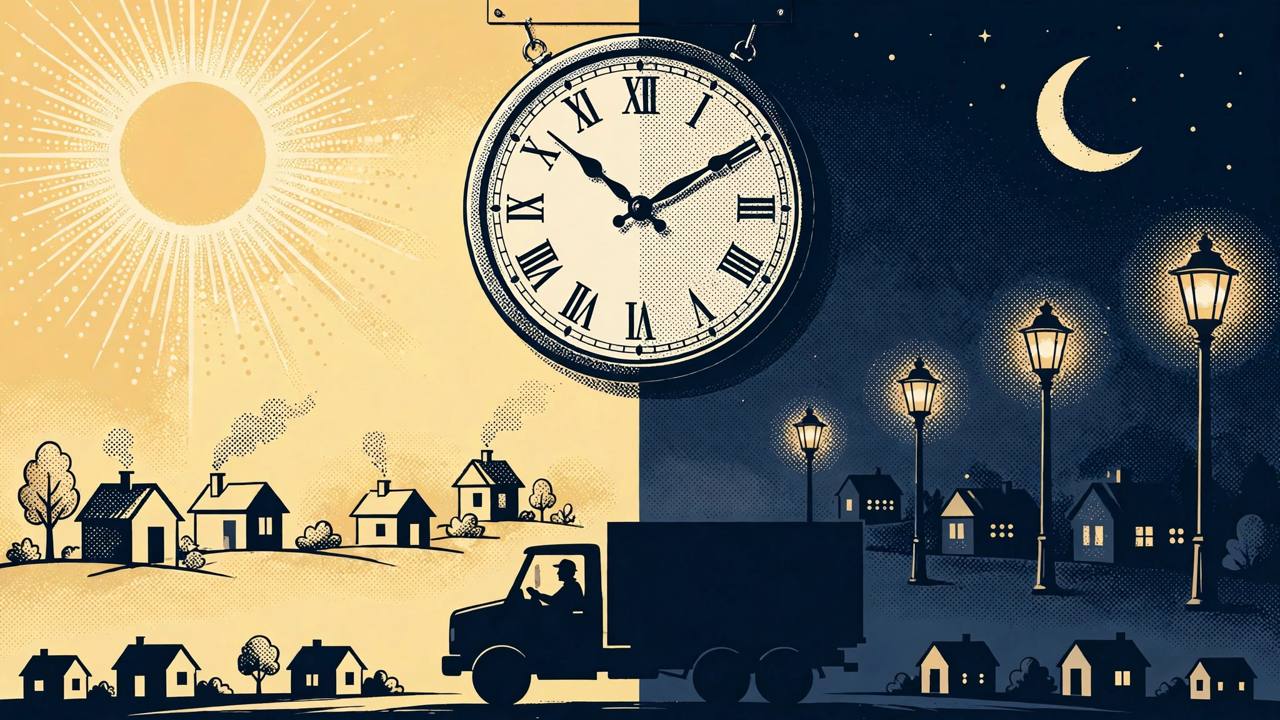
Daylight Saving Time ends across most of the United States today, Sunday, November 1, 2026. At 2:00 a.m. local time, clocks are set back one hour to 1:00 a.m., returning the country to Standard Time and giving most Americans a 25-hour day — the 1-to-2 a.m. hour happens twice. The Old Farmer's Almanac calls it the 'fall back' half of the yearly change: an extra hour in the night, lighter mornings from tomorrow, and darkness arriving about an hour earlier every evening.
Source: The Old Farmer's Almanac
Exactly what changes, and where
Timeanddate, which tracks clock changes worldwide, confirms clocks are set back one hour in 48 states. Two states do not take part: Hawaii, and most of Arizona, which stays on standard time all year. Inside Arizona, the Navajo Nation does observe Daylight Saving Time and does set its clocks back, so the same state can be on two different times in winter. The U.S. territories of American Samoa, Guam, the Northern Mariana Islands, Puerto Rico and the U.S. Virgin Islands also do not observe Daylight Saving Time. Most smartphones and computers update automatically when automatic date-and-time settings are on, the Almanac notes, but wall clocks, ovens and car clocks usually have to be changed by hand.
Source: timeanddate
Lighter mornings, darker evenings — and the sleep question
The change does not create or remove any daylight; it moves one hour of daylight from the evening to the morning, as the National Institute of Standards and Technology describes it, and sunrise and sunset both happen about an hour earlier by the clock from Sunday onward. That means school runs, farm work and early shifts start in better light, while evening commutes, deliveries and after-school activities finish in darkness sooner. The night itself is one hour longer, but whether anyone actually banks an extra hour of sleep is doubtful — the Almanac cites Harvard Health Publishing noting that many people do not actually get that extra hour.
Source: The Old Farmer's Almanac
Why the rules are what they are
The modern calendar is set by federal law. The Energy Policy Act of 2005, signed by President George W. Bush, extended Daylight Saving Time to 238 days a year starting in 2007 — longer than Europe's 210 or 217 days, timeanddate notes. Europe ended its daylight time a week earlier this year, on October 25, 2026. In the United States, daylight time began this year on the second Sunday in March and ends on the first Sunday in November, which in 2026 falls on November 1 — the earliest date it can fall.
Source: timeanddate
Congress just voted to end the clock changes — but the Senate has not
This could be one of the last fall-backs. On July 14, 2026, the United States House of Representatives passed the Sunshine Protection Act, which would make Daylight Saving Time permanent, by 308 votes to 117 with bipartisan support, timeanddate reported. President Donald Trump supports ending the seasonal changes and making daylight time permanent. The bill now awaits consideration in the Senate, where it has drawn both support and opposition. Timeanddate quoted Arkansas Senator Tom Cotton, an opponent, warning that permanent daylight time would push winter sunrises to a very late hour and leave children walking to school in the dark, or force schools to move their start times. If the Act were enacted, most of the United States would stop changing clocks twice a year and stay on daylight time year-round; places that do not observe daylight time now would not be required to adopt it.
Source: timeanddate
Across the border: parts of Canada no longer change at all
For cross-border families and truckers, the patchwork now extends north. Timeanddate notes that several Canadian provinces have adopted permanent time: Yukon adopted permanent UTC−7 in 2020; British Columbia announced on March 2, 2026 that it would stay on permanent daylight time after the March 8 change, so most of that province observes UTC−7 year-round; Alberta brought its Official Time Act into force on June 18, 2026 and observes UTC−6 year-round, meaning its clocks do not go back on November 1; and Manitoba stays on UTC−5 year-round. Canadians in provinces that still observe seasonal changes set their clocks back at the same 2 a.m. moment. A driver crossing the border this week can therefore pass between jurisdictions that changed, and jurisdictions that never do.
Source: timeanddate
Phones and computers should already show the new time. Check the clocks that do not update themselves — wall clocks, oven and microwave clocks, and older car dashboards — and allow for the repeated 1 a.m. hour when reading overnight timestamps, dispatch logs and delivery records dated November 1.
What it means for truckers, shift workers and the diaspora — and what happens next
For Punjabi truckers and other night-shift workers in the United States, the repeated hour is not a curiosity: hours-of-service logs, border appointments and delivery windows dated early on November 1 carry two different 1 a.m. hours, one in daylight time and one in standard time, and evening routes from Monday onward run into darkness an hour earlier. Families calling Punjab also gain a changed offset to India, which does not change its clocks. What happens next is already on the calendar: Standard Time runs through the winter, and unless the Senate passes the Sunshine Protection Act and it is signed into law, clocks spring forward again on Sunday, March 14, 2027, at 2:00 a.m. — the night America loses the hour it gains today.