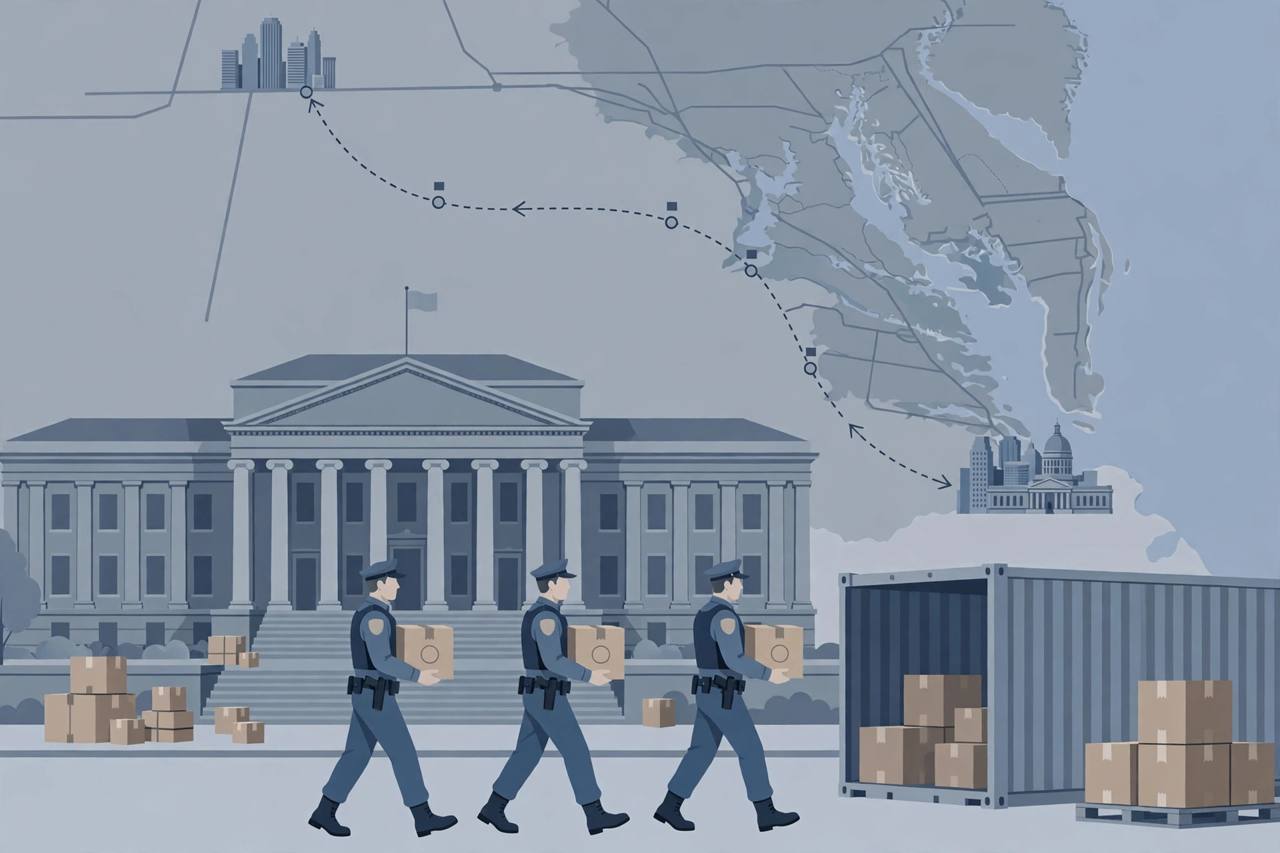
WASHINGTON — Fifteen defendants are now charged in a twelve-count superseding indictment unsealed in U.S. District Court in Washington, D.C., in connection with what prosecutors describe as a sprawling, transnational drug trafficking organisation that imported methamphetamine from California and gamma-butyrolactone — GBL — from South Korea for distribution in Washington and elsewhere along the East Coast, U.S. Attorney Jeanine Ferris Pirro announced.
Source: U.S. Attorney's Office, District of Columbia (DOJ)
The superseding indictment, case 26cr94, adds four new defendants to a case first charged earlier this year, and it landed with fresh arrests: on October 27, law enforcement arrested four of the alleged traffickers and executed search warrants across two federal judicial districts — the District of Columbia and the Eastern District of Pennsylvania — recovering approximately 13 pounds of methamphetamine, about 1.5 pounds of GBL, additional narcotics including ecstasy pills, and more than $16,000 in cash, according to the U.S. Attorney's Office.
Source: U.S. Attorney's Office, District of Columbia — initial indictment release (background)
The four new defendants, and what each is charged with
The four new defendants are Joseph Micha Macias, 47, Jason Andrew Frasher, 52, and Peter Allan Rothberg, 42, each of the District of Columbia, and Rassoul Amall Martin-Wilson, also known as "Duce" and "Deuce," 40, of Philadelphia. Each is charged with conspiracy to distribute 500 grams or more of a mixture containing methamphetamine and 50 grams or more of pure methamphetamine. Rothberg is additionally charged with conspiracy to distribute a detectable amount of GBL, prosecutors said.
Macias is also charged with five counts of unlawful possession with intent to distribute 50 grams or more of pure methamphetamine; Frasher with two such counts; and Rothberg with one such count. On October 27, Martin-Wilson was ordered detained pending trial by Judge Craig M. Straw of the Eastern District of Pennsylvania. Macias, Frasher and Rothberg were each set for initial appearances in the District of Columbia before Judge Zia M. Faruqui on October 28, 2026.
The Justice Department states this plainly at the end of its own release: an indictment is merely an allegation, and all defendants are presumed innocent until proven guilty beyond a reasonable doubt in a court of law. The charges, seizure figures and network description in this report are prosecutors' allegations and statements, not court findings.
The original eleven, and the separate gun complaint
The initial indictment named Artemio Jacobo-Magana, 26, of Santa Ana, California; Aaron James Landry, 39, of Los Angeles; Matthew Thomas Kent, 40, of the District; Colton Keet Huthsing, 30, of the District; Rene Alexander Acosta, 33, of Baltimore; Javier Gomez-Franco, 48, of Baltimore; Joshua Glen Taylor, 47, of the District; Robert David Fitch, 40, of Baltimore; Michael Robert Spitzer, 52, of New York City; Scott Patrick Morgan, also known as "Scotty Rox," 44, of New York City; and Kenneth Harold Archer, 46, of Fort Lauderdale. Each was charged with the same methamphetamine-and-GBL conspiracy, prosecutors said.
Spitzer, Morgan and Gomez-Franco were additionally charged with conspiracy to commit money laundering. Kent was charged with three counts of distribution of 50 grams or more of pure methamphetamine for specific transactions in the District. The eleven previously charged defendants were arrested in late April and early May 2026, and eight of the eleven were ordered detained while the case proceeds, the U.S. Attorney's Office said. Gregory Wallace is separately charged by complaint with conspiracy to possess with intent to distribute methamphetamine and GBL, and with possession of a firearm in furtherance of a drug trafficking crime. Chief Judge James E. Boasberg is presiding over the case.
How prosecutors say the network worked, from Seoul to the Northeast Corridor
According to court documents cited by prosecutors, from at least November 2022 and continuing through the present day, the defendants and their co-conspirators operated a multi-layered network stretching along the Northeast Corridor from New York City to Philadelphia, Baltimore and Washington, D.C., with active expansion efforts underway into Chicago, Florida and Southern California. The organisation sourced methamphetamine in California and imported GBL from South Korea, distributing both to an established customer base while recruiting new markets, prosecutors allege.
The conspiracy operated with a defined division of labour, according to the indictment account: upstream suppliers sourced narcotics in bulk; regional distributors stored, repackaged and moved product; and downstream distributors sold to customers while collecting and concealing proceeds. Members allegedly used encrypted messaging applications, coded language, commercial parcel services, stash locations and shell business entities, accepted payments through peer-to-peer platforms, and laundered funds through business accounts designed to disguise the proceeds as legitimate income. Working with South Korean law enforcement, U.S. prosecutors and agents travelled to Seoul to identify GBL exporters and disrupt the supply chain at its source — cooperation that resulted in the arrest of five South Korean nationals by South Korean authorities and the September 2025 seizure described in the stats above, prosecutors said.
Why GBL is treated as so dangerous
GBL is an industrial solvent with legitimate commercial uses as a paint remover, adhesive and nail-polish remover, the U.S. Attorney's Office explained. When illegally sold for human use, it is a Schedule I controlled substance. The body rapidly metabolises GBL into GHB, described by prosecutors as one of the most pervasive date-rape drugs currently available. GBL is sometimes called "Liquid Ecstasy" and is abused as a euphoria-inducing club drug, and it has a dangerously narrow safety margin: a small increase in dosage can produce unconsciousness, seizures, slowed heart rate, severe respiratory depression, coma or death, according to the release.
Prosecutors allege the organisation distributed methamphetamine and GBL together for simultaneous consumption in a combination known as "sexchem," a pairing they describe as lethal and unpredictable, and that local D.C.-based distributors were selling the drugs together as party drugs. The newly added defendants were bulk distributors of methamphetamine within the District, prosecutors allege, with Martin-Wilson serving as a primary source of supply after the initial indictment and the coordinated search-and-arrest operation earlier this year.
What the officials said, and what happens next
"This organization peddled a deadly combination of meth and GBL, putting lives at risk for profit. They used encrypted apps, shell companies, and the U.S. mail to hide their operation. It didn't work," U.S. Attorney Pirro said. "Fifteen defendants now face federal charges. Since my appointment as U.S. Attorney, my office, alongside the Homeland Security Task Force, has seized more than 1,800 pounds of meth." DEA Washington Division Special Agent in Charge Cindy Marx said the network stretched "from Washington, D.C., and across the East Coast, with active plans to expand" further, and HSI Washington acting Special Agent in Charge Kai Wah Chan and IRS Criminal Investigation Special Agent in Charge Kareem Carter joined the announcement.
The investigation was conducted by the DEA Washington and New York divisions and its Seoul Country Office, IRS Criminal Investigation, Homeland Security Investigations in Washington, the U.S. Postal Inspection Service and U.S. Customs and Border Protection, with help from Arlington County, Metropolitan and Prince George's County police, prosecutors said. The case is being prosecuted by Assistant U.S. Attorneys Matthew W. Kinskey, George P. Eliopoulos and Solomon S. Eppel. What happens next: the three District defendants' initial appearances on October 28 open the superseding case in court, Martin-Wilson remains detained pending trial in Pennsylvania, and all fifteen defendants face, if convicted, mandatory minimum sentences of 10 years to life in prison — a range that will only be tested as the case moves toward plea negotiations or trial in front of Chief Judge Boasberg.
For diaspora and trucking readers, the corridor in this case is familiar ground: the Northeast Corridor and its I-95 spine, the California supply end, and the parcel-and-mail channels the indictment describes are the same logistics arteries legitimate Punjabi trucking and warehouse businesses work every day — which is why federal task-force cases built around shell companies and peer-to-peer payments also raise the compliance stakes for legitimate operators whose paperwork must be able to withstand exactly this kind of scrutiny.