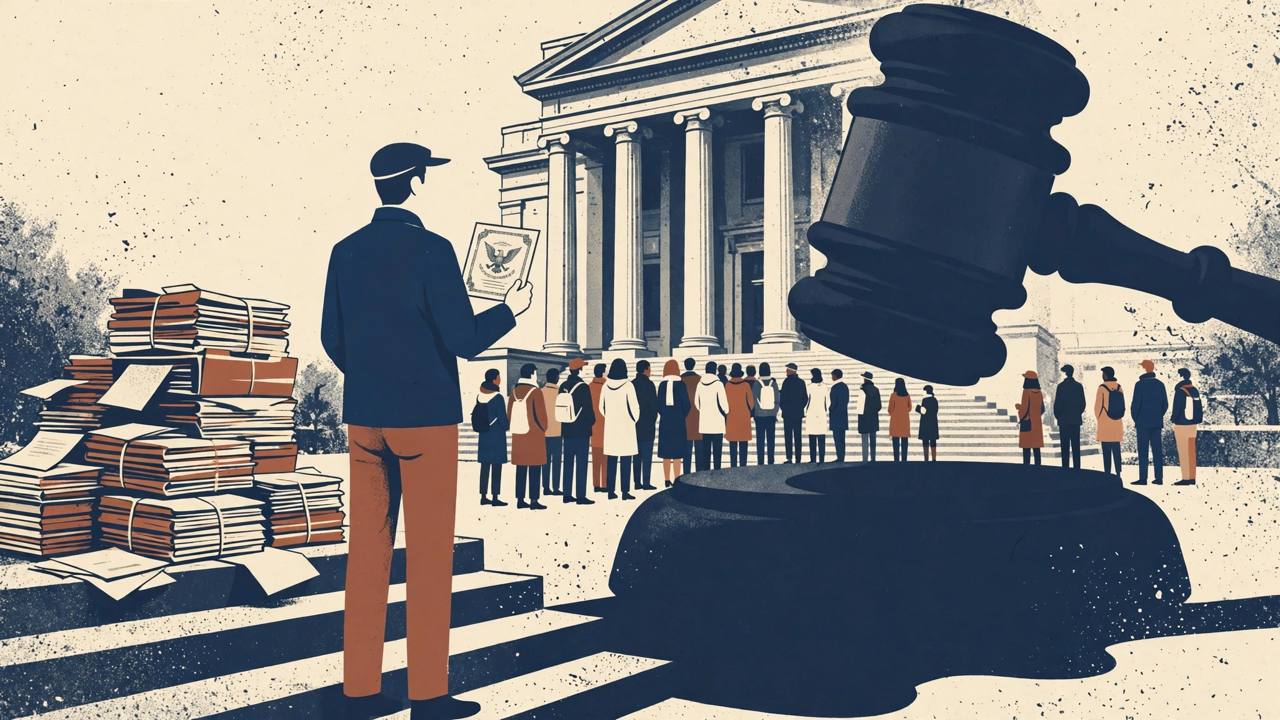
WASHINGTON — The U.S. Department of Justice has filed civil lawsuits against 40 naturalized American citizens seeking to revoke their citizenship, in what Attorney General Todd Blanche called 'the largest denaturalization effort in modern history.' The 40 complaints were filed between August 21 and October 2, 2026, in federal district courts across the country — 19 districts, according to reporting on the filings — and a U.S. Citizenship and Immigration Services (USCIS) news release on October 13 laid out the cases person by person.
Source: U.S. Department of Justice announcement, Oct 5, 2026 (via Karmactive)
For the roughly 24 million naturalized citizens in the United States — a group that includes a very large share of Awaaz Punjab's diaspora readers and their parents — the announcement raises an obvious question: can citizenship, once granted, really be taken away? The legal answer is yes, but only through a federal court, only on narrow grounds, and only if the government proves its case. Nothing in the 40 complaints has yet been decided: the Justice Department itself stresses that the filings are allegations, not findings, and not one of the 40 has lost citizenship as a result of this batch.
Source: USCIS news release, Oct 13, 2026 (via MigraPrep)
What the government alleges in the 40 cases
The complaints, filed by the Civil Division's Office of Immigration Litigation, allege that the defendants obtained naturalization illegally or by concealing material facts or wilfully misrepresenting their histories during the application process. Across the 40 cases, the alleged concealed conduct includes acting as an agent of a foreign government and espionage-related activity, voluntary manslaughter, aggravated sexual offences including offences against minors, marriage fraud, identity fraud, visa and passport fraud, tax fraud and money-laundering conspiracies, USCIS said. Assistant Attorney General Brett A. Shumate of the Civil Division put the department's position bluntly: 'Every single one of these individuals lied their way into U.S. citizenship.' That is the government's allegation; each defendant is entitled to contest it before a federal judge.
Source: U.S. Department of Justice announcement, Oct 5, 2026 (via Karmactive)
The 40 come from some 20 countries of origin. Reporting on the Justice Department's release says Mexico is the largest single group with 11 of the 40, with others from countries including China, Egypt, Iran, Pakistan, India and the Philippines, and that the defendants range in age from 26 to 76. Awaaz Punjab is not naming individual defendants from this batch: the cases are unproven civil allegations, and the department's list mixes grave criminal accusations with cases that reporting indicates rest on alleged visa-form lies — at least 19 of the 40, according to NBC News reporting, face proceedings tied to alleged misrepresentations on visa forms rather than violent crime.
Source: NBC News reporting via The Morning Post summary, Oct 2026
The scale: from a rare tool to an enforcement priority
Denaturalization was, for decades, one of the rarest actions in U.S. immigration law. Between 1990 and 2017 the Justice Department averaged about 11 cases a year; the Biden administration filed 24 across four full years. The current pace is of a different order. Before this batch, the department had already brought about 120 cases between President Trump's return to office on January 20, 2025 and late August 2026, and Syracuse University's Transactional Records Access Clearinghouse (TRAC) counted at least 105 civil denaturalization lawsuits in the first seven months of 2026 alone. Reporting says officials aimed to reach at least 250 filings by the end of October. The machinery behind the surge is a June 2025 Justice Department memo directing its lawyers to 'prioritize and maximally pursue' denaturalization cases, followed by audits of original naturalization files to identify alleged fraud.
Source: Heritage Review / Just The News reporting, Oct 7, 2026
The Justice Department's own release notes that the complaints allege facts that courts have not finally adjudicated. A filed complaint does not strip anyone of citizenship: only a federal judge can do that, case by case, after the government meets a high burden of proof. Anyone who receives DOJ or USCIS correspondence about denaturalization should get an immigration lawyer immediately — these are federal court cases, not paperwork matters.
The law: what the government must prove — and what it cannot do
Under the Immigration and Nationality Act, 8 U.S.C. § 1451(a), a naturalized citizen's status can be revoked only if a federal court finds the naturalization was illegally procured, or was procured by concealment of a material fact or wilful misrepresentation. The government's burden is 'clear, unequivocal, and convincing' evidence, and these civil cases are bench trials — a judge decides, not a jury. The Supreme Court narrowed the law further in Maslenjak v. United States (2017): a misrepresentation must have been material to the granting of citizenship, so a lie about a minor matter that would not have changed the outcome cannot support revocation. Two protections follow from that framework. Citizenship cannot be stripped for crimes committed years after naturalization, and honest paperwork errors are not, by themselves, grounds for denaturalization.
Source: U.S. Department of Justice announcement, Oct 5, 2026 (via Karmactive)
What happens if the government wins a case
A final denaturalization order cancels the person's certificate of naturalization and can restore their prior noncitizen status — which may be lawful permanent residence — potentially exposing them to separate removal proceedings by the Department of Homeland Security. Removal is not automatic and would be its own case with its own defences. Until a judge rules, however, every one of the 40 remains a U.S. citizen with the full rights of citizenship, including the right to contest the government's evidence.
Source: U.S. Department of Justice announcement, Oct 5, 2026 (via Karmactive)
Why this matters to Punjabi and South Asian families
Naturalized citizens of Indian and Pakistani origin are named in the department's own case summaries for this batch, and the wider message lands on a community for whom naturalization was often the end of a decades-long journey through work visas, green cards and citizenship queues. The practical takeaways from lawyers and the law itself are narrow but important: keep your naturalization records; do not ignore any federal court papers; and remember that the government, not the citizen, carries the burden of proof — and that it must prove the alleged lie was material and wilful, not a mistake. Advocacy coverage of the drive notes that the stated target is fraud in the original application, not post-oath conduct.
Source: USCIS news release, Oct 13, 2026 (via MigraPrep)
What happens next
The 40 cases now proceed separately in their district courts — the earliest filed on August 21, 2026 — and each will be decided on its own evidence by its own judge, a process expected to take months or longer per case. With the department publicly committed to the largest denaturalization effort in its history and a reported internal goal of about 250 filings by the end of October, more batches are likely. Awaaz Punjab will report outcomes — grants and dismissals alike — as courts rule; until then, every name in this batch stands accused, not convicted, and remains a citizen.
Source: Heritage Review / Just The News reporting, Oct 7, 2026