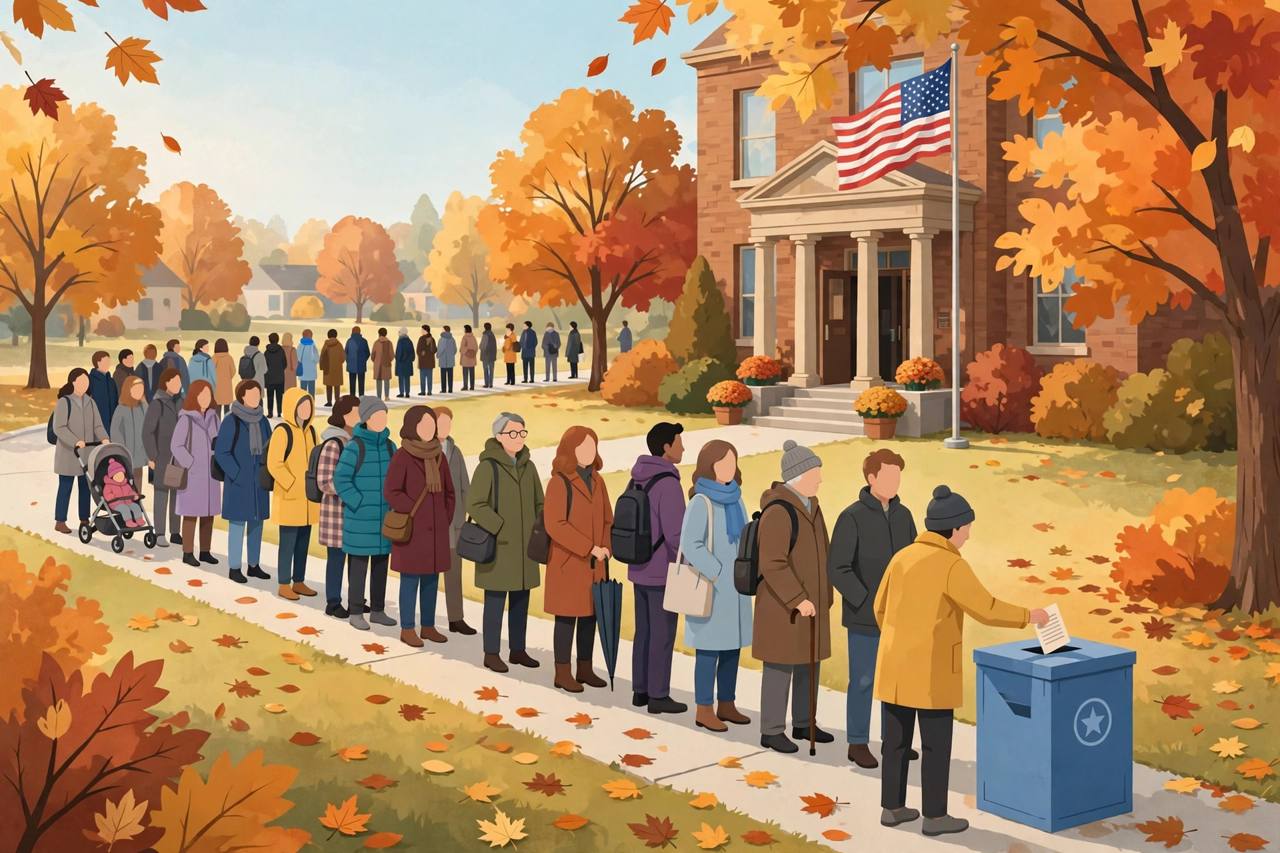
More than 34 million Americans had already voted by Tuesday afternoon, October 27 — in person at early-voting sites or by mail — with one week left until Election Day on November 3, according to the University of Florida Election Lab tracker cited by States Newsroom. The tally is on track to surpass early voting in the 2022 midterms, said Michael McDonald, a University of Florida political science professor who runs the lab.
"Right now, the data that I can see, it looks like we're running at least even to the 2018 election. If the voting continues through Election Day, we would be somewhere around that number," McDonald said. "That's a high water benchmark," he added, noting that 2018 was the highest turnout for a midterm election since 1914. Nearly 46 million Americans voted early in 2022, according to the lab. A later lab file on Tuesday put the national total at 34.76 million, with 18.00 million votes in person and 16.76 million by mail.
What is at stake on November 3
The midterm election will determine control of the US House of Representatives and the Senate, possibly flipping one or both chambers from Republicans to Democrats, States Newsroom reported. The party of the president historically loses seats in midterms. The Cook Political Report shifted 19 House races in the direction of Democrats on October 23 and lists 17 House races as toss-ups, with Republicans defending 12 of them, and seven Senate races as toss-ups — in Alaska, Iowa, Kansas, Maine, Michigan, Ohio and Texas.
The battleground numbers, state by state
Texas leads the country: more than 5 million people had cast ballots there by Tuesday, according to the Election Lab — its detailed file put the figure at 5,078,422 — in a Senate race between Republican Attorney General Ken Paxton and Democrat James Talarico that Cook rates a toss-up. President Donald Trump was campaigning in Texas on Tuesday. California had recorded 3,421,226 early votes and Florida 3,517,675 in the lab's Tuesday files.
In Michigan, more than 1.3 million people had voted early by Tuesday, the lab said, and the Michigan Secretary of State's office put the exact figure at 1,392,170 voters — 18.8% of all active registered voters — with more than 1.1 million voting by mail ballot and 215,795 casting a ballot at an early-voting site since sites opened statewide on Saturday, October 24. Michigan's open-seat Senate race between Republican Mike Rogers and Democrat Abdul El-Sayed is rated a toss-up. Deputy Secretary of State Aghogho Edevbie said: "Michigan voters are showing enthusiasm for early in-person voting, making the first weekend a great success." Early in-person voting in Michigan continues through Sunday, November 1.
Ohio recorded nearly 1.2 million early votes — 1,189,616 in the lab file — in a toss-up Senate race between Republican Senator Jon Husted and Democratic former Senator Sherrod Brown. Iowa recorded nearly 307,000 early votes in a toss-up Senate race between Democratic state legislator Josh Turek and Republican US Representative Ashley Hinson. Alaska recorded more than 46,000, Maine more than 196,000 and Kansas more than 245,000, according to the lab.
Party split — and why it does not predict the result
Twenty-seven states record party affiliation, and of the roughly 16 million early voters in those states, 45% are Democrats, about 31% are Republicans and 24% are unaffiliated with either party, according to the Election Lab. Those shares describe who has voted, not how they voted, and analysts caution that a large Election Day vote can still change the picture in close races.
Some states are reporting sharply heavier turnout than in 2022. In Tennessee, midterm early turnout stood 57% higher than the 2022 midterms during the first eight days, according to a Monday report from the Tennessee Lookout. In North Carolina, unaffiliated voters cast 34% of ballots in the first five days of early voting, NC Newsline reported. In Louisiana, Black voters comprised a larger share of participants on the first day of early voting than in nearly every other election over the past 18 years, the Louisiana Illuminator reported.
Why are so many voting early?
McDonald said he cannot tell the motivation from the data alone, but offered two ideas. The first is a post-COVID explanation: voters are less likely to vote by mail, so "we're sort of reverting back to a normal election." The second is that President Trump's "potential threats with trying to monkey around with the U.S. Postal Service" may have led some people to vote in person instead of by mail, he said. In September, the US Supreme Court kept in place a lower court's order blocking Trump's plan to place new restrictions on mail ballots for this year's midterms, States Newsroom reported.
Early voting is still open in most states this week. Rules, sites and hours differ by state and county — check your state or county election office for your early site and for mail-ballot return deadlines before November 3. Casting a ballot early in person is also the simplest protection against a mail delay.
What happens next
Early voting continues through the weekend in most states, with final in-person early days varying by state — Michigan's runs through November 1, for example. Election Day itself is Tuesday, November 3. If the pace McDonald described holds, the 2026 early total will pass 2022's nearly 46 million and approach the 2018 benchmark, the highest midterm turnout since 1914 — but the results, not the early tally, will decide control of Congress.