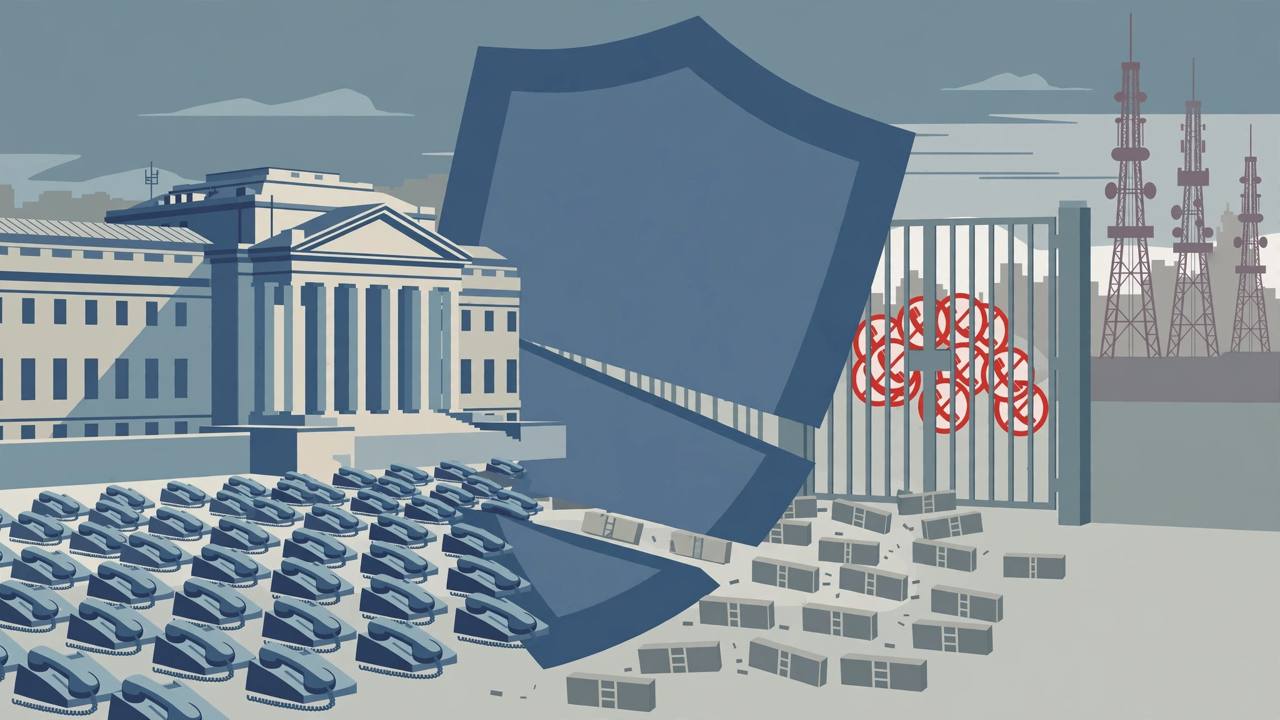
WASHINGTON — The United States plans to ban Chinese telecom firms from direct access to U.S. phone numbers on national security grounds, in a measure the Federal Communications Commission says is also designed to prevent scam-related robocalls. The FCC said on Thursday, October 29, that it will vote on November 19 on a proposal to ban China Mobile, China Telecom and China Unicom, and other internet-enabled (IP-enabled) service providers, from direct access to U.S. numbers, Reuters reported.
Source: Reuters
Direct access matters because of how internet calling works. For telecom firms providing Voice over Internet Protocol (VoIP) service — technology that converts voice into digital data and transmits it over broadband connections — holding numbers directly, rather than obtaining them through a U.S. intermediary, is a much cheaper option and makes it easier to offer advanced features. Cutting off that direct route raises the cost and difficulty for the named firms of operating U.S.-number calling services, and gives U.S. regulators a clearer choke point against numbers used by illegal robocallers.
"With this decision, the FCC will be strengthening our first line of defense against bad actors and illegal robocallers," FCC Chair Brendan Carr said in a statement. The agency frames the proposal as both a national-security step and a consumer-protection step: numbers obtained directly by providers outside effective U.S. oversight can be used to place large volumes of scam calls into American homes.
Why Washington says it is acting: Salt Typhoon
Concerns about the potential for spying and other harms from Chinese access to U.S. telecom data and infrastructure have grown in recent years. In late 2024, Washington said a Chinese state-sponsored cyber espionage group known as Salt Typhoon stole consumers' call records and U.S. call data and infiltrated U.S. telecommunications and telecom infrastructure firms. The FBI said this year that threats from Salt Typhoon are "still very much ongoing," according to Reuters. China has consistently denied any wrongdoing.
Beijing responded within a day. China's foreign ministry said on Friday that it firmly opposes the likely U.S. ban and accused Washington of overstretching the concept of national security and abusing state power to suppress Chinese enterprises. "China will take necessary measures to resolutely safeguard its own legitimate rights and interests," Chinese foreign ministry spokesperson Guo Jiakun told a daily press conference.
More bans under consideration
The November proposal does not stand alone. The FCC also said on Thursday that it plans to bar IP-enabled service providers that use equipment from companies on the FCC's list of entities posing national security risks, such as Huawei or ZTE. The agency added that it would ban all Chinese labs from testing U.S. electronics in December 2028, and that it may also revoke direct number authorizations for Chinese companies that it deems to pose national security risks.
The FCC has previously barred China Mobile, China Telecom and China Unicom from providing international telecommunications services to the United States. Other measures under consideration include barring the firms from connecting to U.S. networks and from operating their data centres in the United States. In July, the FCC also added California-based Digitalsystem Technology to a list of companies posing risks to U.S. national security, citing links to Chinese telecom firms and its ownership by a Chinese national.
If adopted on November 19, the rule would not change ordinary phone service for U.S. households overnight. Its target is who may hold U.S. numbers directly: cutting off direct access is meant to make scam robocalls harder to place and to keep Chinese state-linked carriers further from U.S. call data — a live concern for diaspora families who rely on VoIP services for cheap calls home.
What happens next
The FCC vote is scheduled for November 19. If the proposal is adopted, phone numbers join the list of U.S. telecom access points already closed to the named Chinese firms, and the further steps — the equipment-based bar on IP-enabled providers and the December 2028 lab-testing ban — move forward on their own tracks. Beijing has said it will take "necessary measures" in response, without specifying them, so a Chinese counter-step after the vote is the other development to watch.