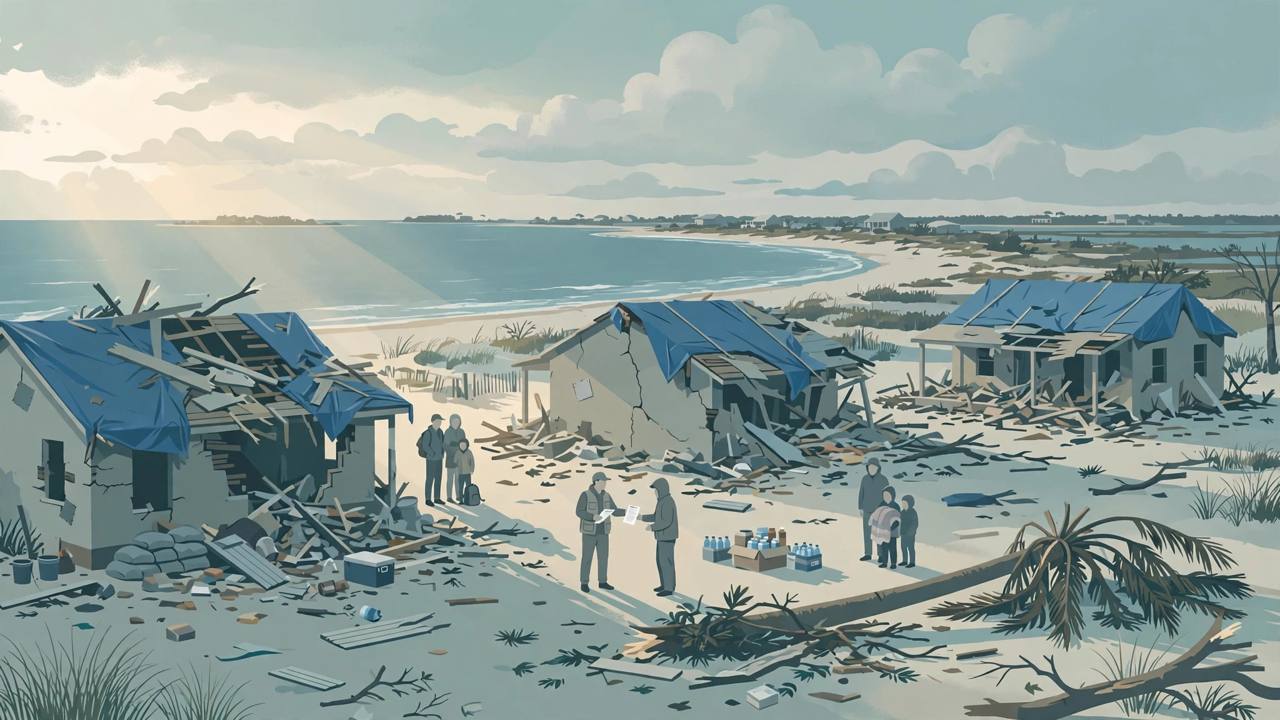
Panama City, Florida — Help that goes directly to households has finally been switched on for Hurricane Isaias survivors in the Florida Panhandle. The Federal Emergency Management Agency (FEMA) has approved Individual Assistance for eight counties, the Florida Division of Emergency Management (FDEM) said in a statement dated October 29, after President Donald Trump amended the major disaster declaration DR-4955-FL to include direct aid to individuals and families. Registration is open.
Source: FDEM statement via Cuba Headlines
This is a genuinely new step, and it follows the development reported here on October 27, when the major disaster declaration was first granted. That declaration covered Public Assistance only — federal money that reimburses state and local governments and certain nonprofits for emergency work, debris removal and repairs to public roads, buildings and utilities. Individual Assistance was explicitly listed as still under review at the time, which meant storm-hit families could not yet apply for federal help with their own homes. That barrier is now lifted for the eight counties named below.
The eight counties
The counties whose residents can now apply are Bay, Escambia, Gulf, Holmes, Okaloosa, Santa Rosa, Walton and Washington — all in the western Panhandle, the part of Florida hit hardest when Isaias came ashore. The FDEM notice identifies the disaster period as October 6–12, 2026. FEMA said additional counties might be added if further damage assessments warrant it, and it has appointed Brett H. Howard as the Federal Coordinating Officer for the recovery operations in the affected areas.
What the help covers
Individual Assistance can include grants for temporary housing, grants for essential home repairs, low-interest loans to cover uninsured property losses, and other recovery programs for families and individuals. Two distinctions matter for applicants. First, the grants do not have to be repaid, while the loans do. Second, approval of the program does not guarantee aid to any individual applicant: FEMA assesses every application on its own facts, and the October 29 notice states no fixed amount or timeframe and no application deadline. Residents with insurance are advised to file a claim with their insurer first, before applying to FEMA.
How to apply
There are three ways to register: online at DisasterAssistance.gov, through the FEMA mobile app, or by phone at 1-800-621-3362, available Monday to Sunday from 7 a.m. to 10 p.m. in the applicant's local time zone. People who use a relay service, such as video relay service or captioned telephone service, should give FEMA the number for that service so case workers can reach them. County governments, meanwhile, apply separately for reimbursement of public costs through the state, and recovery centers remain open in Escambia, Okaloosa, Walton and Washington counties, according to FDEM updates reported this week.
Source: FDEM notice via Iliyn record, Oct 30
1) File your insurance claim first if you have coverage. 2) Register with FEMA at DisasterAssistance.gov, on the FEMA app, or at 1-800-621-3362 (7 a.m.–10 p.m. local). 3) Keep receipts and photos of damage — FEMA decides each application case by case, and a grant is not guaranteed.
The scale of the damage
Isaias made landfall near Destin on the night of October 9 as a Category 2 hurricane with sustained winds of 105 mph (169 km/h). The storm knocked out power to approximately 448,000 homes and businesses across Florida, and in Santa Rosa County about 90% of customers lost power. Governor Ron DeSantis reported six fatalities in Florida from the storm, directly or indirectly. The insurance toll has kept climbing since: the state Office of Insurance Regulation had logged more than 62,000 claims by Tuesday, about 7,000 of them added in a single week, with potential insured losses reaching $652 million, the News Service of Florida reported. More than 52,000 of the claims are for residential property.
Source: News Service of Florida via Florida Realtors
The county breakdown shows where the damage concentrated: almost 29,500 claims in Santa Rosa County, just over 19,000 in Escambia, nearly 6,000 in Okaloosa, about 2,300 in Walton and 2,200 in Bay. In all five counties more than a third of claims have already been closed, with Okaloosa near 50% — a measure of how far cleanup and adjustment have come three weeks after landfall, and of how much work remains for the households whose claims are still open.
What is still pending, and why it matters on the road
One piece of the federal package is still missing: hazard mitigation funding — money to rebuild stronger so the next storm does less damage — remains under review, as does any extension of Individual Assistance beyond the eight counties. For the Panhandle's working families, including the truck drivers who run Interstate 10, the region's main east–west freight corridor through the disaster counties, the practical meaning of this week's amendment is simple: the help that was previously only for governments fixing public infrastructure is now, for the first time since the storm, open to the households living in the damaged houses themselves.