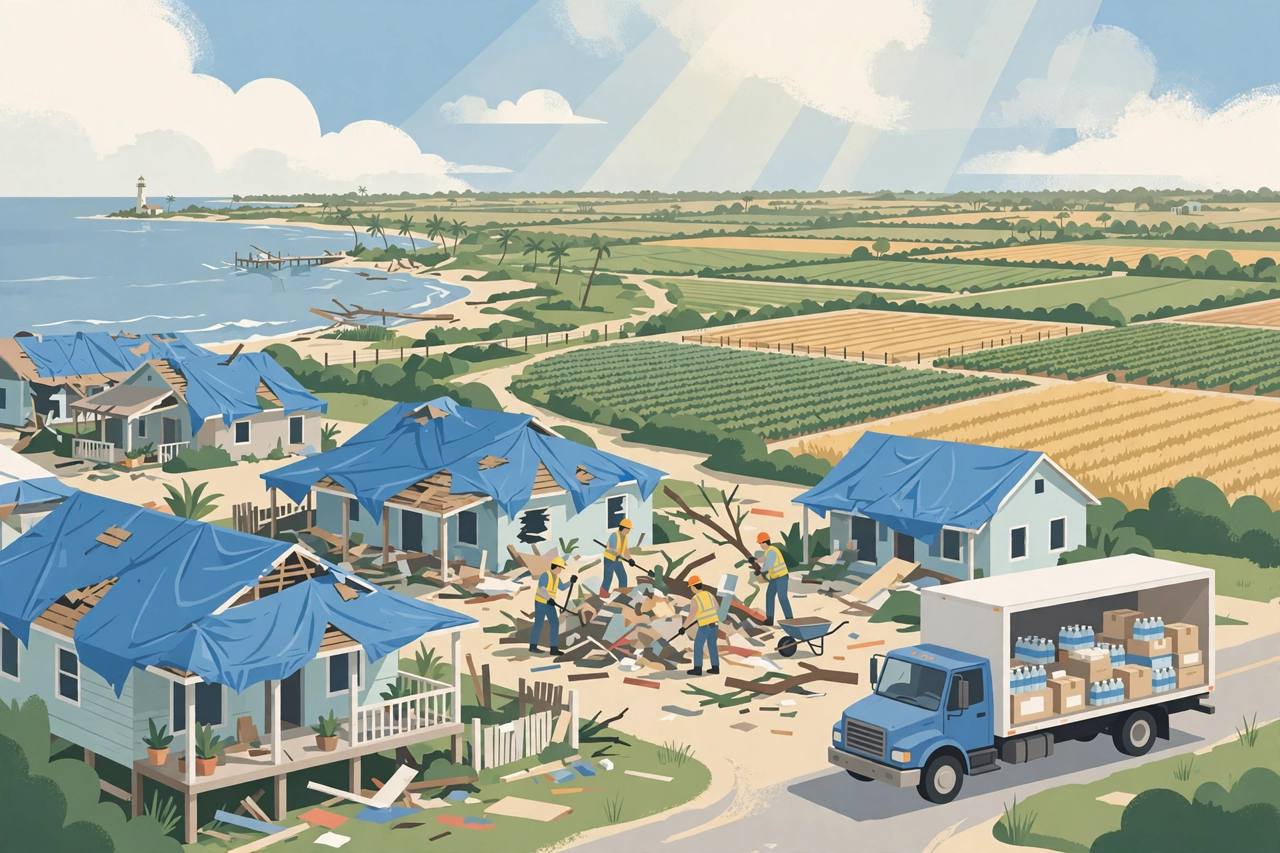
PENSACOLA, Florida — The Trump administration has granted a Major Disaster Declaration for Florida after Hurricane Isaias, unlocking a wider tier of federal help for storm-hit communities in the Florida Panhandle. WKRG News 5, the CBS affiliate in the region, reported on Tuesday evening, October 27, that the administration had granted FEMA assistance to 12 Florida counties for Isaias damage relief, and WEAR Pensacola independently reported the same evening that President Donald Trump had declared a major disaster for the state of Florida following the hurricane.
Source: WKRG News 5 via Spot On Florida
The two local reports did not publish the full county-by-county designation list in the excerpts available when this story was filed, and FEMA's own major-disaster page for Isaias had not yet been located. Readers should therefore treat the headline fact — a major disaster declaration has been granted, covering 12 counties for FEMA assistance, according to WKRG — as confirmed by two independent Panhandle outlets, while the exact list of designated counties and the exact mix of programmes opened for each county will be updated here once FEMA publishes its designation page.
Source: WEAR Pensacola via Spot On Florida
What changed on Tuesday — and why a major disaster declaration is different
Until Tuesday, Isaias help for Florida rested on a narrower emergency declaration. On October 9, FEMA announced that President Trump had approved an emergency declaration for conditions beginning October 6, covering 27 counties — Baker, Bay, Calhoun, Citrus, Columbia, Dixie, Escambia, Franklin, Gadsden, Gilchrist, Gulf, Hamilton, Holmes, Jackson, Jefferson, Lafayette, Leon, Levy, Liberty, Madison, Okaloosa, Santa Rosa, Suwannee, Taylor, Walton, Wakulla and Washington. That declaration authorised FEMA to coordinate federal relief and to provide emergency protective measures, limited to direct federal assistance, at 75 percent federal funding, with Brett H. Howard named federal coordinating officer. It did not, by itself, open the household and long-term recovery programmes that come with a major disaster declaration.
Source: FEMA
Governor Ron DeSantis then announced that Florida's Division of Emergency Management had submitted a request for a major disaster declaration. According to the governor's office, the request sought about $237 million in federal resources, Public Assistance for 15 counties — to repair or replace damaged roads, bridges, public buildings, utilities and other critical infrastructure and to cover emergency response operations — and Individual Assistance for residents in eight counties: Bay, Escambia, Gulf, Holmes, Okaloosa, Santa Rosa, Walton and Washington. The governor's office said that, upon federal approval, eligible residents in designated counties would be able to apply to FEMA at DisasterAssistance.gov or by calling 800-621-3362, and that Florida was partnering with Emergency RV to provide temporary sheltering for displaced residents, prioritising those whose homes sustained the most significant damage.
Source: Office of Governor Ron DeSantis
The scale of the damage the declaration answers
Hurricane Isaias made landfall in the Florida Panhandle as a Category 2 storm on October 9, near Destin, with the worst damage reported around Destin, Pensacola Beach and Navarre and major damage around Milton and Pace. According to figures from the Florida Office of Insurance Regulation reported by Florida Trend, about 55,000 insurance claims had been filed statewide and estimated insured losses were approaching $582 million. Santa Rosa County accounted for more than 26,000 claims, followed by Escambia County with nearly 17,000, Okaloosa County with about 5,200, Walton County with more than 2,000 and Bay County with nearly 2,000. About 47,000 claims involved residential property, with the rest covering automobiles, commercial property, business interruption and other lines.
Source: Florida Trend / Florida Office of Insurance Regulation
Of the claims filed, just over 3,500 had been closed with some payment and nearly 8,500 had been closed without any payment, while 1,454 open claims had already resulted in some level of payment — a picture that explains why uninsured and underinsured households in the Panhandle had been pressing for household-level federal help for more than a week. Six deaths in Florida have been linked to the storm. Moody's RMS estimated multistate insured losses at $2.5 billion to $4.5 billion, Karen Clark & Company projected about $3 billion in privately insured losses nationwide, and Moody's estimated a further $250 million in National Flood Insurance Program claims, which the Karen Clark figure excluded.
USDA opens a parallel farm-recovery package the same day
Also on Tuesday, October 27, the U.S. Department of Agriculture issued its Florida disaster-assistance notice from Gainesville, saying agricultural operations across the state had been significantly impacted by Hurricane Isaias and that USDA technical and financial assistance was available for crop, land, infrastructure and livestock losses. 'USDA has a suite of programs to support farmers and ranchers as they recover from natural disasters,' said Farm Production and Conservation Under Secretary Richard Fordyce. 'I encourage impacted producers to contact their local USDA Service Center to report losses and learn more about program options available to assist in their recovery from crop, land, infrastructure, and livestock losses and damages.'
Source: USDA Natural Resources Conservation Service
For livestock producers, USDA listed the Livestock Indemnity Program (LIP) for livestock deaths in excess of normal mortality or injured livestock sold at a reduced price, and the Emergency Assistance for Livestock, Honeybees, and Farm-Raised Fish Program (ELAP) for feed and grazing losses, honeybee colony and hive losses, and farm-raised fish feed and inventory losses. For both LIP and ELAP, producers must file a notice of loss and, for ELAP, a payment application with their local Farm Service Agency (FSA) office no later than March 1, 2027, for 2026 calendar year losses. Orchardists and nursery tree growers may seek cost-share help under the Tree Assistance Program (TAP) to replant or rehabilitate eligible trees, bushes or vines, with an application due within 90 days of the disaster event or of the date the loss became apparent. 'Impacted producers should timely report all crop, livestock and farm infrastructure damages and losses to their local FSA county office as soon as possible,' said Marcinda Kester, State Executive Director for FSA in Florida, urging producers to gather farm records, herd inventory, receipts and pictures of damage.
On conservation and land recovery, Florida's Natural Resources Conservation Service (NRCS) is extending the Fiscal Year 2027 sign-up for the Environmental Quality Incentives Program (EQIP) and the Conservation Stewardship Program (CSP) to November 16, 2026, for counties declared in a state of emergency by FEMA. FSA's Emergency Conservation Program (ECP) and Emergency Forest Restoration Program (EFRP) can help landowners and non-industrial private forest stewards restore fencing and damaged farmland or forest and remove debris, while NRCS's Emergency Watershed Protection (EWP) program helps cities, counties, towns and federally recognised tribes address watershed hazards such as debris removal and streambank stabilisation — sponsors must submit a formal request to the NRCS state conservationist within 60 days of the disaster or of the date access to the sites became available. 'At USDA, we serve as a partner to help landowners with their resiliency and recovery efforts,' said Ken White, NRCS Assistant Chief for the South Region.
USDA also listed direct and guaranteed farm loans, including low-interest emergency loans for producers in counties with a primary or contiguous disaster designation who cannot secure commercial financing, loan servicing options for borrowers unable to make scheduled payments for reasons beyond their control, and the Farm Storage Facility Loan Program, with terms from three to 12 years, for building, repairing or upgrading commodity storage. On risk management, producers with Noninsured Crop Disaster Assistance Program (NAP) coverage must file a Notice of Loss (CCC-576) within 15 days of the loss becoming apparent — 72 hours for hand-harvested crops — and producers with federal crop insurance should report damage to their agent within 72 hours of discovering it and follow up in writing within 15 days. 'Crop insurance and other USDA risk management options are offered to help producers manage risk because we never know what nature has in store for the future,' said Pat Swanson, Administrator of USDA's Risk Management Agency.
Households: once FEMA opens registration for your designated county, apply at DisasterAssistance.gov or call 800-621-3362 — the channels named in the governor's request announcement. Farmers and landowners: contact your local USDA Service Center, report losses to your FSA county office as soon as possible, and note the deadlines above — March 1, 2027 for LIP/ELAP notices, 90 days for TAP, November 16, 2026 for the extended EQIP/CSP sign-up, and 60 days for an EWP sponsor request.
Why this matters beyond the Panhandle
The Panhandle is a working corridor as well as a coastline: Interstate 10 carries east-west freight across the top of Florida, and the counties at the centre of the claims map — Santa Rosa, Escambia, Okaloosa, Walton and Bay — are farming, forestry, fishing and trucking country as much as beach country. A major disaster declaration matters there for two practical reasons. Public Assistance is what reimburses smaller, fiscally constrained counties for debris removal, emergency operations and repairs to roads, bridges and utilities — the infrastructure every recovery load has to travel on. Individual Assistance, where it is designated, is the only federal channel that can put grants for temporary housing and basic home repairs directly into households with uninsured or underinsured losses. For Punjabi and other immigrant farm, transport and small-business families in Florida, the practical step is the same as for every affected household: document damage now, keep receipts and photographs, and apply through the official channels above rather than through anyone charging a fee to 'arrange' aid — county sheriffs in the region had already warned Isaias victims about scammers in the days after the storm.
What happens next
Next, FEMA is expected to publish the formal designation page for the major disaster declaration, listing each designated county and which programmes — Public Assistance, Individual Assistance, or both — apply there. That list will decide exactly which households can register for household grants and which local governments can claim infrastructure reimbursement, and this story will be updated when it appears. Florida's state response and recovery operations remain ongoing in the meantime, and USDA's deadlines run in parallel: the extended EQIP and CSP sign-up closes November 16, 2026, EWP sponsor requests are due within 60 days, TAP applications within 90 days of the loss becoming apparent, and LIP and ELAP notices by March 1, 2027. The declaration also lands eight days before Florida's November 4 general election, in which both major gubernatorial candidates campaigned in Escambia County on October 27 calling for exactly this federal declaration — a measure of how central Isaias recovery has become to voters in the Panhandle.