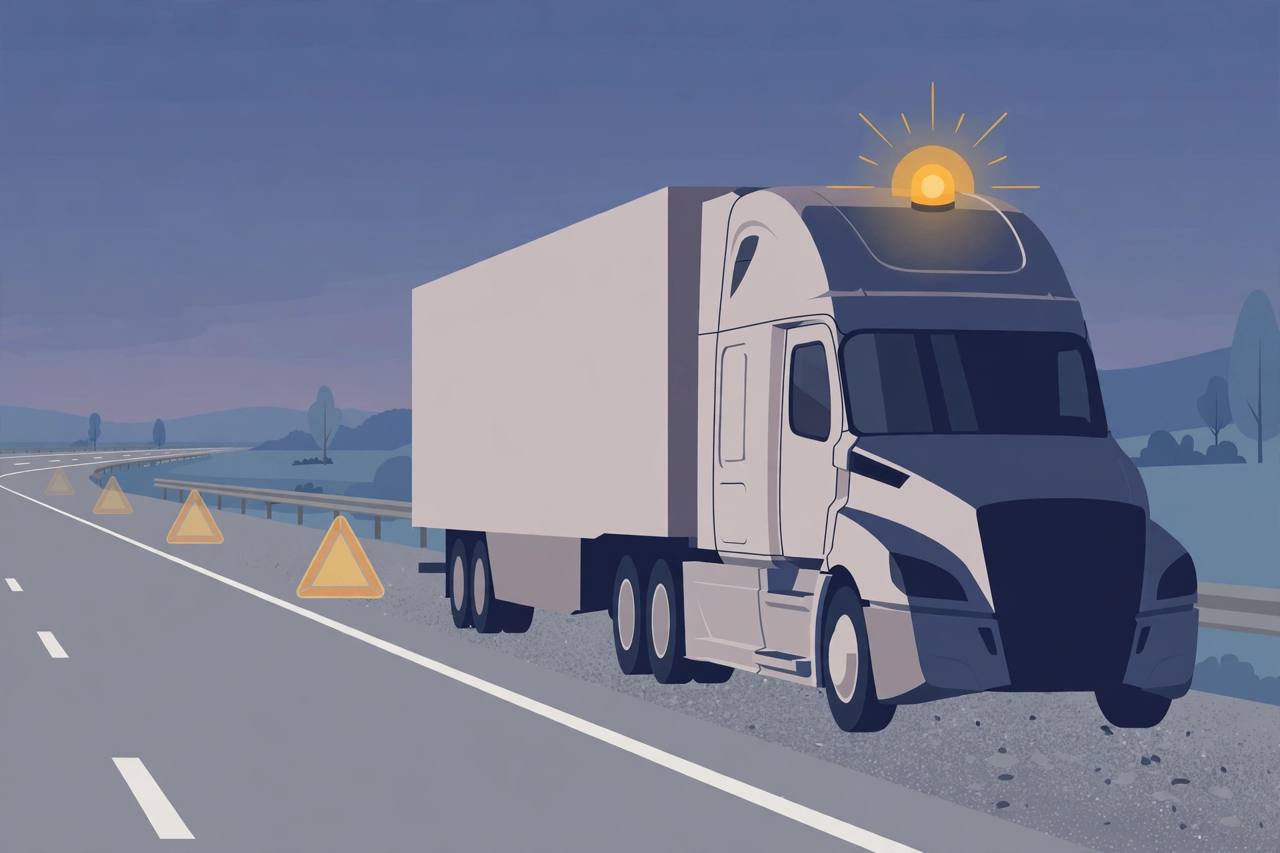
Driverless trucks stopped on an American highway no longer need a human being to climb out and set warning triangles around them. The Federal Motor Carrier Safety Administration (FMCSA) has granted a five-year exemption allowing carriers operating Level 4 automated driving systems to use cab-mounted flashing amber beacons instead of the reflective warning devices federal rules normally require, The Trucker reported.
Source: The Trucker
The exemption took effect on October 7, 2026 and runs until October 7, 2031. It was originally requested by Aurora Operations, and it extends to other qualifying autonomous trucking operators that notify FMCSA of their intent to operate under it and comply with its conditions.
Source: The Trucker
The problem it solves is simple: federal regulations require the driver of a truck stopped on a road or shoulder to turn on hazard flashers and place warning devices — three bidirectional reflective triangles, or at least six fusees — in front of and behind the truck within 10 minutes. A driverless truck has no one aboard to do that.
Source: FreightWaves
FMCSA said it determined the alternative warning system is likely to achieve a level of safety equivalent to or greater than the existing rules, provided operators comply with the exemption's conditions. The grant replaces four consecutive three-month waivers that Aurora had operated under since October 2025; Kodiak AI, Waabi and Stack AV opted in along the way, FreightWaves reported.
Source: FreightWaves
"Going from a temporary waiver to a five-year exemption gives the industry a lot of confidence," Jeff Farrah, CEO of the Autonomous Vehicle Industry Association, told FreightWaves. Bart Teeter, director of fleet and operational safety at Bot Auto, also welcomed the decision, saying it gives the autonomous freight industry regulatory certainty to keep scaling safely.
Source: FreightWaves
Not everyone in trucking is convinced. The Trucker reported that the Owner-Operator Independent Drivers Association (OOIDA) has questioned the safety of the alternative warning system. The exemption also lands at a moment when drivers themselves rank autonomous trucks among their top industry concerns — in the American Transportation Research Institute's 2026 survey, drivers placed autonomous trucks fourth on their worry list, behind fuel prices, truck parking and driver compensation.
For human drivers — including the large Punjabi long-haul workforce — the decision does not change anything they must do at the roadside: manned trucks still need hazard lights and triangles within 10 minutes of stopping. What it changes is the pace at which driverless freight can scale on U.S. highways over the next five years.