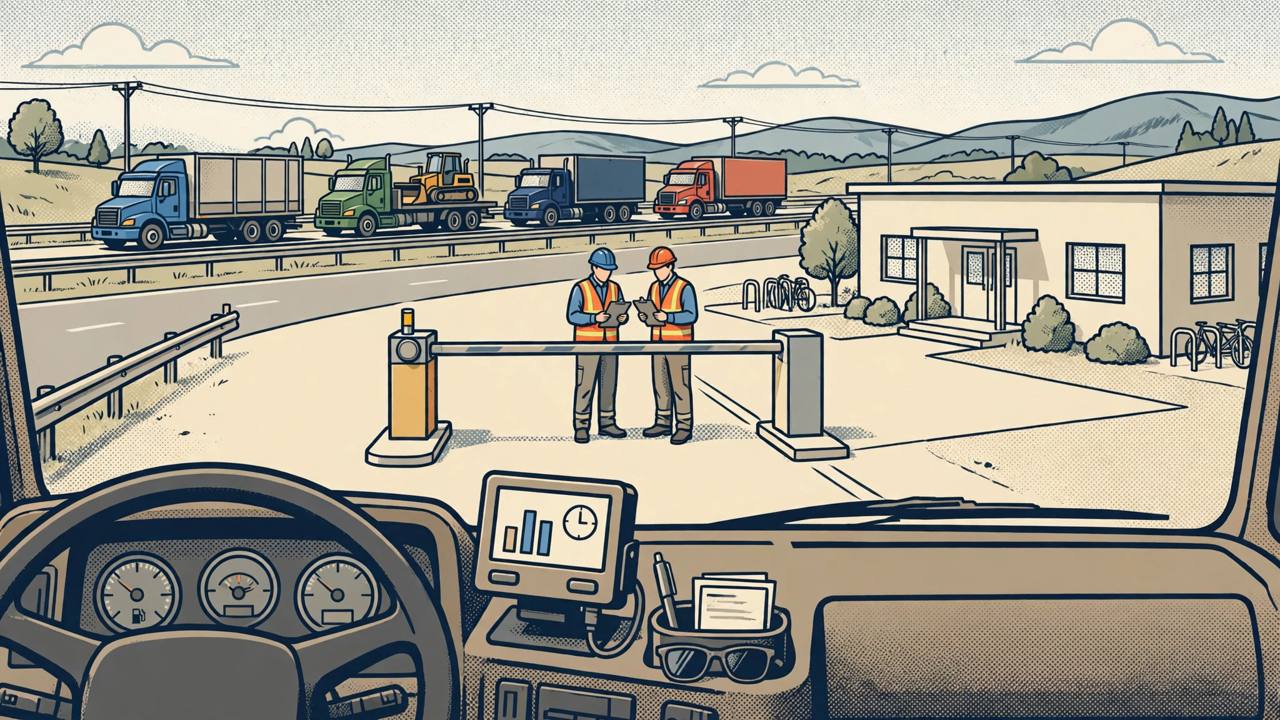
America's federal trucking regulator is in the middle of its widest cleanup in years — more than 10,000 driver-training providers have been struck off the federal Training Provider Registry since December 2025, more than 100 electronic logging devices have been removed from the approved list, and new rules on training hours, logging-device testing and commercial driver's licence standards are now being drafted, senior officials of the Federal Motor Carrier Safety Administration (FMCSA) said at two industry conferences this week.
Source: FreightWaves
Steve Dowling, who became FMCSA's chief safety officer in August, laid out the numbers on Wednesday at the second annual WEX OTR Summit in Jacksonville, Florida. Dowling, a former California Highway Patrol official and a former safety executive at Covenant Logistics, said the agency's enforcement strategy now works through five stages of a commercial vehicle's life: training, licensing, registration, operations and enforcement.
"If we want to protect the industry, we need to make sure that we start at the driver level and how they're trained," Dowling told attendees, according to FreightWaves' report of the keynote.
The registry cleanup is not the August school action
Dowling was careful to separate two numbers that are easy to confuse. The 10,000-plus removals are the broader registry cleanup since December 2025. A different, emergency enforcement action announced in August targeted approximately 110 commercial driver training schools whose operations were linked to more than 5,000 drivers cited for English-language proficiency violations, he said.
"Since December of '25, there have been more than 10,000 providers that have been removed from the training provider registry," Dowling said. "You've seen a real increased enforcement effort from us and emphasis on that. You're going to continue to see us try to make sure that the schools are doing what they're supposed to do." FMCSA is also strengthening oversight of state CDL programs and third-party testing operations, so that carriers can trust that a licence means the same standard in every state, he said.
Training hours plus proficiency: the Dallas announcement
A day earlier, on Tuesday, October 27 in Dallas, FMCSA Administrator Derek Barrs told the Women In Trucking Association's Accelerate! Conference & Expo that a rulemaking on entry-level driver training is in the works, The Trucker reported. Current federal training rules require a new driver to demonstrate proficiency in the required behind-the-wheel skills, but they set no minimum number of training hours. Barrs said the coming rule would address hours without dropping proficiency: "You've got to have hours, but you've also got to show proficiency that goes along with that." He announced no proposed number of hours and no publication date.
Source: The Trucker
Drivers in the audience raised the quality and consistency of short courses, and the uneven training some new licence holders receive from carriers after they qualify. Barrs acknowledged the concern and said standardising that post-licence stage is complicated by the differences between large carriers, owner-operators and one-truck businesses, adding that continuing education for drivers also needs further consideration.
Log books that can be edited by phone call are a target
Both officials put electronic logging devices (ELDs) — the systems that record a driver's hours of service — near the top of the crackdown. Dowling said FMCSA has removed more than 100 noncompliant devices from its registered ELD list and prevented nearly 600 others from being approved at all. "You can't go in and edit logs by making a phone call," he said. "Anytime we hear of that, we're going and investigating." He urged carriers to check that their ELD provider is still on the registered list.
Barrs, in Dallas, said a separate rulemaking is intended to strengthen oversight of ELD providers, possibly through third-party testing or a testing laboratory, and that the agency is investigating alleged manipulation of electronic logs with federal partners. He gave no timeline or final details. After the Dallas conference, Barrs said he was travelling to West Memphis, Arkansas, to join an enforcement operation involving federal and law-enforcement partners in Arkansas and Tennessee.
Chameleon carriers and the Motus registration system
The third front is who gets into the industry at all. Dowling described so-called chameleon carriers — companies that shut down and reopen under new identities to evade safety enforcement or penalties — and said FMCSA's modernised registration system, Motus, is built to verify carrier ownership and principal places of business before operating authority is granted. "One location that maybe has 20 different DOT numbers coming out of a PO box in a location, that's a problem," he said.
Dowling acknowledged Motus has had technical problems in its rollout: about 95% of carrier registration activity was functioning through the system, based on data he reviewed the previous week, but he called the problems affecting the remaining users unacceptable, and said FMCSA has temporarily suspended its biennial registration update requirement while the issues are fixed. He said the changes are keeping thousands of people out of the industry, but gave no precise count and no breakdown of how many were suspected of fraud rather than caught in registration problems. In a question-and-answer session, he said FMCSA is increasingly working with the Justice Department, the FBI and federal prosecutors on chameleon-carrier and trucking-fraud investigations, and warned: "You're going to see cases that start coming out that are specifically combating against chameleon carriers."
What this means for Punjabi and other diaspora truckers
A large share of this site's readers in the United States drive trucks, run small fleets or are studying for a CDL — and every part of this package touches them directly. A training school that was legal to attend last year may no longer be on the federal registry, so a new driver should check the school against FMCSA's Training Provider Registry before paying. A fleet's ELD can likewise drop off the approved list. On non-domiciled CDLs and English-language proficiency, Dowling said the agency is seeing indications that drivers who do not meet non-domiciled requirements may also have proficiency violations, but he acknowledged FMCSA needs more time and data to know whether the enforcement is reducing crashes, and he could not recall a specific nationwide count of non-domiciled CDL holders — some of whom, he noted, remain legally eligible to operate.
Barrs also pointed drivers to money already announced: the U.S. Department of Transportation's October announcement of approximately $200 million for truck parking projects, intended to support 14 projects in 12 states and more than 2,400 additional truck parking spaces. He said work is continuing on changes to the Compliance, Safety, Accountability (CSA) scoring system, with no release date, and urged drivers to comment when the rulemakings are published: "We need your input individually."
No proposed training-hour number, ELD-testing design or CDL-standard text has been published, and neither official gave a date. Dowling said FMCSA is also evaluating hours-of-service flexibility — including sleeper-berth provisions and the 14-hour duty window — and changes to its Safety Measurement System looking ahead to 2027. Until a rulemaking is published, the existing training, ELD and hours-of-service rules remain the rules drivers are judged by.
For now, the practical steps are the ones both officials named themselves: verify the training school, verify the ELD, and watch the federal register for the three rulemakings Barrs described — training, ELD oversight, and CDL standards, including the language used for the written knowledge test.