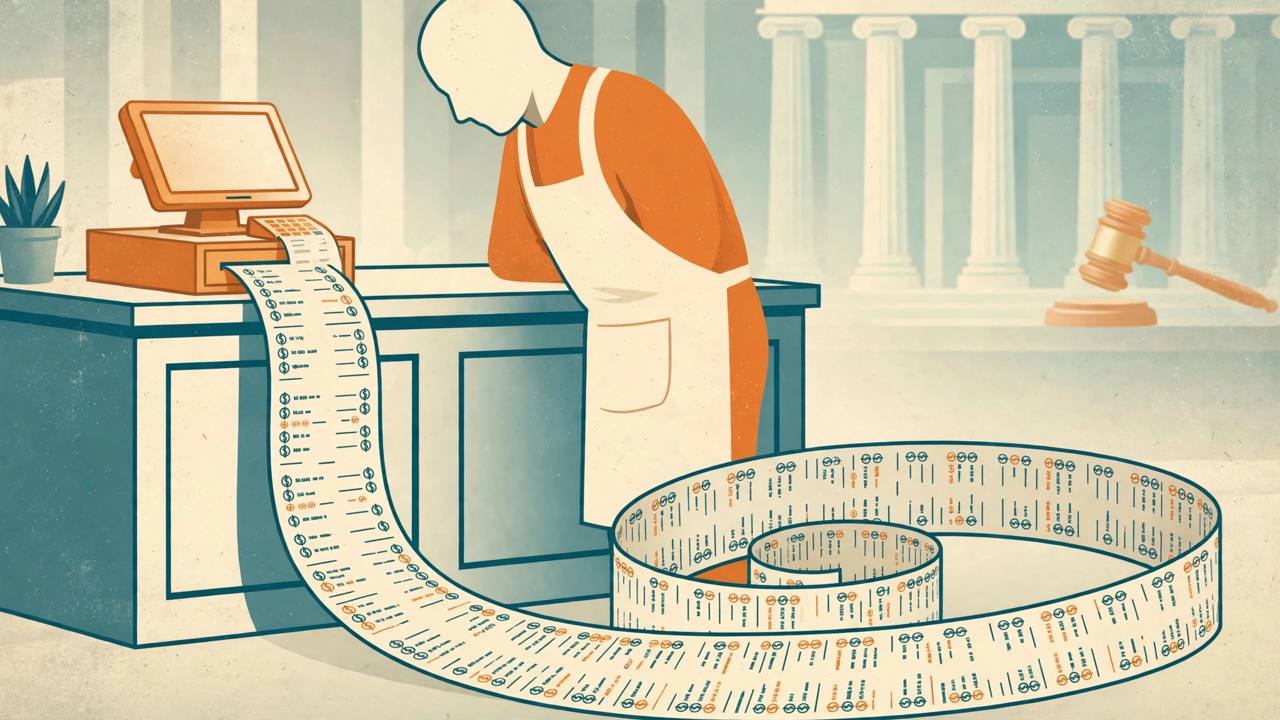
The Federal Trade Commission and eight states have sued Toast Inc., the Boston-based company whose orange terminals sit on the counters of restaurants across America, accusing it of saddling those restaurants with hidden fees, unauthorized add-ons and subscription traps — and of charging diners themselves a 99-cent fee that went to Toast, not to the restaurant, without adequately telling either side. The lawsuit, filed on Thursday, October 29 in the U.S. District Court for the Northern District of California, alleges that Toast failed to deliver on its customer-support promises and built a cancellation process so convoluted that customers kept paying for months or years after they tried to leave. Toast says it strongly disagrees and will vigorously defend itself.
Source: Federal Trade Commission, press release, Oct. 29, 2026
Who is suing, and where
The plaintiffs are the Federal Trade Commission; the People of the State of California, acting through Los Angeles County Counsel Dawyn R. Harrison and San Francisco City Attorney David Chiu; and the attorneys general of Colorado, Florida, Illinois, Iowa, Nebraska, Oklahoma and Utah. The defendants are Toast Inc. and affiliated entities including Toast Capital LLC, Toast Processing Services LLC, Stratex Holdco LLC, Strategy Execution Partners LLC and Xtra Chef LLC. The Commission vote authorizing the complaint was 2-0, and the FTC's lead attorneys are Stephanie Liebner, Carlton Mosley and Sally Tieu of the Bureau of Consumer Protection. The complaint seeks a permanent injunction, a monetary judgment, a civil penalty judgment and other relief — it is a filing, not a verdict, and the FTC itself notes that it files a complaint when it has “reason to believe” the law is being violated; the case will be decided by the court.
Source: Federal Trade Commission, press release, Oct. 29, 2026
“Small businesses are the backbone of communities across the country, and they deserve tools and services that are transparent, reliable and truthful,” said Christopher Mufarrige, Director of the FTC's Bureau of Consumer Protection. “Toast failed to honor a number of its promises and instead imposed hidden fees, unauthorized charges and subscription traps that drained the hard-earned profits of businesses just trying to serve their customers. These practices are illegal, and the FTC will continue to take aggressive action to ensure a fair, transparent and competitive marketplace.”
The product almost every restaurant now runs on
Toast markets and sells point-of-sale hardware and software and payment processing services to small businesses in the restaurant industry. Its cloud-based products are used to take and manage orders, accept payments and track inventory, among other tasks, and it sells its software as an annual or biennial subscription, billed monthly. It also sells financing — Toast Capital loans — to its existing customers. That ubiquity is the context for the complaint's scale: Bloomberg, reporting the filing on October 30, put Toast at 156,000 customers and $6.1 billion in revenue last year, billing itself as a “one-stop shop” for restaurants. When a platform that size changes a fee, thousands of small businesses feel it at once.
Source: Bloomberg, via Claims Journal, Oct. 30, 2026
Add-ons restaurants say they never agreed to
To obtain Toast's products, restaurants must enroll in auto-renewing subscriptions, which vary in cost depending on the number of terminals used and the add-on services bundled in — examples in the complaint include employee timekeeping, payroll processing and the filing of payroll taxes. The complaint alleges that Toast customers frequently complain they have been enrolled in, and charged for, subscription add-ons without their consent. Restaurant Dive, reporting the complaint on October 30, put the average subscription at about $900 a month and quoted the government's line that “at least tens of thousands of consumers have complained about these issues to the FTC, online, and directly to Toast.” The complaint further alleges that Toast advertises a “Pay-as-you-Go” plan — higher per-transaction fees, with hardware and software at $0 per month — while imposing various fees on that hardware and software it fails to clearly disclose; in the government's words, none of Toast's hardware is in fact $0.
Source: Restaurant Dive, Oct. 30, 2026
The fee list: 120 days, $85 a month while closed, $150 a month to leave early
The complaint's examples are specific. Clients who fail to start processing payments within 120 days of purchasing their subscription must return all of their hardware or pay its full retail value. Restaurants that must close temporarily are still required to pay $85 a month for payment processing. And customers who wish to cancel are required to pay an undisclosed early termination fee of $150 per month for each remaining month of their contract. None of these numbers, the government alleges, was clearly disclosed up front — which is the legal heart of the case: the FTC Act and the Restore Online Shoppers' Confidence Act both turn on whether material terms were clearly and conspicuously disclosed before the customer was charged on an ongoing basis.
Source: Federal Trade Commission, press release, Oct. 29, 2026
The 99 cents diners paid — to Toast, not to the restaurant
One allegation reaches past the restaurants to their customers. The complaint alleges that Toast unilaterally charged restaurant patrons a $0.99 fee without adequate disclosure or consent of the patrons or the restaurants themselves. From September 2021 through late July 2023, Toast added the fee to certain online orders above $10 placed through its platform. The fee went to Toast and not to the restaurants, and it came on top of the fees those restaurants were already paying Toast for its services. A diner ordering a $12 takeout meal, in other words, was allegedly paying a near-dollar surcharge to a software company most diners have never heard of — itemized, if at all, in a way the government says did not make clear who was keeping the money.
Source: Federal Trade Commission, press release, Oct. 29, 2026
The cancellation maze
Cancelling, the complaint alleges, is where the trap closes. Toast failed to provide a simple cancellation process, instead instituting a counterintuitive, multi-step process requiring the involvement and coordination of multiple teams inside Toast, leaving many customers incurring months or years of unwanted charges. To cancel, customers must first provide 30 days' written notice of their “intent not to renew” — a requirement the complaint alleges is not clearly disclosed when they enroll, and Bloomberg's reporting adds that Toast offers no online cancellation option at all. Even customers who give timely notice report receiving no response and incurring additional charges; others are told to call “Customer Care” or use live chat, where they are questioned about why they want to cancel and given sales pitches to dissuade them. And at the end of the maze can sit the early termination fee: one consumer complained he was charged $5,318.87 when he cancelled after four years, and that Toast refused to refund it.
Source: Federal Trade Commission, press release, Oct. 29, 2026
Toast Capital: cancel the software, repay the whole loan — now
For customers with a balance on a Toast Capital loan, the complaint alleges, leaving is more expensive still. If customers cancel their subscriptions or change providers, Toast treats this as if the customers have defaulted on their loan and requires them to immediately pay the total outstanding amount. The complaint alleges this restriction serves as a roadblock to cancellation, forcing customers to choose between paying unwanted subscription charges to avoid defaulting on their loan, or facing accelerated loan charges in addition to any early termination fees. It is, in the government's telling, the lock on the subscription trap: the financing product and the software product hold each other in place.
Source: Federal Trade Commission, press release, Oct. 29, 2026
“24/7/365 support” — the promise the complaint says was not kept
Nearly every page of Toast's website, the complaint alleges, highlights some variation of the claim that customers can get help 24 hours a day, 7 days a week — boasting that they will connect with “[r]eal people with real solutions” who “really get restaurants, 24/7,” and listing “24/7/365 support” as a feature in each subscription package during enrollment. In reality, the complaint alleges, consumers have difficulty reaching anyone who can provide support at any time of day, let alone around the clock. One consumer called on a Saturday only to be told the team that could help him was not available on the weekend, costing his small business thousands of dollars in credit card transactions; others report spending weeks to months trying to resolve an issue, often with no follow-up and none of the promised “real solutions.”
Source: Federal Trade Commission, press release, Oct. 29, 2026
Toast's defence: a consumer law aimed at the wrong target
Toast, in a statement issued Thursday and reported by Bloomberg, American Banker and Restaurant Dive, said it “strongly disagrees” with the allegations and will “vigorously defend” itself. Its central legal argument is jurisdictional in spirit: the FTC is trying to apply the Restore Online Shoppers' Confidence Act — the 2010 law governing certain online subscription practices — to negotiated commercial agreements with restaurant customers. “No court has held that” ROSCA “applies to negotiated business-to-business agreements, and we don't believe it applies here,” Toast said. The Boston-based company, founded some 15 years ago, added that it has been cooperating fully with the FTC's review since mid-2025 and engaged in good faith throughout, including efforts to reach a resolution short of litigation, and that the agency disregarded information showing the extent to which its restaurant customers negotiate their contracts. All of the government's claims remain allegations; Toast has not been found liable for anything.
Source: Bloomberg, via Claims Journal, Oct. 30, 2026
Why this matters to the restaurants in our readership
A very large share of this site's U.S. readers either run, work in, or eat at exactly the businesses in this complaint: family restaurants, dhabas, pizza and takeout shops, food trucks and truck-stop eateries, many of them immigrant-owned, running on thin margins where a few hundred dollars a month is the difference between a good month and a bad one. The complaint's arithmetic is their arithmetic: an auto-renewing subscription averaging about $900 a month; add-ons appearing that nobody remembers approving; $85 a month still owed in a month the doors are shut; a four-figure fee for leaving early; and a loan that comes due in full the moment the software is cancelled. The case also draws a line every small business signing a platform contract should note, whatever the platform: the terms that cost the most — termination fees, closure charges, what happens to a loan when you cancel — are the terms to find in writing before the first terminal is plugged in.
Source: Federal Trade Commission, press release, Oct. 29, 2026
What happens next
The case is pending in the Northern District of California, where Toast and its affiliated entities will have to answer the complaint. The government plaintiffs are asking the court for a permanent injunction, monetary judgment and civil penalties; whether any money flows back to individual restaurants — as refunds, damages or penalties paid to the government — will be decided in that litigation, and no automatic refund program exists today. Toast's threshold fight, on its own stated position, will be over whether ROSCA and the consumer-protection theories in the complaint can be applied to negotiated business-to-business contracts at all. For the tens of thousands of businesses that complained, and the 156,000 customers still on the platform, the first practical effect is simpler: every fee on the next Toast statement now has a federal complaint to be read against.
Source: Federal Trade Commission, press release, Oct. 29, 2026