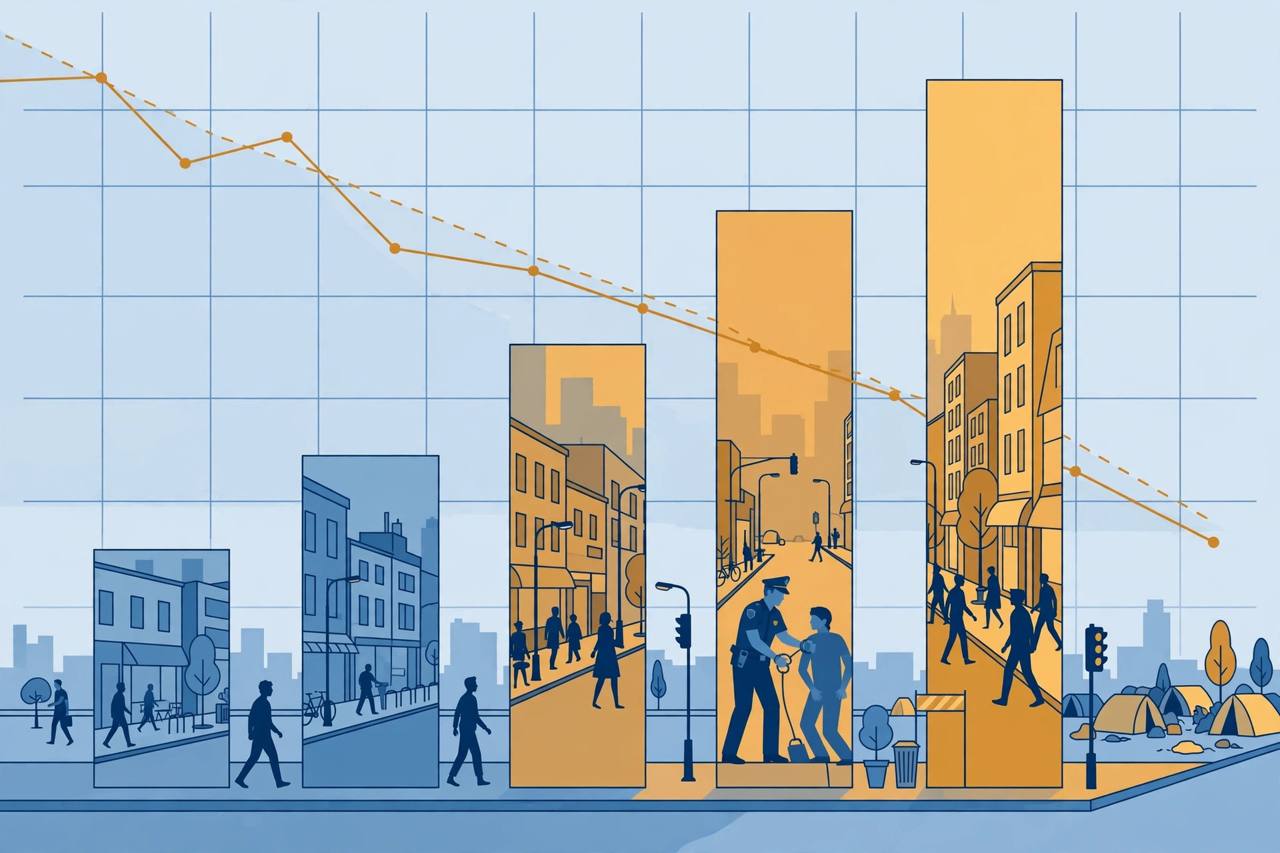
Arrests for low-level offences rose sharply across the United States from 2024 to 2025 even as violent crime, including homicide, plummeted to historic national lows, according to a new analysis of federal data by FWD.us, a criminal-justice and immigration reform advocacy group. The report, released on Wednesday, was reported by NPR, which noted that the analysis uses publicly available FBI and immigration arrest data and does not show whether charges were later dropped or whether anyone served jail time.
Source: NPR, via Kansas Public Radio
Four states — California, Hawaii, Nevada and Arizona — accounted for over half the increase in vagrancy arrests, FWD.us found. Vagrancy is legally defined as roaming from place to place without a permanent job, home or material resources, and in practice is disproportionately enforced against people experiencing homelessness, NPR reported. Asian Americans and Native Hawaiian and other Pacific Islanders accounted for 17% of the increase in vagrancy arrests — largely in Hawaii — although they make up only about 7% of the US population, according to the report.
Source: FWD.us, Arresting Progress report
Drug arrests and the policy rollbacks
Marijuana-possession arrests rose 6% nationally, mainly in Southern states that have not legalised the drug, and Black people accounted for 83% of the national increase and nearly half (45%) of all cannabis arrests, the report found. FWD.us linked part of the drug-arrest rise to policy rollbacks: California voters' 2024 Proposition 36, which increased penalties for repeat theft and drug offences, was followed by a rise of over 14,000 drug-possession arrests in a single year in California, and Oregon's reinstatement of criminal penalties for simple drug possession was followed by a 39% rise (2,205) in non-marijuana drug-possession arrests there.
Source: NPR, via Kansas Public Radio
“This increase signals a really troubling return to some of the extreme law and order policies that defined the American criminal justice system during the 80s and the 90s,” FWD.us executive director Zoë Towns told NPR ahead of the report's release. Towns said an arrest can mean days or months in jail, a lost job, missed rent or a missed mortgage payment, and families separated. FWD.us tied the increases in part to federal changes in the first full year of President Trump's second term, including expanded deportation efforts, federal money for local police immigration arrests through the 287(g) programme, and federal deployments — it found marijuana-possession arrests in Washington, D.C. more than doubled after the National Guard deployment there. A representative for the FBI did not immediately respond to NPR's request for comment.
Source: NPR, via Kansas Public Radio
What is solid
- FWD.us's analysis of FBI arrest data shows low-level arrests rose from 2024 to 2025: vagrancy +44%, marijuana possession +6%, other drug possession +3% and immigration violations +188% (109,936 to 316,304).
- The same period saw violent crime, including homicide, fall to historic national lows, as NPR reported.
- California, Hawaii, Nevada and Arizona accounted for over half the increase in vagrancy arrests.
What is only claimed
- FWD.us is an advocacy group for criminal-justice and immigration reform; its interpretation — that the rises mark a return to 1980s-90s 'law and order' policies driven by federal changes — is its own conclusion, not a finding of the FBI, which did not immediately comment to NPR.
- The arrest data alone does not show charges dropped, convictions, or time served, and arrest rises can reflect enforcement priorities as well as underlying behaviour.
Insha Rahman of the Vera Institute, who was not involved in the report, told NPR there are still “incredibly positive trends” showing crime across the board is down, which she credited in part to states and localities investing in treatment, diversion, community violence intervention and youth services. For immigrant families — including Punjabi and Indian communities across the US — the headline figure in the report is the immigration number: more than 200,000 additional immigration-violation arrests in a single year (yaani: over 2 lakh more arrests than the year before).