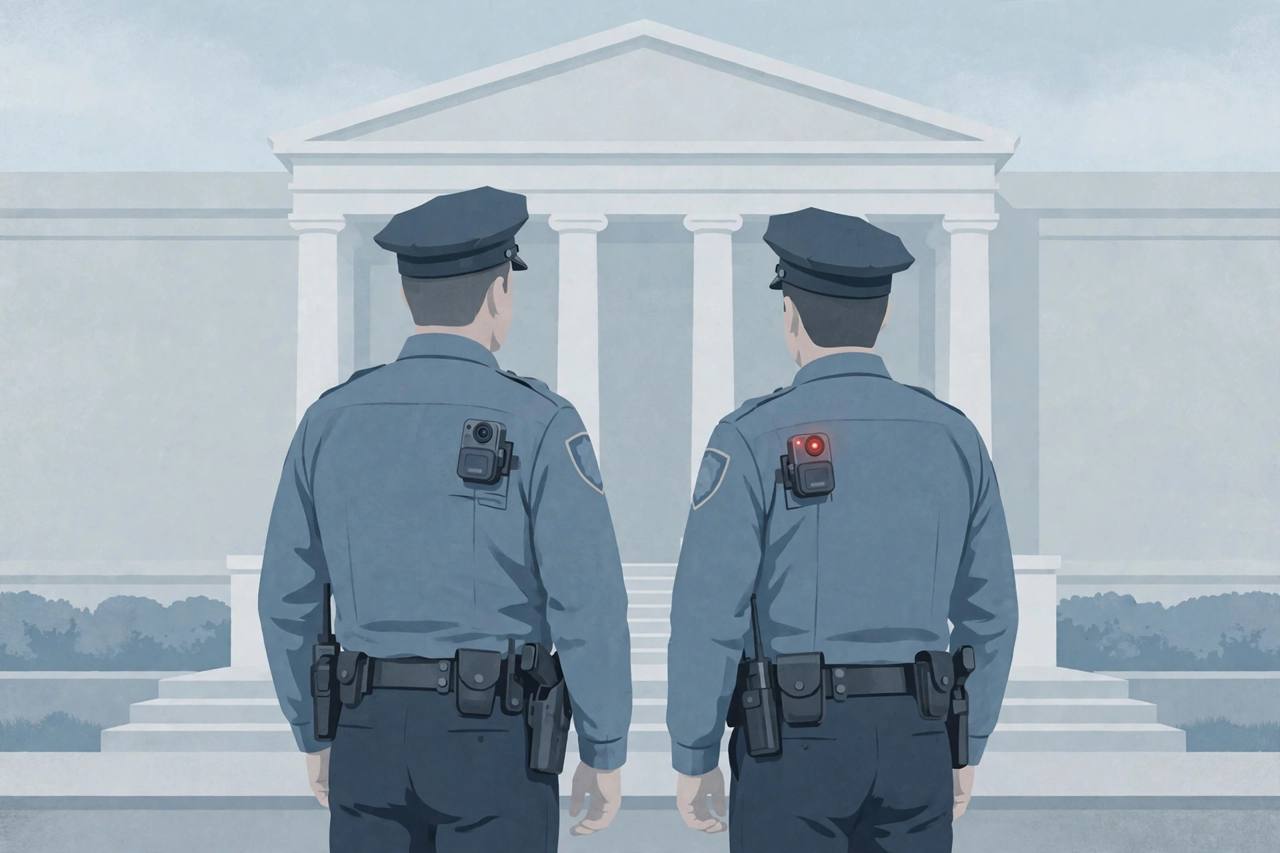
The U.S. Department of Homeland Security has accepted six of the seven fixes recommended by the Government Accountability Office for the body-worn camera programmes of Customs and Border Protection and Immigration and Customs Enforcement — but it has refused the one that auditors say matters most at ICE: controls that make a camera start recording on its own, instead of depending on an officer remembering to press a button.
Source: U.S. Government Accountability Office, GAO-26-108157
The report, numbered GAO-26-108157 and dated September 2026, was publicly released on October 14 and drew fresh attention on Tuesday, October 27, when new reporting highlighted the single rejected recommendation. GAO is the independent watchdog that audits federal agencies for Congress, and this study was prepared for congressional requesters including House Homeland Security ranking member Bennie G. Thompson.
Source: U.S. Government Accountability Office, GAO-26-108157
Automatic activation means the camera starts when a linked action happens — for example when emergency lights are engaged, or, in systems other agencies use, when a firearm or TASER is drawn. GAO said additional controls of that kind would provide better assurance that ICE personnel capture footage in accordance with policy. DHS did not agree to implement automated camera activation controls at ICE, and GAO said it is maintaining the recommendation.
Source: U.S. Government Accountability Office, GAO-26-108157
Plans that no longer match the programme
GAO found that CBP and ICE each started with a plan containing key parts of a comprehensive programme plan, but neither agency has kept that plan current. CBP has not updated its plan since 2022 and ICE has not updated its plan since 2024, so the documents do not reflect significant changes since then — including increases in the number of cameras scheduled for deployment and a pause in further camera deployment in 2025.
Source: U.S. Government Accountability Office, GAO-26-108157
The gap is sharpest at ICE. According to the GAO findings reported by TechDirt, ICE is at least one year behind its 2024 plan, and although ICE officials intend to provide cameras to all personnel including planned future hires, the number of cameras scheduled for deployment in the 2024 plan had remained relatively stable as of April 2026 — even after ICE began a hiring surge of about 12,000 additional personnel in July 2025.
Source: TechDirt, Oct 27, 2026
Stated goals, but no way to measure them
Both agencies say their camera programmes are meant to enhance officer safety, transparency, accountability and public trust. GAO found they track some information about camera availability and reliability, but they have not implemented results-oriented performance goals and measures — so they cannot properly assess whether the programmes are achieving those results. GAO gave the example of measuring how footage is used in use-of-force investigations.
Source: U.S. Government Accountability Office, GAO-26-108157
Most CBP and ICE offices have also not developed specific operational guidance explaining how personnel should use, or not use, cameras in their own working circumstances. GAO warned that this lack of guidance at the operational level increases the risk that personnel will fail to use cameras as policy requires. The audit ran from February 2025 through September 2026 and included interviews with headquarters officials and camera users at 10 field locations.
Source: U.S. Government Accountability Office, GAO-26-108157
GAO recommended that ICE implement controls to help ensure cameras are activated, including automated activation. DHS agreed with the other six recommendations — updating both agencies' plans, setting performance goals and measures, and issuing operational guidance — but did not agree to automated activation at ICE. Summaries of the agency response cite operational risks, including false activations during routine movements.
Why this matters for diaspora readers
ICE officers carry out arrests in homes, workplaces, courthouses and traffic stops in cities where large Punjabi and other immigrant communities live — from California's Central Valley to New York, New Jersey and Washington state. In contested encounters, body-camera footage is often the record that decides between two versions of what happened. If recording depends on an officer activating the camera manually at the start of an encounter, a missed activation can mean there is no footage at all, which is exactly the compliance problem GAO says ICE has not built controls against.
Source: TechDirt, Oct 27, 2026
What happens next
DHS now has to deliver on the six recommendations it accepted: updated programme plans for CBP and ICE, performance goals and measures to assess effectiveness, and operational guidance for field offices. The seventh recommendation does not disappear — GAO says it maintains that automated controls would help ensure adherence to ICE policy, and the members of Congress who requested the study can press DHS on it in oversight. For now, ICE's policy still requires officers to activate their cameras, but the start of the recording in ICE encounters will continue to depend on the officer, not on the camera itself.
Source: U.S. Government Accountability Office, GAO-26-108157